
Confessions of a Regressionist
Is There a Life or Time Other than the Present?
by
Book Cover & Preview Text
From Chapter Seven: To see how clients’ regression sessions could be explained, let us examine the case studies already discussed. Pam first went to a slab in Egypt that explained the start of her abnormal blood clotting. Then she went back to a difficult birth in which both she and the child died. That problem started with a forced mating in a much earlier time, which had resulted in the genetic mutation that led to the disastrous birthing. When the negative energy was released from each event, the previous event was easier to access. After she had gone to the initial event, the decision point of the forced mating, Pam could finally make the decision she was originally unable to make. While re-experiencing the terrifying nonhuman invasion, Pam realized she could make a choice, an alternative decision, no matter how difficult the choice might be and how onerous the possible results. She decided to do something that would prevent conception from the forced mating. When she made a decision to mate with someone else, she and the child survived the birth in a later life, though they both died in an accident shortly afterward. Medical doctor Carol Phillips, retired emergency room physician, explained to me (phone conversation on March 28, 2010) that once released, the ovum or egg has 48 hours to be fertilized for successful conception. In extremely rare cases, two ova are released, and more rarely each may be fertilized by a different sperm donor. When a pregnancy has progressed more than two weeks, it is almost impossible for another pregnancy to occur. Next, let’s go to the slab in Egypt. She was being killed part by part to teach her to be afraid of death. She realized it was her decision to go through that death and had no fear. Afterward, Pam realized she could always make a decision, even when all choices did not seem good. Her power lay in making the decision. She also realized there were those who did not like success and would do what they could to destroy what they did not like, and that some would call them evil. Pam’s session could offer an example of the many-worlds concept of parallel outcomes from a decision point. The session could also be explained by the convenient use of a timeline metaphor to allow the consciousness to jump to another connected event. The release of energy attachments to the event, after the initial decision, would allow energy to be available for subsequent actions, and subsequent decisions would come more easily, possibly collapsing alternative lives. An alternate explanation was obtained by following the folding time-stream back to the precipitating causal event and changing one’s perception of it. Thus, the DNA changed, which also changed the present now, the current period. Now, let’s look at the session with Bob, which is very different from Pam’s. Bob went into an altered state with abreactions when merely discussing his dream about the airplane crash. He instantaneously jumped time and space to be in the plane and easily accessed information about that life. Once he realized that the incident was completed, the abreactions stopped and all difficulties surrounding the crash disappeared. There is a lingering possibility that Helmet was attached at a very early age to Bob, perhaps in the womb. Because of the possibility of an immediate abreaction, I did not look for attachments prior to the session. According to Barbour and Witt, everyone has access to every point, to every now. Bob was able to access that point, another part of the current complex Now, and he released unneeded attachments that had sapped energy and prevented him from being his total effective self. Again, once the connection had been detached, the problem dissolved. Considering Bob’s dream, the concepts of Barbour’s Nows gives dreaming new meaning. It could be that in dreaming we access another reality full of different Nows. Some of the Nows are similar to those of waking experience, but some are not. Another explanation could be that a part of Bob (Helmet) was living in another complex Now and was caught up in the dying process in the airplane; then he was, for some reason, unable to move forward. At some point, the part known as Helmet found a part known as Bob and pestered Bob at night—when his conscious mind would not interfere—knowing that Bob would get the assistance needed for Helmet to complete the death process. By this completion, Helmet and Bob would be free. Helmet would be free to continue his existence, and Bob would be free to enjoy a full night’s sleep. Another explanation might be that Bob entered a different state of consciousness; some might call it dreaming, remembering, or entering a different dimension. He slid along a fold in time into a simultaneous event in another timespace. By placing his conscious awareness fully into that place, the negative emotions could be fully expressed and released, thereby releasing Bob from the negative experience. The experience became just another experience, neither negative nor positive. With Bud, the session started out to be a normal, standard regression to the original event that caused his physical symptom. Because he was symptom free when he came into my office, I proceeded to talk to his unconscious mind. When we started the process of accessing the original event, we took a detour. As Barbour and Witt explain, all events happen simultaneously with the warping of timespace in time capsules. Time capsules are the way Barbour describes what Franz Perls referred to as gestalts (see Chapter Five). There were more layers to the event than I had originally considered. Part of the personal complex of Nows could lie within the genetic structure of the individual. Lipton found memories of mother and father in each cell in addition to memories of an individual’s own memories or perceived memories. We can access any point in a time capsule. The events––the dinner in the crab restaurant, the death on the steamboat, and the death as a blacksmith from the fire––were all related to Bud’s current symptom. The shot on the steamboat that came close to his heart was the trigger to his chest pains. The ultimate decision point was when the smoke from the fire was in his esophagus. He was trying to gasp for breaths and decided, unconsciously, that as long as he felt the roughness in his throat (esophagus), he could be found and he would survive. Looking at Bud’s session from the viewpoint of folding time, which is that all time is now, it looks similar. All of Bud’s experiences––the blacksmith, the riverboat gambler, the farmer, and the current life as a retiree––are layers or different dimensions of the same time, now. By changing conscious awareness, he was able to access a different part of Now and change a perception that was affecting the current situation. We see this in children. A child can develop likes and dislikes of a certain food yet change them to match the likes and dislikes of a cherished playmate. The child doesn’t change and the food doesn’t change, but the child’s perception of the food changes. …
Formats

Book Details
About the Book
For the past thirty-fi ve years, Dr. Barbara Pomar has guided her clients on journeys into their past lives. Confessions of a Regressionist presents both her personal account of her work with clients working to reverse past decisions to change the present and future and the theories behind the practice.
For some, the very existence of past lives, let alone the ability to reconnect with them, is a point of spirited debate. Even so, Dr. Pomar has helped many to come to their own conclusions about the validity of this technique. Now, she guides readers on using her techniques to live more fully or mold their destinies. She also discusses theories on why and how past-life regression is possible.
If you’ve ever struggled with how the possibility of past-life regression fits within your faith, Dr. Pomar off ers advice on how to evaluate your conflict. If you are a regressionist, Dr. Pomar’s work can help you realize that by helping your client, you also help past and future generations as well. If you’ve ever considered meeting with a regressionist, Dr. Pomar explains how this sort of experience can help you live more fully in the present, with joy, confi dence, and prosperity—by releasing or neutralizing memories of harmful events.
About the Author
Having over thirty-five years of regression experience, Dr. Barbara H. Pomar has regressed thousands of individuals individually and in groups. She has a BS in business and finance, an MA in psychology, and a PhD in clinical hypnotherapy. Currently Dr. Pomar; her husband, Craig Salsbury; and their cairn terrier, George, reside in Fairbanks, Alaska.
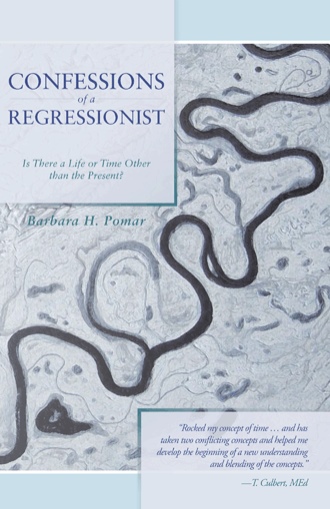
The cover art, an oil painting titled Koyukukiatatna, is by Spelman Evans Downer, a visual artist who has exhibited internationally and nationally. He is an art instructor at Copper Mountain College in California and has a studio on the Kenai River in Alaska. Learn more at www.spelmanevansdowner.com.