
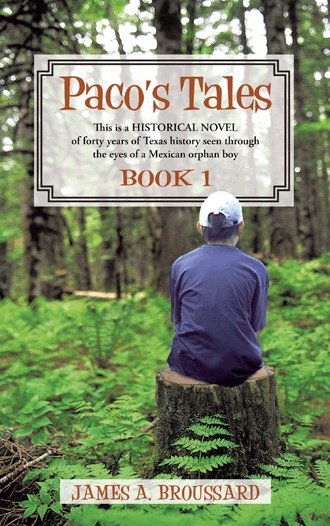
Paco's Tales
This is a HISTORICAL NOVEL of forty years of Texas history seen through the eyes of a Mexican orphan boy: Book #1.
by
Book Cover & Preview Text
There were many heroes that week in 1831 when Beaumont caught on fire. The ladies, somewhere about three hundred of them, made up a bucket brigade, passing buckets full of water from hand to hand to be poured out on the roofs not yet up in flames. The ladies came a-running from as far away as Voth Farm six miles north and Forest Park Ranch eight miles from Beaumont.
Many seven-year-old girls and boys had ridden to each ranch and farm around, shouting, “Fire in Beaumont! Bring your buckets and shake a leg!” People in wagons picked up those on foot, and many carried food and burn medicine which would be needed.
It meant working in soot and ash and heavy smoke. Most of their clothing had holes after fighting the fire and their faces and hands all had burns from flying ash. Once they got a roof soaked well, they left one person up there with a full bucket of water or a wet rug to slap out any ash that landed. On they would go to the next house that was savable. Downwind for as far as eight or ten miles the people were wetting the roofs and moving on.
Slow burns during the year kept the brush and weeds down around the cabins. That way the roof was the only thing they had to put out or keep from starting a fire. There would be a panic when the winds shifted direction because the downwind places now were different. The bucket brigade had to move with the wind. Then, when the ash was not bad, they would rush back to try to put out the cabins on fire. Even if they only saved the walls of a cabin, it was enough to build back up. Expensive tools of iron would need new handles and leather gear would have to be replaced by others who had extras. Night saw more buckets of water splashed on the coals as they were raked around, and then it was on to the next place.
By the morning of the second day, people from as far as a hundred miles had gotten news and brought their buckets, food, and medicine. But of all the usual firefighters, only the old men and young boys were there to help.
The rest of the men, all three dozen of them, were out riding as vigilante killing outlaws. By the time they headed back to Beaumont, the main fires were all under control. As they rode in, the men, many wounded or dead across their horse’s saddles didn’t always find their cabins still there. But while the men were out in the swamps riding in clear air, their wives, daughters, old men, and young boys were in heavy smoke that killed as many as the outlaws’ bullets killed among the men. Few people died from the flames—it was the air they breathed that scorched their lungs even through thick cloths, and many died of exhaustion or heart failure.
The outlaw camps would take much raiding. In the end, fire was used to drive out the real bad-asses who were forted up. The women had only fought for two days before they got control of the fire. But this lightning-started fire cost the lives of twenty-six women, thirty old men, and one child. It too was a battle field and the timing couldn’t have been worse.
The dead were buried, and two days later, with reinforcements from New Orleans and other places, the vigilante raids went on. The outlaw camps that had been scattered had regrouped, fortifying their cabins and digging in again. But some of the outlaws were also pulling out, lock, stock, and barrel, every time the smoke cleared. The farmers were already moving into the outlaw camps that had been cleared and setting up housekeeping, which was very dangerous. The vigilante was sure to come back through when they saw a site was occupied.
A lot of women had tried to save their own homes, barns, and sheds when they saw the smoke coming their way, but few could cover the hard climbs and the many ashes in the air until a line of buckets got there to help. A few of the bigger farmers had their slaves form bucket brigades and pass out wet sacks to beat out the fires on top of the buildings, but most of them too lost one or more buildings in the course of the battling the flames. The slave quarters were the hardest to save because the buildings were side by side. If one caught on fire, a whole mile-long row could burn up. It didn’t help when the wind would gust up to forty miles per hour at times. The hard winds threw up ash that flew for hundreds of yards, leapfrogging from place to place faster than the bucket brigade could wet them all down.
It had been a Saturday morning when the fire started, so a lot of the women from outlying farms and ranches were on their way into town to do the week’s shopping. These folks sent their kids up ladders to wet down the roof shingles, since an adult would more easily fall through the shingles. Some put sacks out over the shingles and wet them down as extra protection, but this took more time and labor so they had to do this mostly on their own.
Had the fire crowned into the treetops, the fire might have gone on until the next good rain and wiped out everything in its path. So Beaumont had been lucky in that way. The ground fires did go on to the waterways, where they burned out. Those two days saw no rain at all to help Beaumont. Many businesses went up in flames while the owners helped others not in flames to save their livelihoods.
On a dark Monday night, everyone met in the big livery barn to eat and drink and rest. Then someone started fiddling. A horn blew, and drums and a guitar took up the tune. Soon the gathering was a barn dance. It was short-lived, and all their go-to-town clothing was ash-blackened, but there were young ones there who later remembered the dance (and maybe a kiss) more than they remembered the fire.
Only a third of Beaumont’s cabins made it through the fire. The more important businesses mostly made it. The older, closer-together cabins were the ones to burn up.
The returning men spread out in the morning light with wet sacks to snuff out all the little, smoking fires, raking out the coals of the cabins and snuffing them too. But they had control now finally. By Monday night the ash-covered people had the fire out for ten miles around Beaumont.
The townsfolk grew as more and more people poured into town to help rebuild the businesses that had burned up. Personal cabins would be put up at a rate of five or six per day, but the roofers would take weeks to finish all their work and the many logs would need more calking a year later, so it didn’t all get done right away. The newcomers often brought food that was ready to eat as well as fresh spring water so they didn’t have to drink the stored-up well water.
At the Wednesday morning meeting of the city fathers, the mayor had nothing but high praise for the way the fire was taken care of. Others who had lost a lot of their life’s work were mad and wanted fire wagons and firefighters to pump the water directly on to any future fires. But these pump wagons were very expensive, and Beaumont didn’t get a pumper until 1862. Texas was a slave state and many fires were set on purpose by slaves and sympathizers with the north during the Civil War.
The first fire station was built in downtown Beaumont at the intersection of Main Street and Crocket Street. The town, now over 2,500 people, came up with the name of “Hell’s Belles” as the station house’s name in honor of the weekend the women had saved Beaumont from flames while the men were away fighting the outlaw camps war.
A big sign is still placed above the main door of Beaumont’s downtown firehouse with the name “Hell’s Belles” on it to remember the ladies.
Formats

Book Details
About the Book
Paco is a good kid in the BIG THICKET series of short stories. He is patterned after Laura Ingles in Little House on the Prairie, a TV show that lasted 9 years. Paco shows good morals and has an optimistic behavior; he has deep strong feelings and shows he cares by making himself useful.
Being raised from age 9 to 19 In Beaumont Texas where these stories are set and doing my homework about Texas has given me relative experience. I wrote from love of this area.
About the Author
Started writing short stories at 14 years old. At 13 I had gotten my first bicycle paper route for the Enterprise and Journal in Beaumont Texas. This six year job helped me to write the Saga THE BIG THICKET. This showed me how to put down the thousands of short stories running through my head. At 19 I became an AIR FORCE POLICE, 4 years 6 months 22 days 1 hour and thirty minutes later I was given my honorable 214 discharge and walked. Five marriages later I’m selling my stories to buy a sailboat and really retire. Wish me luck.