
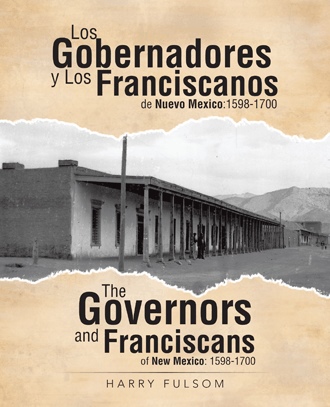
Los Gobernadores y Los Franciscanos de Nuevo Mexico:1598-1700 The Governors and Franciscans of New Mexico: 1598-1700
by
Book Cover & Preview Text
Chapter II The Spaniards’ Principle Foundation Laws of 1600’s Spanish conquistadores, such as Francisco Vázquez de Coronado {1540-1543} and Juan de Oñate {1598-1607}, each of whom came to the New Mexico during the sixteenth century, were dependent, in order to rule on the Requirement of 1512; which had been drawn up under the reign of Juana de Castilla {1504-07} and Fernando de Aragón {1479-1517}. The Requirement of 1512 {the first of three Spanish secular documents of the seventeenth century to have a decided effect on the Spaniards; relations {Consider Oñate’s conquest, conversion and possession speech given at Santo Domingo Pueblo on July 7, 1598}, required los indios e las indias of the New World to participate in Spanish religious rights, swear allegiance to the pope and to the Spanish king. But if you do not do this, and wickedly and intentionally delay to do so I certify to you that, with the help of God, we shall forcibly enter into your country and shall make war against you in all ways that we can, and shall subject you to the yoke and obedience of the church and their highnesses. We shall take your goods as our highnesses and shall do harm and damage that we can, as to vassals who do not obey, and refuse to receive their lord and resist and contradict him; and we protest that the deaths that shall accrue from this are your fault, and not that of our highnesses or our cavaliers who shall come with us. And that we have said this to make this requirement, we request the notaries here present that they should witnesses of this Requirement. Had Queen Isabella {1451-1504}, the person most responsable at the Spanish Court for the discovery of the New World, been living at the time, the requirement of 1512 may not have come into existence. For she had advised in letters the Franciscans to regard the Indians of the New World. The New Laws of the Indies, which the Spanish King, Carlos I, drew up in 1542 {due in part to the influence of the Dominican, Bartolomé de las Casas}, liberated in principle if not in fact the Indians of the New World from la encomienda; liberated in principle if not in fact from overwork the Indians of the New World; made the Indians of the New World vassals of the Spanish king; made proper treatment of the Indians of the New World a prerequisite for their bondage; and required {largely ineffectively for a time} that the Spanish encomienda grants revert, after 2 generations and equally ineffectively in New Mexico {until 1640} to the Spanish king. The Recolonization Laws of 1573 or The Ordinances of his Majesty for the Discovery, Conquest and Pacification, which amended, at least, for the clergy, the motives for entry of the Spaniards into the New World, came into being largely because of the incapacity of the fraile Marcos de Niza and Francisco Vázquez de Coronado expeditions to treat with the Pueblo Indians of New Mexico. The Ordinances were to make an effort to temper the entry of Spanish miners and slavers into New Mexico and insure that all Spanish entries into New Mexico had the approval of el virrey español. As subject of el repartimiento {a Spanish Institution for the acquisition of individual and communal labor{, numerous Pueblo Indians were forced to work during and beyond their working day for the Spaniards. To maintain in bondage the Indians of the New World, the Spaniards introduced the encomienda grant. La encomienda, was ideally a form of social and economic trusteeship. Under la encomienda, the Pueblo Indians of New Mexico were forced, for a time, to provide, food, blankets and service in defense of the Spanish frontier and, in Mexico, of even money to the Spaniards in exchange for human protection and religious instruction. In New Mexico, the service roles, would, in part, be reversed. The soldier-settlers or settler-soldiers {after the departure from San Gabriel of two-thirds {approximately 246 members} of the Oñate expedition for the city of Santa Bárbara, Nueva Vizcaya in October of 1601} and encomenderos {possessors of encomienda grants for the lands of the Moqui or Hopi of future Northern Arizona and the Pueblo Indians of New Mexico} had always to serve as protectors of the Santa Fe and provision carts from Santa Fe to Paso del Norte. The encomenderos had to promise to live in Santa Fe; even though their encomiendas were to be discoverable among the houses and pueblos of the Pueblo and Moqui Indians. The Pueblo Indians of New Mexico were forced for a time to pay tribute to the Spanish governor, to the Franciscans and to the Spanish Crown. The Royal Fifth, a measure for the division of wealth among the Spaniards of the era, may not have been, like the position of Corregidor or corrector, adhered to Santa Fe. Under la encomienda, the Pueblo Indians were forced to provide {twice a year for a time} 1 fanega or 1.5 bushels of corn to the Spanish settlers and often deer and buffalo hides, depending on the location of the Spanish encomienda grants} to the Spanish encomenderos whose limit {down from hundreds} was set, for motives of royal efficiency, by el virrey Escalona, at thirty-five during the 1640’s. Second in command of the Spanish Empire {the Council of the Indies or el Consejo de las Indias aparte} only to the Spanish kings during the 1600’s, Spanish Viceroys {el virrey Lorenzo Suárez de Mendoza took it upon himself to authorize the departure of the Rodríquez-Chamuscado expedition of June 5-6, 1581 for New Mexico} such as the Count of Monterrey {1596-1603}; el marqués de Monteclaros {1603-1607}; Luís Velasco II {1590-95} {1607-11}; and Garcia Guerra {1610-1612}; did not define the respective jurisdictions of the governors and Franciscans in New Mexico.
Formats

Book Details
About the Book
The Governors and the Franciscans contains the only, at least, up to the moment {there must be something beyond narrative and primary documents} chronological record [“The history of the province from the fall of Acoma on December 4, 1598, to the great revolt of 1680, can never be made complete, for lack of data.” ---George Bancroft, Bancroft Public Library, Berkeley, California.”]
[“An accurate account of the building of Santa Fe and annals from founding of Villa down to the Peublo Revolt of 1680 will probably never be written.”] --Ralph Twitchell Santa Fe, New Mexico} of the explicit as well as implicit; un-real as well as real; subjective as well as objective; and ideal as well as representative history of New Mexico; and as such paralells the juirisdiction of the three principal Spaniish law decrees of the sixteenth century.