
Missionary Practices and Spanish Steel
The Evolution of Apostolic Mission in the Context of New Spain Conquests
by
Book Cover & Preview Text
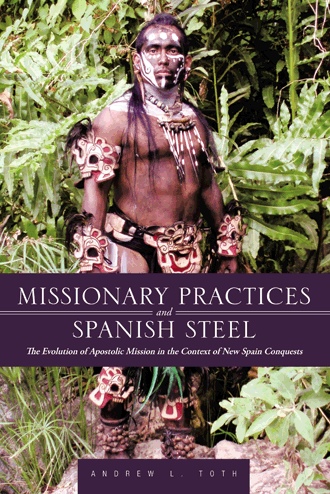
The Spanish conquest of North America, or New Spain as it was called, has been exhaustively studied and permeates all modern American history. The Spanish Mission, and the friars that penetrated indigenous lands undertaking the spiritual conquest for their king and God, have inspired countless biographies and histories. The reports of clerics and friars that came to the New World would indicate a mighty movement toward Southern European or Latin Catholicism that is unprecedented in history. Juan Zumárraga, the first archbishop of Mexico, writing just seven years after the first missionaries arrived in Mexico, declared that the Franciscan friars had baptized more than one and a half million indigenous converts.1 The warrior and conqueror Hernán Cortés, himself a Brother of Penance Tertiary, a third Order of Franciscans, can be painted a missionary with apostolic zeal, insisting upon religious conformity both in his own ranks and among the masses of new converts, long before any religious professionals appeared on the scene of the conquest of Mexico (Braden 1930).
Many great stories emerged from the conquest; stories of valor, of controversy, and of utter confusion. Then the numerous interpretations of what took place, or defenses and justifications of policies, have continued to circulate since 1492. The Black Legend holds that the Spanish murdered, maimed, tortured, and in general made life miserable for the indigenous Americans through cruelty, exploitation, religious intolerance, capture, enslavement, and sexual abuse. This continues to be thought of as fact by many, even among some in higher education, though the legend could be applied to many of the other European colonists at some point in their conquests.
Most people have some idea of what a Spanish-Catholic mission settlement was. They may even understand who the indigenous people of the missions were, and probably have some impression of an alleged mistreatment of the mission converts. There are stereotypes of the friars that would have them appear to us as almost saintly, some indeed have been canonized by the Roman Catholic Church. Yet there are a number of murals on subway walls and public buildings in Mexico City that present the friars as demonic taskmasters. Neither view does justice to the facts of life common to the early Spanish settlements and missions. Polarization has thrown the public perception of missions, and Roman Catholic missionaries, into a quagmire of doubt and misconceptions. The sources of this confusion go all the way back to Cortes and his letters to the Crown of Spain (Cortes 1969) stating the accomplishments of his armies and defending his actions in the New World. The letters and reports (Lockhart and Otte 1976) coming from explorers and colonists ignited a passion in the hearts of the people on the Iberian Peninsula. The stories of these encounters, as told from a European perspective, raged throughout Europe. They were liberating for the archaic, medieval, and decaying European upper crust of society and at the same time depressing for many of the European Christians to discover the world was still so populated by pagans and infidels. Many clerics felt the end of times prophetically predicted in the Scriptures was already upon them. Muslims still held Africa; they had just recently taken Constantinople, and were systematically taking central Europe as far north as Hungary. The Holy Roman Empire stood alone; the great Eastern Orthodox Church having already been overrun by Roman Catholic and then Muslim armies. In the midst of this corporate, besieged state of mind, Columbus verified rumors3 that there were indeed heavily populated lands to the west. Populations that needed to have the gospel preached to them. Columbus thought he had found some islands off India and that a new water route to the Spice Islands had been found. After four voyages, he died still believing it.
However, later it was discovered that Columbus had actually stumbled upon a huge obstacle in the western route to Asia. Not only were there two whole unexplored continents, but they were full of pagans who were so culturally different from anything the Europeans had seen to date as to raise the question regarding whether they were really human.4 Some reports described the indigenous people of the Caribbean as docile children (Berger 1992). In another report they were described in the worst imaginable way as savage cannibals preying upon each other (Menzies 2003, 267). Either way they were seen by the early explorers as pagans in great need of the one true Holy Roman Catholic Church, and someone had to make them into civilized, tax-paying citizens of the Spanish Empire.
New Spain was the name that was used for all the Spanish claims on mainland North America until much later when the sheer size of what they had discovered became known. As the Spanish continued to expand to fill its claims of territory and to 'Christianize' the tribes and nations they encountered, a responsibility bestowed upon them by the Pope Alexander VI in 15015, each geographic area presented physical challenges not before experienced by the adventurers. Each indigenous group presented a new way of life, a new language, and new ways to scratch out basic survival needs from the often barren, inhospitable land. Too often they were hostile toward the Spanish due to tales of slavery raids that preceded the friar’s incursion, or due to the horrible, usually fatal sicknesses that too often appeared just before or after first contact with the Spanish. Most indigenous people wanted nothing to do with the European strangers. The city of Matehuala was so named for the often repeated word used by the natives upon their first encounters with the Spanish. Later it was found that the word means: do not come. But the Spanish had come to stay. Friars were to expunge and replace the indigenous religions with a new faith. The new, Southern European faith was defined by the Council of Trent in a marathon sixteenth century response to the reformation movements within the European Roman Catholic Church. Trent gave Roman Catholic leaders a fixed doctrinal position and required that the Latin Church traditions be locked into a rigid, unchangeable, hierarchal structure centered in Rome. This was a response to those reformation movements that were questioning the church’s legitimacy and challenging the Roman church’s spiritual authority and political structure. A second mandate of the friars during the conquest was to make Spanish citizens out of the indigenous groups by teaching them gainful employment and Spanish cultural mores, and then to incorporate them into the imperial economy. Eventually employment meant agriculture, ranching, and limited cottage industry, all of which the friar was to be proficient in himself and able to teach his flock. Often the survival of the mission and its converts depended upon their self-sufficiency. An evaluation of the degree of success of this great missionary enterprise must take into consideration the degree of success of both of these objectives.
The King was the civil head of government, but he was also the Emperor of the Holy Roman Empire. The Council of Trent defined in clear, concise terms what being a Roman Catholic meant; the religious police of the Inquisition were there to enforce Roman Catholic doctrinal purity. The civil law that came down from the King, through the Viceroy and to his magistrates, and eventually to the priests and friars, was also very clearly defined for each stage of the conquest of New Spain. To fulfill his mission the friar morally and legally had to accomplish both, i.e. make them Roman Catholic Christians and make them culturally Spanish citizens of the Empire.
Formats

Book Details
About the Book
The work and ministries of the Roman Catholic friars who gave their lives, both as martyrs for the cause of their church and in years of hard and often thankless labor, are the inspiration and basis for Missionary Practices and Spanish Steel, a theological and practical narrative that seeks to remember and understand their accomplishments in Christian mission.
Missionary and theologian Andrew L. Toth investigates the roots of Christian mission as it developed into the field of Christian missiology in the chaotic, terrible, and incredibly diverse three-hundred-year Spanish conquest of North America indigenous nations. Through his research Toth shows that, in the great majority of the cases studied, the friars accomplished their goals to transform these native cultures into their own Spanish culture to account them as Roman Catholic Christians.
This study us more than just a history of the friars’ missionary movement. Toth not only explores how Spanish Catholic missionaries approached their work, but also asks to what extent their approach conformed to a particular theological perspective. Toth rounds out his argument by speculating on what the friars can teach us about the role of missionaries today.
Comprehensive and thought-provoking, Missionary Practices and Spanish Steel offers a new perspective on the current missionary movement by looking through the lens of the past.
About the Author
Andrew L. Toth earned a missiology degree from Fuller Seminary and a doctorate in theology from the Universidad de Las Naciones. He and his wife have spent thirty-eight years of working in Latin America in Christian missions. They currently live in New Braunfels, Texas, where Toth is the director of candidate training for World Indigenous Missions.