
Re-evolution of the Fragile Ego
A Path to Leadership’s Core
by
Book Cover & Preview Text
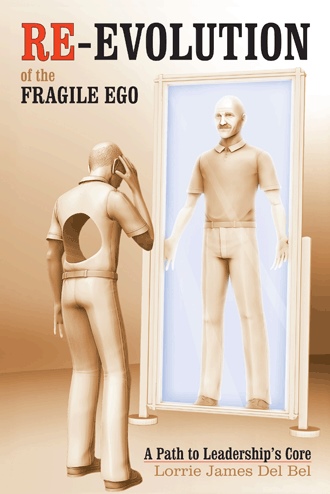
The drive to succeed: a severely weighted and near-crippling passion, generating enormous anxiety within. It dominates us like the light does a moth and steers us like a herd through a cattle chute.
Bearing the burden of our ancestry and namesake, we march blindly toward what we envision to be our purpose in life. Like the moth, we are lured forward, never deeply questioning this purpose, our motivation, or the reward. I had never questioned it myself. I too, like the moth, had always focused without question on the dominating light ahead.
Yet deep within me stirred a sense that there was much more to my place and role—something beyond the light. In spite of all my successes, there was so much more not accomplished. This nervous anxiety only amplified my lack of contentment. Despite this, I kept my place among the herd. I subdued the conflicts within me and chose the safe predictability and anonymity I found within the group, but then, suddenly, an innocent comment was followed by an unexpected moment of clarity.
Those words, which were spoken by a neighbor, would rock the dormant core within me, resonating through the most sensitive parts of me. The obvious conflict in leadership had been revealed, and the glimpse of a new revelation on leadership began to immerge in my mind. Minutes later, pencil met paper, and I found myself almost uncontrollably writing thoughts and emotions about all aspects of leadership and its connection to my life. I was in free-fall mode—or perhaps the better term to use is free-rise mode—with the force of gravity negated by the pencil in my hand. There was no safe experience, thought, or emotion as words turned into sentences, pages, paragraphs, chapters, and ultimately this book.
So where did this journey take me? Much like a bullet from a gun, it shot straight out from me. On the fi rst stage of my journey I found myself spewing recalled experiences. Soon spewing turned into blaming, and I was well on my way to creating page after page of support documentation to illustrate the pain and suffering I bore and on whose behalf—all the circumstances and failures of others who I felt had negatively affected me and the course of my life. Then an incredible thing occurred as I began to see all the recounting of my negative life experiences as a thick blanket of fog that had enveloped me, preventing me from seeing all my life experiences clearly and hindering my development; the fog, a manifestation of my own fl awed thinking and perception.
Then there came the critical transition from bullet to boomerang as questions turned into answers, understanding, and a belief system that would bring it all back to me. With a newfound perspective through which to reflect and analyze my life experiences, I could start to clear the fog that had previously hindered my thinking. As my mind cleared I could see the path and solution that lay ahead and the reflection of a better me, peering back from within the mirror.
Yet seeing a better self was only the first part of a two-part solution; as I came to see myself in an honest light, I began to see others more clearly as well. Then there came the powerful realization that we are all so very much alike, if not identical, in our weaknesses. That which occupies my core and suppresses my individual spirit is no different than that which suppresses the spirit of others. It is our weaknesses that cause us to conflict with other people so frequently and for seemingly the most simplistic and mundane reasons. We collide into and bounce off each other’s weaknesses like bumper cars at the fair, powerless to control and dictate our path. We are at the mercy of the circumstances that surround us and the frailty that all on this ride conceal within.
I see this weakness and the fragility that results almost everywhere I look. I see it in places of work—from the mannerisms of persons in manufacturing to the hands of health-care providers. It is noticeable in the movement of people as they bump, squeeze and grind their way through the crowded spaces of the shopping mall and maneuver along the more crowded roads upon which we drive. It is present in the paint sprayed on the fences, street signs, and overpasses of our communities. It is evident in the debris dumped without care, the emptied containers tossed across our lawn and the bundled newspapers heaped upon the sidewalk. It is the abandoned shopping carts left as pylons to be dodged at the local supermarket, and in the determination of drivers to prevent others from merging as a lane restriction approaches. It is evident in the kids at play in the school yard and the one off to the side who is not. It is certainly hard to miss while watching or listening to the confrontational and sarcastic interactions between persons in all forms of media. Yes, it is even visible in our close-knit neighborhood communities and within our own family circles as we jostle for position in relation to those around us. The key to unlocking the riddle is to understand the driving forces that define who we are and why we act as we do.
Writing this book had a two-part purpose. First and foremost, it fulfilled my personal need to define and express my true self. Me, a product of a lifetime of experiences and the beliefs that resulted in my discovering the solution to the riddle; what drives and therefore defines me? It is really no different than the expression of a dancer’s own heart and soul through the art of movement; these words are the expression of mine. My writing has been the culmination of my journey inward and the lessons I learned during the past years as I sought to discover my true self, accept that self, and feel an honest sense of peace within. It has all been part of the ongoing re-evolution of my fragile ego on the path to heal my weakened core.
The second purpose was to share my experiences and beliefs with others—those who may also be seeking answers to questions they are asking about themself. Perhaps they are trying to calm that same nervous anxiety that once dominated me. By sharing my journey and the lessons I learned, I may help to fulfill my outward role as a leader—to be a positive influence, provide guidance, and mentor persons in need. I do this with the sincere hope that my words provide enlightenment for those looking to experience contentment and a sense of peace from deep within themselves. So, in essence, by sharing my experience, I become the source of my own ripple on the water; my influence spreading out from me to others.
Formats

Book Details
About the Book
In the midst of an innocent conversation with his neighbor, author Lorrie Del Bel’s life was forever changed.
His neighbor was unsure about leaving his labor job to become a supervisor. He felt himself incapable of bossing people around and disciplining them for not doing their job. He confessed these feelings as though he was afflicted with a fatal disease or shameful deformity.
But the remarks sent Lorrie on a journey of self-reflection, examining his own life, purpose, the type of leader he was and what drove him to succeed. He began to understand that the essence of leadership was not based upon what is achieved, but rather on the condition of a person’s ego and their intentions as a result.
Join Lorrie on his journey of self-discovery as he explores the poison of pessimism and the underlying root cause. Growing to acknowledge weaknesses and finding strength in doing so.
Follow the course he lays out; the principle cornerstones for the re-evolution of the fragile ego, then the functional cornerstones necessary to lead others successfully.
Lorrie shares his journey for others to use as a guide, in discovering their true self and purpose, and become fulfilled.
About the Author
Lorrie James Del Bel, a native of Sault St. Marie, Ontario, Canada and raised on principles of obedience, religion, and hard work. He left school early to work as a laborer, later returning to earn a business degree from Algoma University. He then began a long successful and diverse career in management. A husband and parent, he enjoys helping people overcome frustration to find peace within.