
Archivo 126
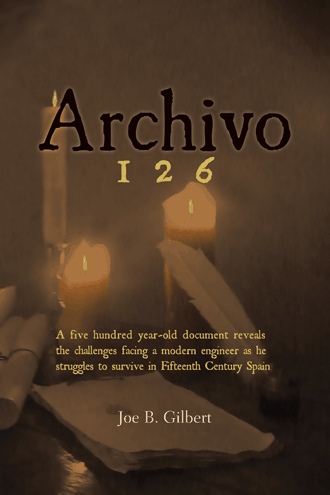
A five hundred year-old document reveals the challenges facing a modern engineer as he struggles to survive in Fifteenth Century Spain
by
Book Cover & Preview Text
Formats

Book Details
About the Book
“Robinson Crusoe, the Connecticut Yankee, lone survivor of nuclear holocaust: how would these the creations of human hubris really fare removed from the support of their usual surroundings? Gilbert offers an answer, delightful as well as astute, in his humane and technologically-savvy book. You’ll have a wonderful time with protagonist, John Hughes, as he struggles and finds his own answer to this old, old riddle.”
John Hughes, a modern day engineer, finds himself thrown back in time to fifteenth century Spain. He tries to employ his engineering background to gain some sort of advantage, even to survive, but none of his “inventions” gets off the ground. He’s frustrated at every turn. He has read Mark Twain’s A Connecticut Yankee in King Arthur’s Court. The Yankee, he remembers, built a railway, a phonograph, a typewriter, a country-wide telegraph system. “How did he make that wire,” Hughes laments, “How did he generate the electricity?” He then descends into self-pity, muttering, “I would give a month’s wages for a box of assorted nuts and bolts.” A sub-theme is Hughes’s desperate urge to send word to his daughter, telling her he did not abandon her. But how, he asks, do you send a message to an unknown continent and only after 450 years have passed?
About the Author
Mr. Gilbert is an avid student of the history of science. He lives in Houston with one wife and three cats.