
Why I Believe in God
Atheism: A Self-Delusion
by
Book Cover & Preview Text
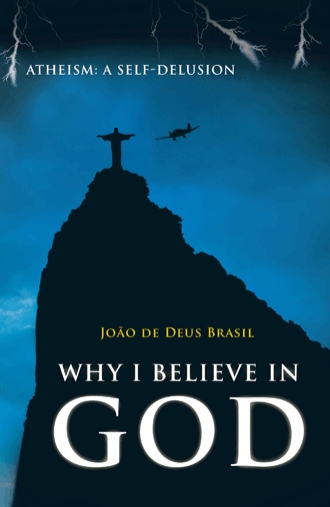
João de Deus Brasil’s book comprises two independent but related works: Why I Believe in God and The Refutation of Atheism. In the first book, he allows us to see the various stages of the evolution of his religious conscience throughout his long life. This begins in his childhood with the congenital, natural, naïve and pure faith of children, but distorted by absurd dogmas and foolish beliefs of the traditional religions. He goes through adolescence with its typical uncertainties, doubts and disbeliefs. Finally, due to the force of facts and to natural as well as supernatural phenomena, he reaches maturity with absolute, rational conviction of the existence of God and the immortal spirit. Broadly speaking, this seems to be the general rule of the religious conscience evolution of those who set themselves free from taboos, prejudice, and social, cultural, religious concepts and conditionings. Such generalization probably results from the easy, universal access to information we find currently in our society. Many of us, however, get lost at the intermediate stages of this evolution, and get stuck to wrong opinions, not allowing ourselves to progress. Such is the case of skeptics and atheists who do not allow themselves to go on to study other conceptions, closing their minds to information. Out of pride, self-love, and other subjective conditionings, they block down subconscious knowledge that naturally comes out from the spirit. This way, they blind themselves towards the infinite evidences of the transcendental truths. Thus, intellectually and philosophically immobilized, they take on the intransigent defense of their indefensible positions, and paradoxically anti-scientific ones, without realizing how futile their arguments are. The author himself recognizes he could overcome this barrier only after having been exceptionally helped by spiritual agents, and having witnessed some occurrences and supernatural phenomena. Today, however, after having set himself free from pride, and from the silly pretention of the omnipotence of rational thinking, he believes he has retrieved his eyes that can see. On this condition, he may perceive the presence and providence of God and the spirits all over the universe, all over nature, from the infinitesimal to infinity. The acquisition of a clear vision like this is enough to enlighten the infinite plans of material and spiritual creation. We may, then, find enlightening answers to the enigmas of life, philosophy, suffering, and of God’s justice ruling over all of His children’s destinies. This knowledge is the philosopher’s stone of the truth of Jesus’s words, capable of setting all of us free, both individually and collectively. The author tells about such truth because this has set him free from ignorance, and prepared him to begin today the conquest of his future happiness, inalienable inheritance of all of us. Ignorance leads to disbelief, to lack of faith. Lack of faith, in turn, means ignorance because those who do not believe ignore the existence of God, and, consequently, His justice, thus feeling free to do evil. Wickedness and ignorance are always together. Theoretically, the smashing majority of us believe, but, at a practical level, we act as though we ignored God and His justice. Why? Because, actually, we disbelieve at a conscious level. We doubt it. And by doubting, we do evil to obtain immediate, passing benefits, and we ignore the eternal disadvantages before God’s justice, which is uncertain and doubtful to us. That’s why we imprudently do evil. Our inconstant faith is insufficient. It is not enough. We must be sure, convinced. We must know. Nevertheless, if we succeed opening our eyes to the light, which radiates from the entire creation, we will clearly see the truth. By meditating about the truth, we may achieve and win over reasoned faith, the certainty, the knowing. Thus, we may set ourselves free to begin our journey towards our future happiness. The knowledge of the truth may, therefore, set us free, both individually and collectively, from evil, from wrong-doings, and from their unavoidable consequences: pain and suffering. The rational faith means knowledge, certainty, and it leads us to renounce all evil and to make a permanent effort to do as much good as possible. However, this is not enough. We need time to educate ourselves in order to extirpate the atavistic conditionings of our millenarian past. Education does not mean knowledge only; it means habit and practice. It is necessary to internalize the new knowledge through the continuous, systematic practice of justice and charity laws. Nature does not leap. It is necessary to bury millennia of bad habits under years, decades, or centuries of doing good. It is time we started up. We must hurry up. The needed time will be inversely proportional to the intensity of our efforts. The author calls us to make this effort, after preparing us for that by rationalizing our faith. This rational faith, considered impossible and absurd by most people, is achieved by the author through the rational, logical study of natural and supernatural phenomena. He ends his work by making us face the following alternative: • 1 – to doubt the absolute sincerity and veracity of his accounts; • 2 – to entirely believe them. If we adopt the first option, we may refute his conclusions. If we adopt the second one, there is no other way than agree with his rationalization of faith. In this case, we will have surpassed the millenarian barrier of doubt. We will have, then, acquired knowledge, the certainty of the existence of the immortal spirit and of God, with all the wonderful consequences and advantages of such knowledge. In the second book, João de Deus Brasil addresses the refutation of atheism based upon Richard Dawkins’s best-seller, The God Delusion, (see footnote 19). While editing Why I Believe in God, the author’s attention was drawn to the best-seller mentioned above written by the renowned English biologist Richard Dawkins, the current leader of the world atheistic movement. João de Deus Brasil came across the back cover copy, which highlights Dawkins’s arguments to whom the existence of God is scientifically improbable. Plus, the latter provokes the convinced religious people, and intends to make the religious by inertia think about their belief rationally, exchanging it for the atheistic pride and for the love of science. Surprised at Dawkins’s assertion and without understanding his pretension to convert the religious by inertia, João de Deus stopped editing his book, and dedicated nearly a month to read and study The God Delusion. He was avid to know the scientific improbability of the existence of God, and to understand the meaning of “to make the religious by inertia think their belief rationally, exchanging it for the atheistic pride and for the love of science”. It was worth the effort because João de Deus, disappointed but happy, found out that the author of those nearly five hundred pages did not provide any reasonable, coherent explanation to those two issues. Nothing did he find that would be able to constitute the least scientific evidence of the inexistence of God. As to the religious by inertia, yes, it is possible and natural to be religious without thinking, for faith is unconscious knowledge that comes up naturally on everyone’s conscience. However, the truly rational thinking cannot lead us to disbelief just like Dawkins wants it to. Reason cannot lead us to err unless it is misled by subjective conditionings or by the individual’s inability to reach the subject of his intended rationalization. Irrationally thinking is the subconscious resource used by those who want to be led by subjective, misleading impulses and motivation. This is what Richard Dawkins does in his book The God Delusion, according to what João de Deus Brasil demonstrates in The Refutation of Atheism. The truly rational thinking naturally l
Formats

Book Details
About the Book
João de Deus Brasil's book comprises two independent but related works: Why I Believe in God and Atheism: a Self-Delusion.
In Why I Believe in God, the author reveals the origins of his faith whereas in Atheism: a Self-Delusion he refutes atheists' arguments expressed by their current world leader, Richard Dawkins, in his best-seller God, a Delusion.
Regarding the renowned biologist's ideas, João de Deus states:
- In his book, Richard Dawkins does not provide any theory capable of scientifically justifying his negation of God's existence. And besides, he does not put forward any evidence whatsoever, either scientific or empirical, in support of that nonexistence.
- Between the lines of his own words, one can clearly see his subconscious knowledge about the life of the spirit, anterior and posterior to material life.
- By analyzing his quotations of other wise, monistic men, without even excluding the magnificent Albert Einstein, one can clearly perceive that they themselves have this subconscious knowledge, and they reveal it as they express their thoughts.
- Materialism is, therefore, a delusion. The true monist does not exist, for all of us have subconscious knowledge of our spiritual existence before, during, and after our material lives. We express ourselves according to this knowledge, whoever we are: believers or skeptics, intellectuals, scientists, or illiterate peasants.
- In the same way, we are also aware of the existence of God, and that's why faith is revealed in children. For the same reason, among many others as we have seen, faith is revealed in all peoples and cultures, with no exception.
- These realities, perfectly clear for those who want to see, provide irrefutable, absolute proof that atheism, like materialism and monism, is a self-delusion.
About the Author
João de Deus Brasil is a senior military officer who has worked in spiritist centers for over thirty years. He was the cofounder of Caminhos da Luz Spiritist Center in Torres, Brazil, in 1987. A father and grandfather, he lives in Torres, Brazil, where he enjoys reading, studying, and writing.