
Truce at Nueviant
by
Book Cover & Preview Text
Chapter 1 The German army was bruised but not beaten in October of 1944; the borders of the Third Reich shrank with each passing day as units of Major General George S. Patton's Third Army closed in on the Rhine River. In a small stand of trees, a unit of panzer grenadiers surrounded their sergeant. They were part of Hauptmann Kurt Hauser's 3rd Company, 119th Panzer Grenadier Regiment of the 25th Panzer Grenadier Division. Their company had been assigned as a rearguard while the rest of the regiment retreated to a new defensive line. The seven men had been separated from the rest of company after the Americans broke through their lines. Twenty-eight-year-old Sergeant Franz Weselmann had fought in Poland, France, and Russia, and his men looked to him to get them out of the ever closing pocket. He rubbed his chin while studying his sector map, his blond hair peeking out from under his helmet. The remaining six members of his squad waited for an answer. They were all that remained of 2nd Platoon. Many lay scattered in a dozen fields in the French countryside. Some were caught in the open by Allied fighter-bombers who strafed and bombed them into oblivion. Some died in quick firefights with Patton's men, and the rest were taken prisoner. Weselmann hoped that the men who survived their captivity would help to rebuild Germany after the war. He erased thoughts of lost comrades and got back to his main objective: think of a way to get his squad back to friendly territory. “Looks like the only way out is northeast. A couple kilometers from here is a small dirt road we can take. I imagine the Americans have all the main roads cut off,” Weselmann said, his concern overshadowed by the confidence of his men in his leadership. “It's rough terrain but good cover. We should be able to avoid any enemy patrols. How much ammunition do we have?” After each man replied, a quick inventory revealed a little more than sixty rounds of rifle ammunition, less than forty-five rounds of submachine gun ammunition and three grenades. “We can fight our way through the entire American army with that much ammunition,” Corporal Hans Vopel retorted. “Instead of fighting in France, let's just invade Britain and then America. We'll capture Churchill and Roosevelt and end the war.” Vopel's comments brought a smile to the faces of Weselmann's men. “We'll leave Roosevelt and Churchill alone for now and concentrate on getting back to our unit,” Weselmann replied. “Would you be so kind as to scout ahead for us, Corporal Vopel,” Weselmann requested with a smile. “Yes, Sergeant Weselmann!” Vopel replied, snapping a sharp salute. “We move out in three minutes.” After picking up his helmet and backpack, Vopel started heading northeast. As he passed Weselmann, the jolly corporal from Munich smiled, “Don't worry Franz,” he softly said. “We'll get the lads back to 3rd Company.” In peacetime he was a baker's assistant now the squad's lead scout and Weselmann's closest friend. One by one, the remaining men moved past the ever alert Weselmann, crunching the newly fallen leaves under their boots. Private Fritz Stempel was a Bavarian clock maker from Augsburg, a graying veteran of World War I, called up as a replacement. He always reminded Weselmann of his own grandfather. It was no wonder that the squad nicknamed him Grandpa. Private Karl Baake was a carpenter from Nuremberg who was the best rifle shot in the company. Once several Russian machine guns had the platoon pinned down for thirty minutes. After crawling into an excellent firing position, Baake calmly checked the sights on his Mauser rifle for 350 yards. With seven well aimed shots, he methodically silenced the Russian crews. Lance corporal Peter Rotter was a pig farmer from Biberach, who at six foot four inches and 250 pounds had no equal in hand to hand combat. Along with Weselmann and Vopel, he was one of the old hands, original members of the squad. The three had been together since the Polish campaign in 1939. Privates Ernest Bunzel and Franz Piontek, the youngest members of Weselmann's unit, had just been conscripted from school in Nuremburg. Both were only sixteen, and Weselmann hoped they would see their seventeenth birthdays. They joined 3rd Company as replacements, for men lost on the Russian front, when the regiment was transferred to France. Weselmann waited until they moved ten yards in front of him before joining the column as the rearguard. The woods were thick and the pace was slow, but there was no chance of Allied planes spotting them. They followed a deer path, not much wider than three feet, through the woods. Weselmann thought it is a beautiful forest. It reminded him of the Bavarian countryside. The leaves that remained in the trees were turning from green to shades of brown and tan. It's a shame that the war will soon tear apart this relative calm they now enjoyed. A combination of the early afternoon sun and the humidity of the woods began to soak their uniforms with sweat. They had walked for about an hour when the woods turned into a clearing. Vopel spotted something. He slowly raised his hand to signal the others. As Weselmann moved up, he noticed at the edge of the clearing there was the dirt road leading to a small village. He studied the village through his binoculars, hunting for any out of the ordinary detail. The dirt road ran through the village disappearing into the forest heading east. A small hilltop, behind an old church, overlooked the village to the south. To the north were multiple houses and shops, ringed in by heavy woods. To the southwest were the remains of several houses, in various degrees of disrepair. It was obvious, that the village had seen better days. There was no sign of any life in the village except behind the old church, in what looked like the local cemetery.
Formats

Book Details
About the Book
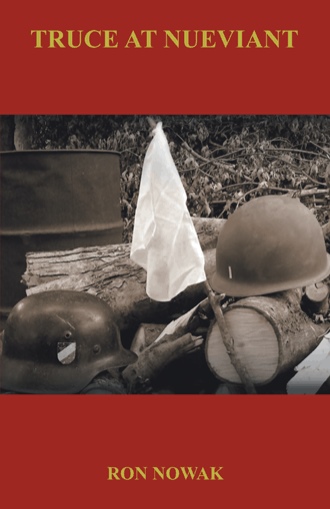
In 1944, allied forces have broken out of the Normandy hedgerows. Allied and Axis units are scattered across the French countryside. American units are advancing faster than the Germans can retreat. And in a small stand of trees, a unit of panzer grenadiers surrounds twenty-eight-year-old Sergeant Franz Weselmann. As he rubs his chin and studies his sector map, the remaining six members of his squad wait for an answer. Everyone is counting on Sergeant Weselmann to lead them to friendly territory. Meanwhile, an ambushed American platoon, cut off by superior German forces and surrounded by thick forests, decides to take a dirt road with the hope it will lead the twelve-man patrol to safe ground. As Lieutenant Jack Wallace and his unit arrive in the village of Nueviant, they have no idea that a chance meeting with German forces will soon prove that survival depends on trusting and fighting together against a common enemy—a one-hundred plus unit of SS Gestapo led by a ruthless commander bent on revenge. In this historical war thriller, two enemies have no choice but to partner together to defeat a common foe. The stakes are high—either the men succeed or die.
About the Author
Ron Nowak earned his bachelor of science degree from Quincy College. He has nurtured a lifelong fascination with American military history and comes from a family with a deep background of military service. He lives in Quincy, Illinois, with his wife, Gale of thirty years. They have two grown children, a son and a daughter. This is his first novel.