
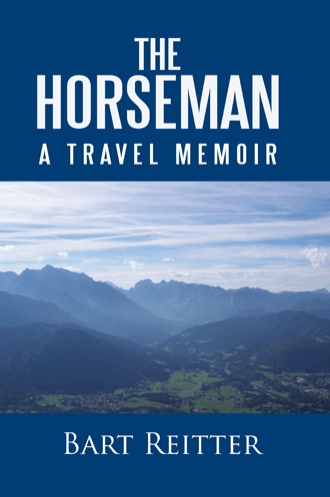
The Horseman
A Travel Memoir
by
Book Cover & Preview Text
I love to travel. I’m not sure why. It satisfies some fundamental need for me. It’s not as primal as eating or sleeping, but its close. At some point at a young age, the urge to be on the move seeped into my DNA and has yet to loosen its grip. Thirty-nine years on, that’s still the case. The prospect of moving from place to place is, for many people, annoying at the very least and inherently unsettling; others hate to travel altogether and avoid it at all cost. But I love it and have loved it for as long as I can remember. I can’t claim some innate attraction that draws me over the horizon, and I don’t have ambitions to scale Mount Everest or plumb the depths of the Amazon. It’s simpler than that for me. I just like to move. My infatuation began around age six. Its source was my father. He was on the road a lot for work and spent significant time away from home. Despite his absence, there was an allure to the itinerant lifestyle that he led. Wanting to be like my dad, I wanted to travel. At that young and impressionable age, it was glamorous to me even though I had no delusions that he was in far-off exotic lands. I knew he was in prosaic towns like Buffalo or Wichita. However, the travel experience became the hook for me, and I still crave that experience today. Having traveled regularly now for nearly 15 years, the novelty has worn off but the yearning goes on. Despite the millions (literally) of miles flown, the countless nights in hotel rooms, and the immeasurable hours spent “moving eight miles a minute” (in the words of Bob Seger), I still enjoy it. From an occupational point of view, travel is a byproduct of my pursuit of global responsibility. Ever since I started working, I sought positions in sales and then marketing that had global reach. I didn’t achieve them at first but always had those roles in mind. And despite my fondness for travel, it was always important for me to put my job first. I worked hard and tried to excel at the task at hand and never traveled for the sake of travel. If that were my only goal, I would have become a flight attendant. My work travel was always linked to a loftier vocational goal and aligned with higher ambition. To be clear, the mundane and routine of work travel far outweigh the glorious. For every hour spent on a veranda watching a sunset over Lake Geneva (2007), there are twenty hours stuck in airports or sitting in traffic. For each visit to the Taj Mahal (2006), there are dozens of mind-numbing trade shows. And for each leisurely stroll along the beach in Rio de Janeiro (2007), there are dozens of client meetings in places like Newark, New Jersey. But the experience is still enjoyable to me. The journey is the destination. Describing Ernest Hemingway’s exuberant pursuit of life, author James R. Mellow wrote that he was, “A man with a voracious appetite for experience.” I don’t share much congruity with Hemingway but I share his appetite for experience. When I first started traveling I even wanted to experience the negative side of travel. That desire has long since worn off, but as a hearty young road warrior I felt that the hassle of cancelled flights, overbooked hotels, and weather delays would expose me to the real side of life on the road. I wanted to experience it all and didn’t always want things to go perfectly. My first travel memory was of a trip that my family took to Orlando in 1977. I was six. We took a vacation to Disney World, and I remember being euphoric about it. I was excited to see Disney World, but I was more energized by the journey and the travel experience and much of my excitement came from the idea of flying. Many people remember their first car, I remember my first plane. We flew from Philadelphia to Orlando on an Eastern Airlines Lockheed L-1011. I remember envisioning what flying must be like, and the anticipation was like waiting for Christmas morning to arrive. I have no good explanation for the origin of such excitement. Throughout my formative years, the urge to move grew stronger. My father’s work situation changed in my early teens and he was home more frequently but he still traveled from time to time and I envied him when he did. While his time at home was a welcome change for me, he and I had already enjoyed a rare and special relationship. His increased time at home only allowed our relationship to flourish further. While his being home quelled some of the restlessness of youth, another development fueled my longing to depart. In 1986 I lost my mother after a protracted battle with alcoholism. I was fifteen. Until two years prior to her death, I was unaware that anything was wrong. In retrospect, it seems incredibly naïve. The long and arduous period leading up to her death caused me to retreat within myself to a degree. As an otherwise extroverted individual, part of my personality began to crave solitude. Paradoxically, travel complemented my introspection. By looking inward, I wanted to move outward. During that difficult stage, and for most of my life, we’d spent a lot of time away from home by going to the mountains, the beach, and on vacations. The time away allowed me to escape, and I unknowingly began to associate travel—even if that only meant a weekend in the mountains—with comfort. Travel novelist Paul Theroux once wrote that travel is “equal parts flight and pursuit.” Flight (the noun and the verb) offered a respite for what I was feeling, and travel equaled solace. While we battled through the emotions and the hardships, I spent a lot of time alone reading and listening to music and that fed my desire to be elsewhere. I began to identify more with music and the Canadian progressive rock band Rush started to have a considerable impact on my life. Their drummer and lyricist, Neil Peart, wrote about teenage disillusion and longing. The lyrics to their song, “The Analog Kid” spoke directly to my loneliness, anxiety and disquiet: A hot and windy August afternoon Has the trees in constant motion With a flash of silver leaves As they're rocking in the breeze A boy lies in the grass with one blade Stuck between his teeth A vague sensation quickens In his young and restless heart And a bright and nameless vision Has him longing to depart The outro to the song crystallized the pain and angst that I was feeling and resolved into departure: Too many hands on my time Too many feelings Too many things on my mind When I leave I don't know What I'm hoping to find When I leave I don't know What I'm leaving behind The lyrics spoke to me in a profound way because they made the connection between disenchantment and departure, at least in my mind. The song brilliantly captured how I was feeling as well as my response to those emotions. In August of 1986, my Dad, my sister Christine, and I were on an annual vacation with the O’Leary’s, a family with whom we were very close while growing up. On a remote island in the Thousand Islands region of New York State, we received the message that my Mom had died. She was thirty-six. The news was difficult, but it was also liberating and comforting. The three of us drove back to Philadelphia to attend the funeral, and I remember thinking that I didn’t want to go. I knew that I owed my mother the respect of attending the funeral, but I didn’t want to deal with all of the emotions and faces filled with sorrow and pity. I didn’t feel like listening to a priest’s sermon and being showered with clichés like “death is part of life.” I just wanted to be away and to ignore it all. The day after the service, we returned to New York for vacation. It seems strange that we did that, but the period leading up to my Mom’s death had been so painful for us that I think it gave us relief to be away from it all. I could feel the stress receding with every mile that we put behind us. While the time away on vacation was not festive, it was peaceful and soothing. The anguish was over. I remember walking on a quiet path on the island aft
Formats

Book Details
About the Book
“Robert Louis Stevenson—who understood a thing or two about the selves we refuse to know—once said “I travel not to go anywhere, but to go.” Surely it was the likelihood of an accident, the unparalleled joy of stumbling upon himself now and then, which Stevenson most cherished in the going. A bit like Stevenson, Bart Reitter is a man who revels in the great distance between here and there. His memoir The Horseman is a wonderful account of the selves forged and found during his travels across the first half of a lifetime—a heartfelt testament to the wisdom of refusing to stand still.”
--Professor Greg Colón Semenza, University of Connecticut
“For those who have ever spent time on the road for a living this book will awaken memories—some fond, some downright scary. It’s the diary of a young man plying his trade as he jets around the world while climbing the corporate ladder. Bart Reitter writes in exacting detail. A delightful read.”
--Thomas J. Gibbons Jr. Retired Staff Writer, Philadelphia Inquirer
“The Horseman is an excellent story about one man’s travels. The book drew me in and I found myself reading longer than I had allowed for. Reitter’s enthusiasm for travel has rekindled my own excitement for the many business trips I have planned for this year.”
--Rich Dibernardo, President, Initech, LLC
“Reading The Horseman brought back fond memories of my travels with Bart. I also have been infected with the travel bug and the cure is to get me on the next flight to anywhere.”
--John Lin, Senior Territory Sales Manager
For author Bart Reitter, the journey is the destination. In this travelogue, he narrates his lifelong journey of discovery through travel. Written with stark clarity and emotional honesty, The Horseman begins with a six-year-old boy’s first joyful trip to Disney World and concludes with a 26,000-mile circumnavigation of the globe.
Compiled from journals kept while traveling the world and interwoven with personal reflection and unique historical perspective, The Horseman voyages through the joys and frustration of global travel as well as the introspection aimed at understanding life’s meaning. It presents an emotional, scientific, funny, and irreverent window into Reitter’s mind as he seeks to understand the insatiable wanderlust that drives him forward.
From the eastern United States to Singapore, and from the streets of Paris to the jungles of Thailand, Reitter communicates a unique point of view of life on the road that pictures rarely tell. From the euphoria of successful business deals to the loneliness of sterile hotel rooms, the story is never boring. In the end, with the help of his daughters, he discovers the best journey of all is the journey home.
About the Author
Bart Reitter is director of global marketing for a US-based life sciences research company. His seventeen-year career in sales and marketing has been spent traveling for both business and pleasure; he has traveled to forty-three countries and five continents. Reitter lives in Skippack, Pennsylvania, with his wife and two daughters.