
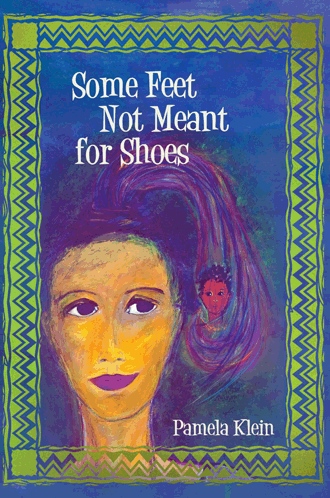
Some Feet Not Meant for Shoes
by
Book Cover & Preview Text
18) Physiognomy……………………………….…….Norah, 2000, Los Angeles It’s bright and sunny yellow in Olivia’s kitchen, with pots and pans hanging from everywhere, above the old stove, the arched doorways and from verdigris hooks nestled between cabinets. If you are tall you could knock your head on them, if you’d didn’t duck. That’s what Gerard does. And what Malcolm does too. Above her white porcelain sink, between the two kitchen windows, is an old mirrored cabinet that’s mounted on mint-green tile. They used to put medicine cabinets in the kitchen too, I wonder, as I scrub an old cast-iron pot that three hours before had turkey legs slow-cooking in it. “Norah,” Olivia says, opening the refrigerator to find a place for the Tupperware container full of leftover rice and peas, “you finally got that skirt thing right.” “Do I?” I ask. “Are you sure my bum doesn’t look big? You know it’s dropped a bit since I had the baby.” I can just see the Grace Jones curve of it behind me, barely covered it is by a tight blue and olive pineapple-print skirt that’s part of a two-piece suit her brother Malcolm designed and made for me. “Now that’s a white-girl question if I ever heard one. White girls obsessed with they puny little butts. Christ Almighty. Well you can’t have it both ways, Norah,” Olivia says, clicking her tongue and shaking her head from side to side. “We got our own distinctive lines and curves, girlfriend. Can’t be black if it’s only from the waist up. No no no no no.” “I never really thought of myself as black or trying to look black,” I say, dusting the pot with Ajax, careful to use only the balls of my fingers and not the tips. I focus so as not to wear away my ginger-color nails. I had them done on Monday, and this is only Friday. “Say what?” she says, snickering. “Just because I prefer the company of black folk doesn’t mean I consider myself one.” Not only do I prefer the company of blacks, but I am inspired by them, by the simple joy in them, colorful as it is, by the extreme rage, which is also colorful, and by the gentleness and the passion that seems first and foremost about divine spirit. Always looking up, they are, always thanking Grandmother and God for this and that. And the pride, oh yes, I am inspired by the pride in them. It plays to me like the high notes of the saddest, sweetest soprano sax, and when I hear it my heart is somehow lifted up. Not that they all have pride, mind you, but all the ones who I know do. It is powerful, this pride. It shows just like money in the bank. Open up the bank book and check out the register, is all you have got to do. It’s a savings account, started centuries ago. You see, I have been quite ashamed of being one thing or another for just about as long as I can remember–ashamed of being white, of being American, of being a liberal, ashamed of being blonde, of being middle class, of being a wife and mother, ashamed even of being a woman. In fact, until I met Jean-Michel and Sylvia on the beach in Guadeloupe, I had never felt proud of much of anything, besides my dead brother and sister, that is. And now that I have these angels in my life, there is almost no shame at all. So long as I fight oppression and racism, so long as I serve, so long as I am about service, there is almost no shame at all. Angels? Did I really say angels again? Black is very beautiful, I think, looking over at Olivia, oh yes, it is truly beautiful. It is the color of skin kissed by the sun. It was a very long kiss, I tell my daughter, and the longer the kiss, the darker the skin. “Come again,” Olivia says, grinning, hand on a mocking hip. We have just finished watching a Jamaican-made film called The Lunatic, about a big blonde German tourist and a poor local boy who meet while on the girl’s vacation. The tourist gives the boy her money; he gives her his sex, raw. When the money runs out and the vacation is over, the German girl moves into the boy’s shack and begins to withhold pumpum. Pumpum is just another way of saying cunt. “Pumpum power,” the boy says over and over. “You want to get some, these are the pumpum rules,” the German girl tells him every single time, and every single time he hides his face beneath his arms as if it were the thrashing of a whip. “Pumpum the boss,” Malcolm had said at the film’s end, “worth more than cash, worth more than just about anything, including dignity. Damn.” “Oh save your breath for coolin’ hot soup,” said Olivia to her brother and threw a hand up in the air. I watched my Caribbean friends laugh hard at this film, one they’d seen a half-dozen times before at least, and I laughed with them, but I wondered if it really wasn’t very funny at all. The boy was slow, and the German girl was fat. Perhaps it was really another story about black slaves and their foreign white masters, hidden beneath playful pumpum talk. “She a fat white girl,” Olivia had said. “The boy a simpleton, given a simpleton’s chores. Leave it there, Norah. West Indians do.” “Some West Indians don’t,” I say, “like those who made the film for instance.” “The Bajans in this house, we leave it there, honey.” End of story, I thought, ‘cause that’s how it is with Olivia, until Malcolm piped in. “Damn. First slavery screw us up. Now tourism screw us up. Plantation owner used to be the boss, now pumpum the boss. White white, foreign pumpum. Damn.” He rubbed his head like there were some hairs on it to push back. “Some crazy, complex shit happens on little islands.” Malcolm is always good for more than a quote. “Some crazy shit,” he said, rubbing his head. “Tee-hee-hee.” “Tongue caught up in da breeze,” Olivia said to her brother with her heavy Bajan accent and those arched eyebrows arching higher. We’d started watching the film when the turkey legs went into the pot, and when they were done, we turned off the VCR to set up the table outside in the backyard beneath the lemon tree like we do most warm nights when we eat a meal together. The tablecloth was white linen with lace edging, and the dishes were porcelain, the color of sweetened condensed milk, and made in England. “We could use paper and plastic,” I’d suggested. “Here we can’t, not here,” she told me as though I should know better, and she was quite willing to pull out the iron and the ironing board to give the cloth crispness and sharp creases, of course. “I press the sheets, you know, towels, just about everything. In Barbados we used to make our own starch,” she’d said, bending down to plug the iron in, “from the cassava.” I haven’t picked up an iron in ages, I think, watching her press the folds with the very tip of the iron, nor do I even want to. “Five kids growing up in the Bajan countryside, there were sure a lot of sheets and school uniform shirts, you know, the white cotton kind. Our stamina’s in the creases,” she said, running the hissing iron back and forth, back and forth across the tablecloth. She told me about a blue Bauer bowl and where to find it, stacked among many vivid old mixing bowls inside the top cupboard toward the very back. I took three stacks of dishes out first and set them on the counter in order to find it. The Bauer gloss, a purple blue, was unmistakable among the Metlox and the Fiestaware. Olivia collects California pottery, and the more expensive, the better, as far as she’s concerned. She’d have dozens of pieces if only she could manage to find them. And store them. “Fetch me some of them lemons out back, nice plump ones, and arrange them in the bowl. It will make the table pretty.” I did what she asked. I usually do. Can’t fight Olivia. She has a will like that iron. Steam like that iron too. “Norah, you the strangest white child I have ever met. What’s wrong with a big butt anyway? Jeeez. Island men love ‘em.” She stands sideways and holds up her red silk tunic so that I can see a profile of her lower body. She has long, lean legs and a full, rounded backside.
Formats

Book Details
About the Book
A defiant young white woman embarks upon a mystical journey through greed, racism and intolerance to find that in a previous lifetime she was a black slave girl.
Caught in the midst of a spiritual metamorphosis she is hardly aware of, Norah is torn between two worlds: the one she expects … and the one she suspects. She marries a scientist who scoff s at her peculiar feelings in just the way that science can. While Norah attempts to suppress what her spirit is trying to teach her, angels appear and challenge her to look deeper within for the elusive truth. She is a reckless and undisciplined young white woman, desperate for answers to questions she is only now learning and daring to ask.
For reasons she barely understands, she finds herself drawn to a wise metaphysician. Norah becomes his student and, through his illuminations, begins to feel her mystical consciousness break free and birth. As her grasp of the world around her is refined, she turns to her West Indian friends, who for Norah become the creation that slavery left behind.
Told from multiple characters’ points of view and in the first person, Norah’s unconventional tale progresses toward the awakening of her past life as an African slave, through which racism, intolerance and greed echo still. Split between cultures, colors, beliefs and even lifetimes, Norah’s perspective on race and the history of hate is the ultimate catalyst for her transformation. Hers is a magical journey of loss, discovery and love that meanders naturally like a river across space and time, drifting from Los Angeles to the Caribbean islands of St. Lucia, Martinique, Guadeloupe and Dominica.
About the Author
Pamela Klein was an editor at the L.A. Weekly, one of the largest alternative newspapers in America. Twice each year she explored the Caribbean and wrote about race and culture for various travel and literary magazines. In 2001, she moved to St. Thomas and now lives with her husband and daughter near San Juan, Puerto Rico.