
Earth Engineering
Perspectives, Principles, and Practices
by
Book Cover & Preview Text
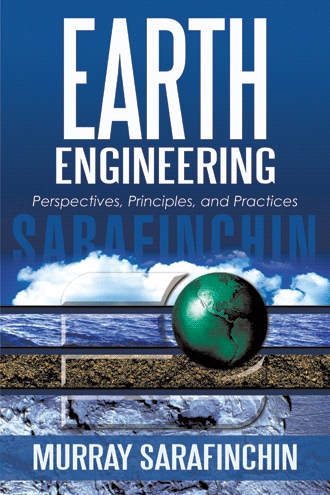
Today we are fortunate to have university textbooks and library references to benchmark various aspects of geoengineering. These secure a wealth of detailed information on engineering geology, geotechnical and geoenvironmental engineering, hydrology, hydrogeology, mining, construction quality assurance, site remediation practices, and related topics. Despite this wealth of information, we habitually encounter earthworks and geoenvironmental problems during engineering, construction and mining projects. Problems may develop in the field from incorrect decisions made during the feasibility, planning and technical design stages concerning project specifications and plans, or from schedule and budget constraints during the construction stages. These problems are commonly of a basic, fundamental nature rather than due to more esoteric causes. This book addresses some of the day to day matters encountered in geoengineering. As such, this book is not about theories and formulae in geoengineering. This book uniquely offers a geoengineering collection with stimulating overviews and enlightening insights to our dynamic Earth transformations. It focuses our thinking to a perspectives, principles and practices approach to the investigation, design and construction challenges commonly encountered in earth engineering and environmental sciences.
These chapters transcend several basic and specialty subjects. Earth formation including soil, rock and groundwater components plus classification methods is presented. Various earth structures and ground subsidence are described. Some specialties are specific geotechnical problems such as expansive clays, collapsible soils, and freezing effects that cause distinctive problems in design, construction and service life. Included are helpful chapters on contamination and remediation, geotextiles, landfills, global warming, health, law and ethics.
The objective of this geoengineering sciences reference book is to provide perspectives, principles and practices to understand common geoengineering problems in civil engineering, construction and mining. The intended audience includes geologists, engineers, architects, contractors, developers, regulators, planners, earth scientists, educators and students who must plan, design, build and operate projects with geomaterials, provide drawings and specifications for the work, and then provide onsite engineering reviews that must optimize earthworks. A theoretical treatment of the issues is deliberately avoided, so prior education in mathematics, sciences and engineering is helpful, but not required to make use of this technical reference book.
Due to the uncertainties of earth evolution, including non homogeneous and anisotropic subsurface conditions as related to engineering, construction, mining and environmental sites, it is always best to set a conservative geoengineering course respecting any uncertainties affecting loss of equipment, property damages and most importantly human safety. Consequently, this reference book will be useful to scientists, engineers, contractors and quality control/quality assurance personnel working with geomaterials. Most projects today require integrated multidisciplinary teams, and it is felt this reference book will prove useful to specialist educators, planners, designers, constructors and practitioners who must work with applied geoengineering and environmental sciences as part of their tools. The student studying geology, civil engineering, architecture, construction, mining and environmental subjects will find this book useful as a guide to the geoscientific background, actual field problems and their solutions, and as a supplement to more theoretical academic studies.
Geoengineering technology is implemented daily to further mankind in the quest for knowledge and sustainable infrastructure development. It is professionally gratifying to be a part of this progressive industry. Hopefully, the perspectives, principles and practices provided in this reference book will assist novices as well as the experienced to build even more upon past experience and to reduce the errors that bring us to where we are.
Whether being more comfortable onsite solving problems for clients or in the office writing reports about them, or sparing time in university libraries the compilation of this book has required an extraordinary effort over many years. Discipline to complete the work has prevailed partly because of my dislike for the confusion created by special interests, a passion to have geoengineering showcased for the prime profession it is, and the fact that it is an essential and rewarding first step for sustainable development in all civil engineering, construction and mining sites.
Formats


Book Details
About the Book
Questions about the Earth continue to haunt engineers. For instance: What do we know about our ancient planet? How should we be using it? And what are the best technologies and strategies to sustain us?
Earth Engineering provides the background necessary to analyze these questions as well as perspectives, principles, and practices to guide your understanding of geoengineering problems. Scientists, engineers, regulators, designers, constructors, educators and students will find this book especially useful when considering challenges tied to civil engineering, construction, and mining. Written in simple language, this reference guide covers many areas, including
• how the Earth began and developed over 4.6 billion years ago;
•
• how the Earth began and developed over 4.6 billion years ago;
• how to use site investigations to mitigate planning omissions and design errors;
• how to cope with variable subsurface strata and building challenges;
• how to approach geologic uncertainty and analyze problems on varying terraine;
• how to handle environmental regulations and legal considerations.
You will treasure this broad collection and overview of geoengineering perspectives, principles, and practices. Enhance your knowledge and troubleshoot common problems with the knowledge, tools, and strategies you will fi nd in the extensive repertoire of topics and concise illustrations in Earth Engineering.
About the Author
MURRAY SARAFINCHIN is a Professional Engineer, a designated Consulting Engineer and an Honorary Geotechnics Specialist licensed in Ontario, Quebec and Barbados. Since 1984 he has served as President and Principal Engineer of Sarafinchin Associates Ltd. He has more than thirty five years of experience and has worked on more than two thousand engineering projects throughout the world. He is a guest lecturer. After graduating in civil engineering at the University of Western Ontario and working throughout Canada and internationally, he received his graduate degree in geotechnical engineering from the University of Waterloo.