
Earth-Watching: A Seductive Pleasure in a Perfect World
by
Book Cover & Preview Text
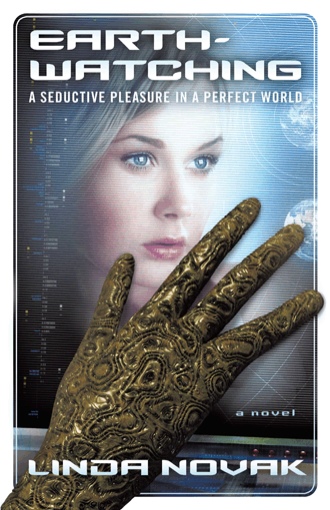
Kebeck was working with all four of his hands, trying to pry open a large juice container without spilling it, when he heard a buzz come from his computer. He placed the container on a shelf with one hand and with two others he simultaneously reached for a towel and clicked a key on his computer. As he wiped all of his big green hands with the towel he thought, good, she’s home. His computer screen came on just in time to see her enter the living room. He felt a surge of joy to see his Adeline, the Earth girl he had watched since she was a baby. He had been worried about her. She had taken it hard when she heard about the death of her friend Carol. He would also miss Carol. She had been good for Adeline and she had been an entertaining being to watch. He had been saddened by her sudden death. He wasn’t used to unexpected deaths. In his world most deaths usually were planned. There were, of course, occasional fatal accidents. But murders, they were extremely rare; he could not remember the last murder that occurred on Palala. Kebeck listened as she talked with Dalton about the missing files. These Earth beings have such complicated lives, he thought. But, that’s what makes them so interesting to watch. Many people in Kebeck’s world watched Earth beings for amusement, but his own interest was more serious than most. Kebeck and five of his colleagues had been assigned the job of studying the planet and the effects that Earth-Watching was having on the sociology and psychology of his fellow Palalans. His specialty was Earth ecology. It had all started around Earth year 1950, when a Palalan scientist developed a way of watching Earth beings through Earth television sets. It had been easy enough to tap into their radio and phone systems (some Palalans had been doing that long before Earth year 1950). Though people had been watching the Earth television shows since they were first broadcasted, the new invention enabled anyone on Palala to watch the Earth beings through any Earth television set or computer monitor, whether these were turned on or not. As long as the set was connected to a power source, they could watch and hear anything that happened in front of the screen. Soon, almost everyone was tuned in to Earth. Many Palalans learned to speak English, while some studied other Earth languages. The Japanese were a popular group to watch; some claimed that they were the most civilized of all Earth cultures. But most seemed to prefer watching the Earth beings located in the United States. They had more televisions, phones, and computers than most locations, and they seemed to be curiously uncivilized and spontaneous compared to the other developed areas on the planet. A light flashed on the corner of Kebeck’s screen. Someone was sending him a message. He clicked a button and the screen displayed a video message from a fellow he had met a couple of times at the Earth Museum. He couldn’t remember the person’s name; he talked to a lot of people at the Museum. “I thought you might like to view a live Earth execution. I have tapped into the video system at a prison in Texas and we should be able to view the government killing of an Earth being deemed too vile to live. It is to take place at 22:20 our time today. Please do not think that I in any way take pleasure in seeing any creature killed. But I am curious. It amazes me that a government kills beings to punish them for killing other beings. I find the concept of punishment odd. I guess we have been taught to think more in terms of logical consequences. But I must admit that the violence of the Earth beings intrigues me. Maybe it is because we have so little violence. Before I started watching Earth, I have never really thought of it as an option for handling conflict. It is unfortunate that Earth children are not taught conflict resolution methods. But then if they were like us, Earth television shows and the Earth beings’ ways of living would not be so very interesting. Recently, I have started to watch the interactions taking place at a bar in the city named Chicago. I am sure you know that a bar is the gathering place where Earth beings consume the liquid chemicals that free their inhibitions, but I had no idea of the purpose of such establishments when I first started watching it. I am growing quite fond of the bartender named Harold. From watching how he handles difficult customers, you would think he had taken some of our conflict resolution courses. I think also that ....” Kebeck stopped the video. He was in no mood to listen to an amateur talking about Earth-Watching theories. He had already spent enough time listening to his friend Sheme yesterday. She watched a financially disadvantaged family of dark-skinned beings who lived in an area called New Jersey and she was very upset because the fourteen-year-old male was injured by a metal projectile while sitting in his home. Many people got caught up in the lives of the Earth beings they watched. Though Kebeck himself tried to maintain an appropriate level of objectivity necessary for his research, he still had developed strong feelings of affection for his Adeline, a strange creature, so far away, that he had never touched or spoken to. Kebeck had watched Adeline’s birth. She was born in her parents’ bedroom, with a midwife assisting. Adeline’s parents had televisions in the bedroom, living room, and kitchen, so it was easy to follow Adeline’s life. The most difficult part was watching her mope and moan through her teen years. She got a TV in her own room when she was fourteen. He wished he could have talked to her when she was suffering through her teens. Unfortunately, communicating with Earth beings was not allowed. Adeline survived her adolescence and became a lovely, intelligent woman. Now, at age twenty-eight, she was going to marry. Kebeck had watched her date some young males that he found to be lacking the intelligence and consideration that she deserved. He very much approved of the male she had now selected to marry. He enjoyed watching them together. This male was thoughtful and loving towards her. He pleased her sexually. They laughed a lot together. Kebeck saw no reason why he would not be a good husband for her, and maybe the marriage would last until they died. People found it strange that some Earth beings promised to live together until death. The custom for Palalan couples who wanted to procreate and raise a young one together was to sign a twenty-year contractual agreement. Each female is allowed to bear two children during her 300-year life span, so most people spent the majority of their lives unmarried. Few people stayed together most of their lives, though occasionally a 200-year anniversary was in the news. Most people simply found it difficult to partner with one person for such a length of time. With their centuries-long life expectancies, Palalans normally had different partners at different stages of their lives. Though Kebeck thought fondly of his two contractual partners and one unofficial partner whom he had lived with during his 156 years on Palala, for the time being he did not desire another partner. There had been unpleasantness when it became evident that he no longer enjoyed the company of his last partner. Still, he had two friends that he enjoyed occasional sexual stimulation with, and his male friend Yerf had shared his house for the last few years and Kebeck found him to be good company. So marriage for life seemed like a silly idea to most Palalans. Nevertheless, from watching the Earth beings it was apparent that long marriages seemed to be desirable to them. It also appeared that their ability to deceive was a positive factor in maintaining a long marriage. Kebeck had watched Adeline’s parents as they interacted. He could see by their actions that although their affection for each other ebbed as they got older, they both seem
Formats

Book Details
About the Book
Earthlings as entertainment? The people of Palala are bored. The planet's an ecological utopia with no violence and little conflict. They watch the antics of those crazy Earth beings with amusement and horror, and are fascinated by the cultures, religions and governments of our flawed planet. Some people have become emotionally connected to the Earthlings they watch. When groups of Palalans start to emulate the Earthlings, and one Palalan get too involved in an Earthling's life, there's problems in paradise. It's a murder mystery and a clash of cultures intertwined. Murder,politics,religion and a few laughs.
About the Author
Linda Novak lives in St. Catharines Ontario Canada, but now spends much of her time watching the clouds glide over the ocean in Akumal Mexico. She has written for TV and radio news and local magazines. After a lifetime of reading sci-fi, she has penned her first book.