
Brooklyn Roots
A tale of pickles and egg creams
by
Book Cover & Preview Text
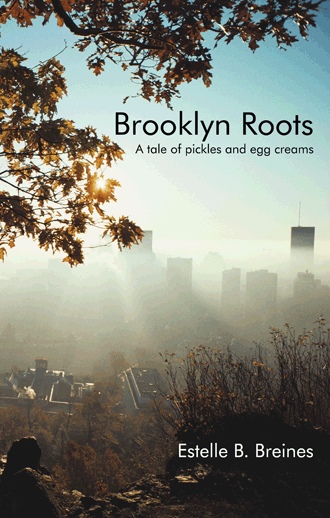
Then there was a tree in Brooklyn reaching up from the ground, its branches nearly touching the window of my small bedroom in our apartment on the fifth floor. It was one of many tall trees in this residential city neighborhood, rising above the classic single family homes with wide front and side yards that stood side by side with the elegant high apartment buildings of this handsome neighborhood. The families who lived there worked and played in the shade of these tall and beautiful elms that stood proudly on either side of the wide streets.
Dad’s new store, a pharmacy in which he partnered with a distant cousin, was at the corner of 51st Street and 13th Avenue. The store had a great round maroon and cream-colored sign with a clock embedded in it that swung from an iron armature that hung diagonally above the corner of the building over the doorway so it could be seen from all four directions as you approached. The sign read Heyman’s, the name of the original owner of the drug store.
Inside the store was a soda fountain that the new partners removed soon after they purchased the business, making more room for shelves on which they could display cosmetics and over the counter merchandise so they could generate more sales. The loss of that soda fountain with its spinning chairs was a great disappointment to me, as I loved to play on them and enjoyed the delicious goodies that came over the counter to me from time to time. When I complained my father explained to me that the soda fountain was not profitable, in terms that I could understand. Daddy knew best and I got my sweets elsewhere. There were other vendors of sweets nearby, one on 50th Street and one on 52nd Street and more still further along the avenue.
At the rear of the store was a sales counter where customers discussed their health conditions or personal needs in privacy with the pharmacist. In those days the pharmacist was invariably a man regardless of where one sought such advice. Women worked only in hospital pharmacies then, which is why Daddy discouraged me from studying pharmacy. He understood that women did not experience equality in that field at the time.
Still further back in the store behind a glass window was the counter on which prescriptions were prepared. At this counter Dad taught me at an early age to shake the bottles properly with one finger on the cap and my thumb and middle finger on the glass, before they were dispensed to the customers.
A wooden bench stood beside the entrance of the store along 51st Street where Grandma watched me play on the sidewalk nearby, supervising me when I called up to the neighbors’ windows from the street telling them to come downstairs to answer the phone in the drug store. I would ring the buzzer in the entrance hall of the building, then run back into the courtyard to yell up to them. “Mrs. Feldstein! Mrs. Feldstein! Telephone!” I cried out in my little voice until they opened their window and responded. Only some tenants had their own phones then so the drug store was message central for a number of the neighbors.
Borough Park was a busy neighborhood, spread out for several blocks on either side of 13th Avenue, the center of activity where all the necessities of life were available, and where the people strolled to see and be seen. The neighborhood had been gentrified in the late 1930’s by the construction of a public market on 42nd Street, built by the city to remove the pushcarts that up to that time had lined the streets on either side. Afterwards elegant shops were built and randomly dispersed along the avenue side by side with mundane sorts of merchandise so that people could meet their various needs. Food, furniture, books, clothing and every other item were available here so the residents of this middle class neighborhood could shop without venturing beyond its streets.
Sprinkled about our neighborhood were various religious institutions. Some were small, some were large, but each had its rituals, and each its days of observance. The yeshiva, a school with a large open concrete yard running between 50th and 51st Street along 13th Avenue was surrounded by a high black wrought iron fence behind which the children played during recess. This was where the Orthodox boys studied their subjects in English in the morning and in Hebrew in the afternoon.
The yeshiva stood directly across the street from the Episcopal Church, a one story building half sunken below ground. The priest’s youngest daughter, my friend Ellen, served as the shabbos goy for the Orthodox Jewish families on their street, enabling them to fulfill their religious observances. She turned their electricity on and off on the Sabbath and holidays, a task restricted to gentiles. It is a sin for one Jew to ask another to violate a religious law.
Churches of various denominations were scattered throughout the neighborhood. They were full on all occasions, but the days of first communion were the most thrilling for everyone. All the little brides in white garnered everyone’s attention, generating envy from the Jewish girls who would have to wait for their wedding day to wear the veil.
Just a few streets away the elevated train ran diagonally through the neighborhood cutting a noisy swath along New Utrecht Avenue, shading the shops below. Under the “el” was Luigi Alba, the fine Italian bakery where our family bought delicious and elaborate birthday cakes, Dad always ordering them with white and chocolate custard filling between the layers. A few feet away was the Chinese restaurant where the unobservant Jews went to celebrate the holidays by eating egg drop soup and chow mein with crispy noodles and white rice, with canned pineapple presented with toothpicks for dessert, their choice of menu limited by their uneducated palates.
On the corner diagonally across was the beautiful art deco Loew’s Boro Park theater with a vaulted ceiling where double feature movies played each day and evening, except on Saturday mornings when special features were added for the neighborhood children who came in droves to watch their favorite heroes escape danger week after week in serial adventures.
Along New Utrecht Avenue the West End train transited between Coney Island and Manhattan, connecting the heart of the city with Brooklyn’s favorite recreation area. The train took the residents of our neighborhood in either direction, but during the summer months the youngsters went to and from the beach for a day in the sun visiting places like Washington Baths, Steeplechase, an amusement park, and Nathan’s Famous, the mecca for hotdogs and other delicious treats. Adults went to their jobs in the city each morning, returning home each evening at dinner time, the crowds of commuters emerging en masse from the train, filtering down from the station platform into thinner and ever expanding lines resembling a stream of ants, as they marched off in different directions toward their individual apartments to eat.
Just across the street from the pharmacy on the opposite corner was a grocery shop where we purchased milk, canned vegetables, packaged bread and other food items which the grocer retrieved with a special long tool he used to grab the customers’ items from the high shelves. We bought our bagels and cake from Ebinger’s bakeshop where Dad got delicious jelly doughnuts for Sunday morning breakfasts. We had a supermarket, the A & P, on New Utrecht Avenue, but most people shopped at the specialty stores along 13th Avenue.
Formats

Book Details
About the Book
Brooklyn Roots is the story of Estelle Breines’ experience growing up in Borough Park, but it will resonate with anyone who grew up there, or for that matter, in any other urban, ethnic neighborhood. She paints word pictures that take you back in time, evoking the scenes, scents and sensibilities of the old neighborhood.
—Leslie Werstein Hann, writer/editor, HannWriting Inc.
Once stirred, those memories rolled out in bursts, demanding recording. A description of the neighborhood of her youth emerged: her father’s pharmacy, shops along the avenue, and the house with its magnificent purple irises peeking above a stone wall as tall as a four year old. A small garment is remembered in detail: a doll‘s dress made from an old pillowcase, using a needle encrusted by baked on grease from the stuffed chicken necks her grandmother prepared; this the woman who braided the author’s hair so tightly as surrogate parent while her parents worked to provide for them all in an era emerging from the Great Depression. There was the school she attended when the war began, and the celebrations at its end, and the places she and her friends explored as they grew. Her recollections of the neighborhood’s artifacts appear as she envisions pickles and egg creams. Each shop along the 13th Avenue of her memory is sustained in its original character, even the corsetiere and milliner of the past, stuck there in time.
About the Author
Raised as an only child, Brooklyn had a strong influence on the author’s life. She was a child between eras, growing up before women were viewed for their full potential, in a family who imbued her with a respect for education and a sense of independence she drew upon to strengthen her love for an expanding family: her husband of 54 years, three children, and nine grandchildren. Her career as an occupational therapist, businesswoman and educator drew from these influences. Living on a farm in western NJ, Dr. Breines now takes time to write, having produced several books, chapters and an ongoing column published since 1994. Brooklyn Roots is the first book she has written about herself and her family.