
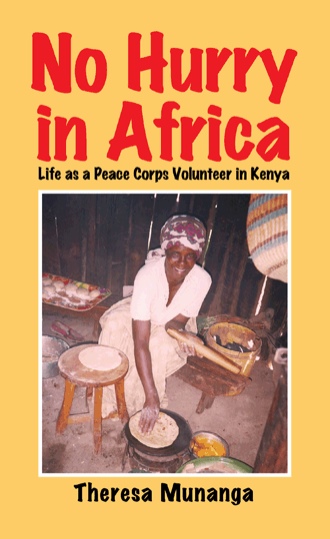
No Hurry in Africa
Life as a Peace Corps Volunteer in Kenya
by
Book Cover & Preview Text
Chapter 1: Training in Kenya
August 27, 2004 – We’re in Kenya! We have shillings now, but can’t spend them until we know where to go. I mainly just want to buy postcards and clothes right now.
Just before we received our immunizations in Nairobi, our group was robbed. We had all been in a room together and went outside for a break, with a few people remaining in the room to finish their tasks. A well-dressed Kenyan woman went through our bags and purses and stole money and credit cards. Luckily, my bags were still in the truck and I had taken my purse with me on break. One of the Peace Corps nurses ran after the woman and shouted to the guard at the gate that she was a thief and not to let her out, but he just opened the gate for the woman and let her out! We’re now wondering if the guard was “in on it.”
We learned today that we can’t take pictures of people in uniform or of government buildings. Also, if we’re nearby when the Kenyan flag is being raised or lowered, we have to stand still. Apparently, if we disobey these two rules, we can be arrested.
I found out that Kenyans pronounce “Peace Corps” as “Peace Corpse.” I want to laugh every time I hear it! It’s just that Kenyans pronounce every letter in a word.
August 28, 2004 – We’re starting to learn Kiswahili, although pole pole sana (very slowly). We can now say basic greetings (which are very important here in Kenya), give our names/ask other people their names, and say where we’re from/ask others where they’re from. Practice is what helps us the most, but I need to be able to see the words written in my mind in order to remember them – which, apparently, makes me a “visual learner.”
Tomorrow we have a language class, a class on safety topics, and then information (and a trip) on our supposed area of expertise (which, for me, is “small enterprise development/information communications technology”).
AUGUST 2004 NEWSLETTER:
Hamjambo, everyone! I made it to Kenya and found a few minutes and a free seat at an Internet café in Naivasha, so I thought I'd drop everyone a line. Sundays are our only days off.
I have a cold (which started the day I left Kauai), but am otherwise well. I am eating well and drinking safe, treated water. We're learning a lot, especially the language and culture. Tuesday we leave to stay at our individual “home stays” – one trainee per family. Our training group has been broken down into small classes (four students per class and teacher) to learn the language and our classes will be “clustered” together in separate villages. My teacher’s name is Mugo. We will spend seven weeks with our host families and our teachers will take a matatu< (a="" taxi="" bus)="" out="" to="" us="" to="" teach="" us="" more="" kiswahili="" and="" to="" help="" us="" do="" some="" kind="" of="" community="" training,="" like="" a="" project="" of="" some="" kind.="" i'm="" both="" nervous="" and="" excited.="" after="" tuesday,="" i’ll="" see="" just="" my="" fellow="" sed/ict="" (small="" enterprise="" development/information="" communications="" technology)="" trainees="" until="" we’re="" sworn="" in="" as="" volunteers="" in="" october.="" that’s="" because="" the="" other="" trainees="" are="" being="" housed="" with="" families="" in="" other="">
I tried not to have any expectations of what Kenya would be like before I came, but it is certainly different than America. My biggest surprise was seeing all of the trash on the ground everywhere. There’s no trash pickup, so I suppose the trash has to go somewhere.
The Kenyan Peace Corps staff makes us practice our Kiswahili with them every time we pass one of them (like in the dining room, while out walking, etc.). They really know what they're doing, having had Peace Corps Volunteers in Kenya for forty years now.
Even though it is strange and hard, I think this is probably one of the best things I've ever done in my life.
In Kenya, at least during the time I served, home stay families were chosen from rural communities. The Peace Corps staff member who placed our training group, Ezekiel, told me he looked for middle-class families in clusters of four to five, within about an hour’s walk to a small town. He said he chose the homes first, then approached the head of the family and asked them if they would be willing to host a Peace Corps volunteer from America. He deliberately did not mention money, because he wanted the families to host the volunteers because they wanted to, not because the volunteer would be a source of income. Most families agreed to host volunteers either because doing so would increase their status in the community or because they were simply curious to learn more about America – or for both reasons. Only after the family agreed to host the volunteer did Ezekiel say to them, “Oh, by the way, Peace Corps will give you a little money to help pay for the groceries the volunteer will eat.”
September 3, 2004 – I love my home stay family. What I don’t like is not being able to bathe when I want to (which might, in certain circumstances, mean skipping a day), not being able to sleep in if I want to, and not having my own bathroom – to use and to clean to my own satisfaction. I’m not complaining; one of the other trainees went home the other day and I’m not even close to wanting to leave. Yet. (After my home stay father, Baba Muchiri, heard about the trainee leaving he said, “I hope you’re a fighter – I don’t want to see you leave!”)
EARLY SEPTEMBER 2004 NEWSLETTER:
Hamjambo tena! (Hello again!)
I'm living with a “home stay” family in a tiny village called Githunguri, where it takes my three classmates and myself one and one-half to two hours to walk to the center of town, where we meet our other classmates for community training. Our language classes are held in the home of one of my three classmates. My home does not have electricity, and the kitchen, bathing room and choo (an outhouse; pronounced “cho”) are all in separate buildings. My family is wonderful: I have a baba and mama (father and mother – who are about my age, by the way), two brothers, ages seven and four, and a ten-day-old sister. All of the community members have welcomed us warmly and they appear to absolutely love us being there. (This is the first time Peace Corps has placed trainees in homes in their area.)
The reason I can send this email today is because I arrived in Kenya with a cold and with our rapid training program and constant hard work, I haven't been able to get over it. I had to come to Nairobi Thursday afternoon to have an X-ray yesterday morning, which was negative. I'm going back home to Githunguri this afternoon; with some cough medicine and strong instructions to rest.
LATE SEPTEMBER 2004 NEWSLETTER:
Hamjambo tena! (Hello again, everyone!)
I'm writing this in the town of Tala, in the Eastern Province of Kenya. I'm doing my “future site visit” – visiting the people and place where I will live for the next two years, starting in about five weeks.
Everything is moving along so quickly and our training and homework assignments continue at a furious rate as well. I'm doing my best to keep up and I'm having a lot of fun doing it.
I arrived in Tala on Saturday and will be here until Thursday. Then I will return to my home stay family in Githunguri for the remainder of my training, making several matatu (a combination of bus and taxi) trips into Naivasha for training at the Peace Corps training center. I think our swearing-in ceremony (from Peace Corps trainees to Peace Corps Volunteers) will be somewhere around October 22nd. Then I will move to Tala permanently (for two years).
Tala is an interesting town, about an hour's ride straight east from Nairobi. It is spread out over a few miles with most houses and businesses just off of the one paved road that runs through it between Nairobi and Kangundo. . .
Formats

Book Details
About the Book
Have you ever dreamed about joining the Peace Corps?
Unemployed and aching to really make a difference in the world, Theresa Munanga applied to serve as a Peace Corps Volunteer. When she left for her assignment in Kenya, she had no idea what the three years from 2004-2007 would hold. No Hurry in Africa follows the author as she teaches computer skills to Kenyans, some of whom have never seen a computer before, in areas where electricity comes and goes, and where four computers serve to teach up to forty students per class. Riveting journal entries and emails home introduce Kenya as a beautiful country, yet a country of contrasts: where people walk miles out of their way to direct you to your destination. Where men can have multiple wives. Where women wash clothes by hand and carry babies on their backs. A country with friendly, hard working people, but also a country with a lack of safe drinking water, poverty, corruption, and less than adequate medical services in the remote areas.
About the Author
Theresa Munanga served as a Peace Corps Volunteer in Kenya from 2004-2007. She holds a Master of Arts degree in Digital Media Studies and is currently a doctoral student. She lives in the Phoenix area with her husband.