
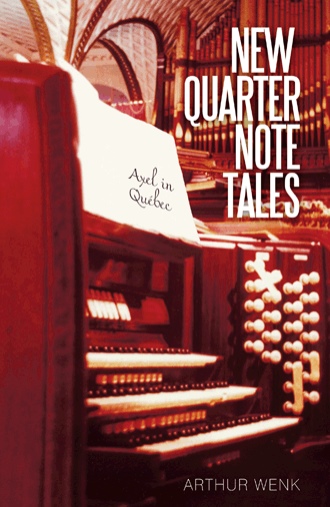
New Quarter Note Tales
Axel in Québec
by
Book Cover & Preview Text
A few months shy of my fortieth birthday I found myself teaching music history at Fleur de Lis University in Rochambeau, Québec: a new country, a new culture and a new language. Especially a new language. Memories of my initial visit to the university, six months earlier, remained something of a blur, so concerned was I with trying to make a good impression on the Search Committee members who served as my hosts and guides, so in order to orient myself I asked a student to direct me to the library. “Pouvez-vous me dire,” I asked, “où se trouve le bibliothèque?” She kindly and subtly corrected me by saying “La bibliothèque est là, après la tour à gauche.” I half-expected her to exclaim, “Le bibliothèque? Le bibliothèque? Send for the grammar patrol and take this poor idiot away. He can’t even keep his articles straight, for God’s sake! What are they letting past the border these days anyway? Shoddy quality control if you ask me.” And were I to confess that I was Axel Crochet, a new professor of music history, I anticipated a disdainful response. “Professor? You? Don’t kid me! What can you teach anyone here and say le bibliothèque? No way are you going to teach here. Yes, here he is, officer. I’m glad you arrived quickly. He’s already contaminated the language enough. Take him away and deport him.” Eventually I traced a path to my office in the École de Musique, located in Pavillon Desjardins, the most distinctive building on campus, a Monty Pythonesque version of a chapel, built during the 60s to hold hundreds of Jesuit priests in training, then sold to the university at fire sale prices in the late 70s after the Quiet Revolution saw the decline of church influence in the province. Students graduating with advanced degrees in musicology went on to teach in music departments across Canada; those in music education taught in secondary and primary schools; no one knew what happened to the performers. My office on the fourth floor had been constructed by tearing down the wall between two cells in the erstwhile seminary, providing ample space for several bookcases and a fair-sized desk under high windows admitting sunlight but no distracting view. Rochambeau being a tourist as well as a university town, I encountered a variety of responses to my efforts to speak French with the Québecois: 1. They spotted me as a foreigner from my first sentence, addressed me in English, and refused to budge. This happened only in the tourist district and felt rather insulting. 2. Their English was better than my French. If I made even a simple request to repeat a remark, they switched immediately to flawless English and refused to budge. 3. They maintained French no matter what. This produced the best learning environment for me. They’d repeat their remarks more slowly if necessary and help me with vocabulary, but always in French. This happened when I opened two bank accounts and purchased a mattress. I couldn’t pretend to understand everything the salesman was saying, but when you order Sears’ best you have a pretty good idea what you’re getting. Renting an apartment also took place entirely in French, requiring a fair amount of patience on the part of the locataire. 4. They spoke English but returned to French when I persevered. This happened while getting directions on which bus to take. (The number eleven bus ran to the university from an intersection near my apartment. On several occasions I heard passengers remark on the approaching vehicle, “Bon, v'lâ la onze.” This bothered me because the noun autobus is masculine: surely it should be “le onze.” Finally I checked this out with my colleague Valéry Turgeon, a musicologist from Geneva. He simply shrugged and said that Quebeckers thought that the word “bus” was feminine.) 5. I just plain chickened out. In the tourist district everyone spoke English anyway, so I just made like another dumb American. I can’t say I was proud of this strategy but sometimes the burden of living in a different language simply became too heavy to endure. Valéry Turgeon, as a non-Québécois francophone, proved to be an excellent friend for a stranger in a strange land. A shock of silver hair, brushed straight back in the style of conductor Herbert von Karajan, gave him an air of masterful authority, frequently undercut by a boyish grin. Each morning Valéry would wander into my office with an infectious “Hey, man!” (in English), would listen sympathetically to my latest tales of woe in wrestling with the French language, and then ask my advice about some arcane English metaphor that he wanted to incorporate into a paper he was preparing to read at the November meeting of the American Musicological Society. I would exclaim in disbelief that the only way to say “what we need” in French is “ce dont nous avons besoin.” He would just smile and say, “That’s the way it is.” Then he would proudly show me a sentence using the phrase “run with the hare and ride with the hounds” that he’d found in his French-English dictionary, and refused accept my insistent opinion that no contemporary English speaker would ever use it. The closest substitute I could come up with was “kill two birds with one stone,” which he found unappealing. Musicologists probably have no monopoly on the sadistic practice of assigning whatever courses nobody else wants to teach to the “new guy.” They typically excuse the practice by saying, “Perhaps he’ll be able to make a go of it,” a breathtaking exercise in wishful thinking. In the fall term my teaching responsibilities included the exquisite frustration of “La Méthodologie de la Recherche.” Masters degree candidates in performance – that is to say, most of them – were required to submit an essay. Some students were better equipped for intellectual activity than others, and one imagines that the negotiations in writing the requirements rather resembled the haggling between Abraham and God over the fate of Sodom and Gomorrah. You remember the story. God got so fed up with all the wickedness and corruption in the Twin Cities – they had pornographic movies and massage parlours and child molestation and people coveting their neighbours’ asses and idol worship and punk rock and toxic waste and drug addiction and MTV and who knows what all else – that he decided to destroy them. Abraham pleaded with God saying, “What if there be fifty righteous in the city?” (They knew how to use the present subjunctive back in those days, so Gomorrah University must have had something going for it.) “For fifty righteous, I will spare the city,” was God’s reply. “But what if there be only forty-five righteous?” Abraham kept at it and finally got God down to ten righteous people. I imagine that the Curriculum Committee must have functioned somewhat along these lines. The original requirement called for all instrumentalists to write an essay of some length illustrating their ability to present and solve a research problem. Then the violin professor, let us say, thought of his star pupil and asked, “What about students who can’t write an essay?” So a second option was added – an instrumental recital of thirty minutes accompanied by a brief essay explaining the choice of these pieces, their interrelationships, style, historical context, et cetera. But the clarinet professor still had his doubts. “What about students who can’t write even a brief essay?” So a third option was added – an instrumental recital accompanied by an oral presentation. But even this requirement was found to be too stiff – what about students who can’t express themselves orally? So a final option was added: the student would play a thirty-minute recital then answer questions posed by the jury. After reading the first disastrous essays, the committee added a further requirement – the semester before undertaking the essay, a student must submit a projet d’essai explaining the historical context, problématique, objectiv
Formats


Book Details
About the Book
New Quarter Note Tales presents a collection of three new novellas featuring Axel Crochet, peripatetic professor of music history.
“A Faculty Affair”—As the new professor of musicology at Rochambeau’s Fleur de Lis University, Axel stumbles upon a colossal cover-up when he discovers a letter suggesting that the efforts of his predecessor to move the School of Music from the Faculty of Arts to the Faculty of Letters may have had fatal consequences. “The Music Man Mystery”—As director of a production of The Music Man in Rochambeau, Québec, Axel has to make changes when the leading man dies a few days before the performance. Although the police rule it an accident, cast members mutter about suicide. Then, some information suddenly appears that makes murder seem much more likely.
“Fire and Ice”—When fire breaks out at the tiny Galton School, claiming the life of one of its students, suspicion falls on a known pyromaniac. Then, the bursar breaks her neck on the icy front steps. Axel, the school’s music director, discovers financial records—stuffed inside a hymnal and concealed in the chapel piano—indicating that these accidents may have been murder.
About the Author
ARTHUR WENK has published books and articles on Debussy, music and the arts, music history and bibliography, and the bookstores of Toronto. Wenk’s teaching career has taken him to southern California, Boston, Pittsburgh, Québec City, and southern Ontario, where he has served as a church musician in addition to his academic duties.