
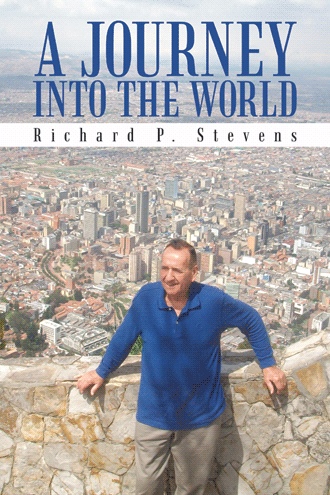
A JOURNEY INTO THE WORLD
Reflections of an Itinerant Professor
by
Book Cover & Preview Text
En route My first glimpse of Africa came the next day on a brilliant Sunday morning as the South African Airways flight made its way south from Cairo to land in Khartoum for refueling. Stretching below was the Sahara and then the rolling, tree-pocked savannas cut by the Nile as it meandered north to the Mediterranean from Ethiopia and Uganda. Upon landing we parked near the terminal where I could see the airport viewing balcony filled with white robed, turbaned men in their jalabas and imas, intermingled with brightly clad women in a rainbow of colored toabs. It was a festive crowd which, I was informed, showed up typically on Sunday mornings to view the South African 707 as a major weekly attraction. With considerable regret at not being able to get off the plane in the absence of landing rights, the image of Khartoum remained as a thrilling introduction to a continent which, far from being "the dark continent" stereotype, reflected brilliant sunlight, vivacious faces and wide open spaces. Sudan was a country I would want to know, a country to which I would return twelve years later and which remains to the present a constant in my life in the most profound personal way. A Perilous Mission: the "underground railroad" Accordingly, before dawn on a designated day, our landrover-type vehicle made its appearance in Maseru and was boarded in great secrecy. The presence of South African spies in Basutoland was well known and a few Africans were in secret police pay; arrangements required utmost caurtion. With nine men stretched out side by side on a few blankets, and with several blankets available for a quick cover we were off. While I drove, with Peter in the passenger seat beside me, we crossed the Caledon River into South Africa without inspection. Having plotted the least traveled roads of the Orange Free State and the Transvaal it would take two days to reach the Bechuanaland border near Lobatsi. En route, driving shifts were arranged, whereby Peter and I, when not driving, exchanged places with one of the fellows in the back so that each would occasionally have a relief from the numbing bumps of the unpaved roads. In practice, however, this meant that Peter and I probably spent as much time in that situation as our African friends since we changed drivers every two hours or so. Kuwait University and politics Respected by the Al Sabahs, an admirer of western style democracy and supporter of human rights, as rector Dr. Hassan was a lightening rod attracting frequent personal and political attacks. Most of these attacks and accusations were first raised in the local newspapers. But in the absence of meaningful libel laws the Rector seldom saw fit to draw further attention to the matter by a public rebuttal. To the extent that the Rector attempted to develop a more professionally qualified and competent group of academic administrators, some few within the University turned to outside religious connections to attack the Rector or the administration.
Formats

Book Details
About the Book
Whether it be understanding inter-cultural living or differing aspects of Islam, racial complexities of the Americas, contrasting political systems of Africa or the importance of good teaching and library usage, a message is to be found in this Journey into the World.
From high school through university to confrontation with racism in USA, Africa and Latin America, in opposition to religious and political fanaticism worldwide, Prof. Stevens continues his support for indigenous and marginalized peoples wherever life takes him; from teen age dissenter to university professor and international businessman, a sixty year JOURNEY INTO THE WORLD, together with his extended international families, has touched the lives of hundreds.
About the Author
From high school through university in confrontation with religious and political fanaticism worldwide, Prof. Stevens continues his support for indigenous and marginalized peoples wherever life takes him; from teen age dissenter to university professor and international businessman, a sixty year JOURNEY INTO THE WORLD, together with his extended international families, has touched the lives of hundreds.