
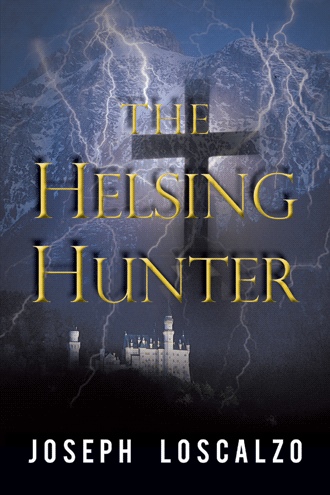
The Helsing Hunter
by
Book Cover & Preview Text
Jake spread his wings and allowed the current of wind to flow over and under them, keeping him aloft and soaring toward the looming spires of the castle. Below him, he could see the narrow, winding road he had been driving upon when he had first entered the foothills of the massive Carpathian Mountains. As he closed the distance between the valley and the Castle, he noticed some of the more historical landmarks made famous by Bram Stoker’s depiction of the area in his fictional novel Dracula. Among the landmarks, and perhaps the most famous along those roads, was the Borgo Pass, the point at which the stage had refused to go any further, and Dracula’s coach had picked up Jonathan Harker. Alone, in the gloomy daylight, the pass did not seem as foreboding a place as described in the novel. But then, no vampire was lying in wait there for an unsuspecting invited guest. Jake circled the pass a few times thoroughly enjoying the sensation of flight; he beat his wings and darted toward the gray, jutting spires of the castle. The luster of daylight seemed to dim as he drew ever closer, as if the place itself was casting such a massive shadow it blotted out the effect of the sun. The castle, it seemed, existed in perpetual darkness. Jake had learned from Roman that there were certain myths pertaining to vampires, and certain verifiable facts. Separating the two had been a major portion of his training, and accepting, as facts, things he had previously thought impossible for vampires had been a difficult transition. A vampire, he had learned, would not be consumed in flame if touched by sunlight. The fact was, many vampires walked among the living during daylight hours, oftentimes undetected. None, it seemed, were daring enough to hunt or feed during the day. Vampires were, indeed, weakened by daylight, and vulnerable to being slain by more than the standard weapons. While a gunshot would not kill, nor even wound, a vampire at night, that same shot could prove fatal in daylight. The vampire, also, would lose its ability to shape-shift during the day. If the day broke while a vampire was in the form of a bat or wolf, that vampire would have to remain a bat or wolf until the setting of the sun. Because of their various vulnerabilities, most vampires chose to sleep during the day and stalk the night, when they were most powerful. Out of this preference, the myth that daylight would slay a vampire had grown. Jake knew he could not count on daylight to be the ally it was to vampire hunters in fiction. And with the perpetual darkness surrounding the castle, he wondered if the vampire within would even be in a weakened state when he entered. He also wondered how many minions he would encounter before facing the Master of the lair. As he neared the castle, the gray gloom became more oppressive, growing almost as dark as night. Snow began to fall and a chill wind blew through the frosty air. Below, a soft blanket of white powder covered the land, contrasting to the dark, dirty spires of the distant castle. He noticed a change in the animal life, as well. His sharp hearing, once picking out all forms of animals rustling, foraging, and hunting in the brush, now could hear only the howling of wolves ululating through the air. The valley had long since given way to jutting cliffs that met the winding road leading to the castle. Soft blue flames flickered a short distance away, but when he flew over the site, they were gone, appearing in another location. Jake began to feel the fatigue of flight, so he stretched his leathery wings and glided through the currents of the wind. Finally, he passed the crooked, rickety gate, flew over the dry moat, and landed at the entrance to the old, haunted castle.
Formats

Book Details
About the Book
Illusion rules our reality. Behind that illusion, unprecedented evil lurks in the darkness. A chosen few have been targeted by a vicious vampire intent on becoming the antichrist. Their deaths mean the advent of the apocalypse. In the small town of West Harbor, New York, Sheriff Jake Petrillo must overcome his doubts, regain a lost faith, and accept the truth of his heritage. He is from a long line of hunters blessed with special powers to preserve the balance of good and evil. Only in accepting his heritage can the targeted be saved, and the apocalypse avoided.
About the Author
Joseph Loscalzo has a bachelor's degree in English from Queens College, where he penned a prize winning play. His short stories and poems have been published in numerous magazines and anthologies. This is his first novel. Joseph lives in Levittown, NY with his wife, four children, and his dog.