
Twenty-Five Absolute and Undeniable Truths About Texas Hold’Em
It’s Texas Hold’Em in a Nut Shell
by
Book Cover & Preview Text
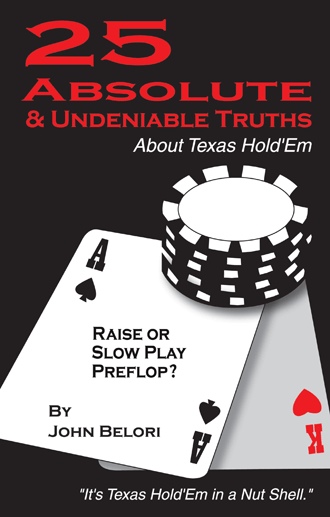
A Prelude: It’s my explanation as to why I have the audacity to think I can give you a different perspective about the whole game of Texas Hold‘Em. One better than that portrayed by many authors whom I have read in their countless books and articles on the subject. I am so happy and appreciative that their work is readily available from which to learn and also to be critiqued. I’m an analyst. My whole career has been focused on determining how the whole of anything e.g. a procedure, a program, an action, an operation, a system, a project, or a function is affected by each of its constituent parts and what’s required to get a desired result. Poker is a game which can be categorized as one of the above. It’s an operation of many actions by individuals whose ultimate objective is to execute them (the actions) most effectively in order to show a profit. It’s the same goal of any business or organization in producing and selling a product or a service. Incidental to my experience as an analyst, I played poker most of my life which also helped make this task a little easier. I played poker since I was ten years old. I was in a home then for young boys and girls (The Sons of Italy). We played for kisses with the girls. As a teenager, we played for pennies in the hallways of our neighbors homes. We also played in the basement of a dance hall when I was in high school. As a young adult I played in the CCC (Civilian Conservation Corp.) during the great depression. We were in a Camp off the shores of Lake Ontario and played mostly in the winter time when hemmed in under 20” of snow. I played on board the ship on our way to North Ireland where we were stationed before “D” Day. While in North Ireland we played endlessly during the several months of darkness they have there each year. I remember luckily winning $3,000 in a winner take all game with five other shave tails waiting for those months of daylight to come around. It was an endurance match because we did not have any forced or increased antes. After the war, I played with fellow employees every Friday night taking turns in each others’ homes. Most of the games played on these different occasions, were either Draw Poker or Seven-Card Stud. When Texas Hold ‘Em exploded on the scene, I became curious because of the nature of the game. Pots seemed larger and the game simpler to play. Since I retired, I played in a variety of ring games (see glossary) with all kinds of players. I tried limit and no limit tournaments. I was a little lucky in the former. After all the time playing in ring games, however, I was only able to win at a break even level of return (BELOR,) a word I coined and use throughout this work of art. I wondered whether it really was possible to win above that level. I also had my doubts about assumptions made by some individuals who claim to be professional players. So, primarily to benefit me, and to make the complex simple, I decided to do the research and analysis that resulted in the following 25 Absolute and Undeniable Truths. When I set out to do my research and analysis, I concentrated intensely to determine the simplest and most effective way to win playing this game. I had no intention to create a 300 page monstrosity with the inclusion of unrelated and insignificant material in that effort. Shakespeare said, “Brevity is the soul of wit.” Brevity is also the essence of truth. For those of you who are beginners, the glossary is an adequate source explaining the basic rudiments of the game. Throughout these truths, I have included the most powerful and useful facts which I siphoned off from the best authors’ literary masterpieces and added my own logic to them. I condensed it all into a method on how to play Texas Hold’Em to get a positive return. I call it ROTE LEARNING, a method I learned and taught as an instructor in the military, in which almost everything is taught and learned by the numbers! I know, I know, I can hear all of you loud and clear, “Texas Hold’Em is too complex to be learned and played by rote.” You can develop a system with specific criteria, learned by rote, to implement effectively any category listed above to get the best results. In Texas Hold’Em, experts have done just that! They have established and described: 1. Excellent starting standards in their tables and lists that must be learned by rote to be successful (see truths #9 through 13). They include the limited number of pocket card combinations to play to be successful (approximately 69). 2. Precise actions based on tangible facts, to be taken, for post flop (see glossary) play. They also must be learned by rote to be successful. They include: a. An assessment of the flop in relation to one’s pocket cards on whether to check, bet, raise or fold. b. Opponents’ actions on the flop. c. One’s own outs (see glossary) and those of his opponents. All new theories, systems, inventions, etc. are created from ideas (whether good or bad) that already exist in the universe of ideas. When players are bombarded constantly in all media (whether to confuse intentionally or not) that it’s necessary to add intangibles to the mix, as mentioned in 2a above, i.e. opponents’ table image, tells, potential pot odds etc, etc., it becomes very difficult to make good decisions because, “A lot of guessin’ is goin’ on, out there.” If you flip a coin, over time, a head or tail will come up 50% of the time. Guessing over time probably will give you the same results, if you’re guessing against only one opponent. However, there are many hands in which you will be guessing against more than one opponent. So why engage in such hocus pocus. Make the game more simple and pleasurable (see truths #6, 7, & 8). Isolationism was a prevailing desire in the U.S. in the 1930’s and early 1940’s. When we were forced into World War II, we were devastatingly ill prepared to fight. Our military had to be expanded from hundreds of thousands of men to millions, fast! Rote learning was a method used to speed up their training. It worked then. It should work here. The criteria established in these 25 truths encompasses a system that if followed precisely will get you a positive return slowly and progressively. However, the poker environment is a little different than being in the military with its autocratic power. There’s no rush to beat the enemy. There are many free spirited people who resist attempts at becoming mind controlled robots. Many of them do not believe playing something like King-Jack, King-Ten, Ace-Nine unsuited, after a raise, results in a negative return in the long term. Therefore, many players, including most of you, are unteachable! You resist the temptation to learn the powerful information available in many books and articles on the subject. Most of you, if you play, do not have the discipline, stubbornness, emotional control, and patience required to play the game as it should be played. Most of you are psyched out as victims of mass indoctrination, being surrounded by bad players. You feel comfortable playing as you see others play, i.e. playing and winning with unacceptable pocket cards, etc. You mimic what you see. You become members of the bad players club. Now, if you see someone play my way, you’ll see one who doesn’t play many hands, is very tight, appears non-aggressive, generally has a poor table image, etc, not realizing he has a powerful, unseen preemptive plan of attack employed to win about an average 1 ½ pots per hour, which takes him over the BELOR! So, if you are tired of being in such a rut regarding your resistance to learn, and are ready to apply the effort required to win, lets go though these truths to see what further gems there are in them that solidify my theory.
Formats

Book Details
About the Book
Limit Texas Hold’Em is a simple game when learned and played by rote. This concept is contrary to a general notion that the game is too complex for such a system to be successfully developed and implemented. The poker elite in all media, i.e. literature, movies, the internet, etc, intensify and perpetuate the false premise that you need to know some exotic, strategic principles to play the game successfully. They also glorify that player who gets four Aces over his opponents’ full house or who won a major tournament as an exceptional strategist. Execute the criteria established in these truths flawlessly, and you will become an unheeded strategist! These truths are the shortest and simplest explanation of how to win playing Texas Hold’Em.
About the Author
John Belori has been an avid poker player and analyst his entire life. He graduated from Seton Hall University and worked as an administrator and analyst in the Department of Human Services for the State of New Jersey. He authored the creation of new standards of operations in the education social and health development of the mentally challenged in both the public and private institutions in NJ, to comply with federal and state laws. During World War II, Belori heroically served in the United States Army as a Company Commander in the famous 2nd Infantry Division and was awarded the distinguished Bronze Star Medal for unusual and exceptional ability in combat actions. Belori was happily married for almost 60 years and has four children and nine grandchildren. In his retirement, John enjoys being an anonymous, recreational Texas Hold’Em player; he plays mostly in Atlantic City and occasionally in Las Vegas, Reno, Laughlin and on Indian Reservations in several states across the USA. This is John Belori’s first and last book, as he believes he has revealed all strategic insight that needs to be known about the game of Texas Hold’Em.