
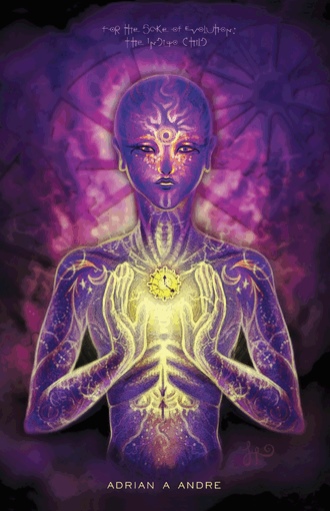
For the Sake of Evolution
the Indigo Child
by
Book Cover & Preview Text
...It was 1984, and Sue George and Megan White had just wasted countless hours arguing about, rather than discussing, whose facial features their hypothetical child would have. A typical conversation between the two would begin by one or the other consciously touching base on a topic they considered taboo. This would then lead to the two unconsciously instigating each other’s insight, which would then lead to the two subconsciously suggesting whose perception was better. This would then turn into a "friendly and playful" battle that, 80 percent of the time, would end in tension and hostility rather than leave the two breathless from a magical feeling lost in translation that would end in a genuine display of affection that also left their endorphins running. This, unfortunately, would only happen 20 percent of the time. Nobody could argue that these two individuals had many perspectives that clashed, but one would have to ask if the argument over what physical stats their imaginary child would have was merely a form of fishing for flattery. When the silliness was set aside, they genuinely embraced the idea of bearing a child of their own, yet they both agreed that now was not the time. Even the fact that these two were fresh high school graduates didn't interfere with their pediatric fantasy. No, it was the status of the United States that stood in between the twosome’s hopes for parenthood. The almighty US had spent a decade infiltrating continent after continent for the purpose of establishing a strong democracy by overthrowing the leader the foreign country had in command and replacing him with one they felt was supreme. To give the impression that a nation was not coerced, the US would encourage the country to hold an election rather than select a particular politician. However, news of America's influence in a rigged election or the hidden agenda behind selecting a certain individual to run office would eventually leak out. It was pretty difficult for the president and the upper echelon who commanded him to be discrete when their companies’ stock averages rose over the thousandth percentile weeks shortly after an invasion. It became blatantly obvious that America's top politicians were working for the elite’s private interest rather than its people's. That being said, the United States had attained omnipotent status and had become the self-proclaimed “World Police.” Team America had stationed over a thousand military base camps throughout the world, costing over a hundred billion dollars to maintain, yet the "home of the brave" would not allow a single country to set up camp on its own turf, deeming itself omnipresent. The US was so focused on foreign affairs that it had ignored the basic necessities back home. America had cut funds for educational programs, social security pension, and natural disaster relief, all for the benefit of what America had coined as “conflicts” and for homeland security. This resulted in the US spending a budget deficit-topping 1.4 trillion dollars, leaving the United States in a “recession.” And this was all after a series of “insurgent” attacks that a minority of politically conscious Americans considered to be orchestrated by the very government that claimed to be protecting its citizens due to mountains of undeniable evidence. A bill named the American act had been passed in relation to the attacks. It allowed the United States government to wire tap any communicational device, access the IP address of any computer’s internet provider to track which websites its “insurgents” stumbled upon, and even inform government agents what books the citizens in "the land of the free" chose to rent. In effect, America had achieved national omniscience. If the three main traits defining “God” are omniscience, omnipotence, and omnipresence, then America, the "nation under God,” had finally lived up to its name. "So what'll you say, baby? Will you marry me?" Sue spontaneously proposed on a glorious, sunny summer day. He had previously planned his approach involving the controversial conversation of conceiving a kid to engage her on the idea of marriage. The hidden intentions obviously failed. Instead, it left both of them hotheaded, yet he still followed through with the act. You could consider it blind faith, but either way, he had already been jaded by speaking on such a subject. He knew very well where she stood when it came to the topic of marriage. She wasn't a fan. Maybe it was because she only ever witnessed her father give her mother any affection when they were on holidays or when he had more than enough to drink. She firmly believed that marriage was a trite, overrated tradition, that the only reason marriage was kept alive was to preserve the puritanical values on which America was founded. Sue disagreed. He was conditioned to believe Holy Matrimony was the foundation of a long-lasting relationship. He never sensed any real romance in his parents’ relationship, but he did see commitment, which was his definition of love. Sue, anticipating her response on one knee, noticed a tear pour out of her cerulean blue eye and trickle down her cheek, only to drip off her chin onto the sweaty black velvet box in the palm of his right hand. After a brief moment of silence, she answered back with a, "No . . ." She was now drenched in tears. Once he heard her response, he clenched his jaw and shook his head ferociously as his eyebrows arched downward, nearly touching his nose. He slammed the velvet box onto the concrete, separating the two moist ends from their hinges, liberating the fourteen-karat gold ring. The ring bounced off the cement and rotated endlessly, glimmering with each spin, finally coming to rest no more than an inch away from the intended bride’s glossy toenails. He paced back and forth, debating what words to say and in which tone he should deliver them when he was abruptly stopped by a "Sue... ...I’m... Pregnant..."
Formats

Book Details
About the Book
There was a time when the evolution of consciousness was at a standstill due to the intentional repression from the higher echelon although they failed to acknowledge that that which you fight you strengthen. Now we are experiencing a flux in evolution. A shift in consciousness. The masses are beginning to awaken to the fact that reality is clay and they are indeed the potters, manifesting their intentions on a daily bases. That being said, “Life will give you whatever experience is most helpful for the evolution of your consciousness” -Eckhart Tolle. For those that come across this novel, this may very well be your next step towards knowledge, wisdom and understanding.
A Controversial Examination of Society through the Innocent yet Cynical Lives of Two Kids with Different Economic and Cultural Backgrounds with Origins Foreign to this Planet
The Most Important Video You Will Ever See... Part One of Eight: http://www.youtube.com/watch?v=F-QA2rkpBSY
The Matrix of Illusion: http://www.youtube.com/watch?v=oePY_MH3mqk
You Have No Rights: http://www.youtube.com/watch?v=hWiBt-pqp0E
About the Author
Love. Society's traditional, and sadly contemporary, definition of love is defined by commitment. Perhaps that is why there is such a high divorce rate. Considering that warped and tainted ideology of love is no longer synonymous with acceptance, infatuation, empathy, appreciation and admiration. Socrates once said, "The unexamined life is not worth living." Yet many wonder why they are so unhappy. Why they are never content. Perhaps it is because of 'civilized norms' or 'social standards' that tend to leave one inevitably disappointed and dwelling on what they do not have rather than being grateful for what they have already attained. This ideology, which the consumer industry exploits, greatly influenced this novel along with a handful of experiences in regards to religion, the socioeconomic class division, spirituality, political corruption, and metaphysics. There was a time when the evolution of consciousness was at a standstill due to the intentional repression from the higher echelon although they failed to acknowledge that that which you fight you strengthen. Now we are experiencing a flux in evolution. A shift in consciousness. The masses are beginning to awaken to the fact that reality is clay and they are indeed the potters, manifesting their intentions on a daily bases. That being said, "Life will give you whatever experience is most helpful for the evolution of your consciousness" -Eckhart Tolle. For those that come across this novel, this may very well be your next step towards knowledge, wisdom and understanding (aka enlightenment).