
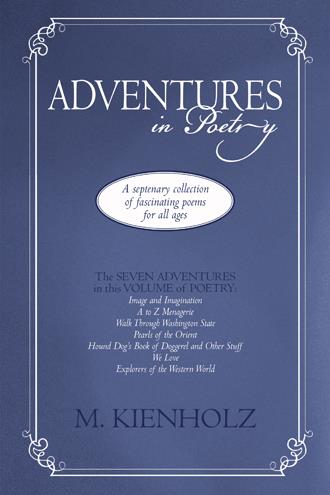
Adventures in Poetry
A septenary collection of fascinating poems for all ages
by
Book Cover & Preview Text
William H. Gates III (born 28 October 1955) (For the computer literate) Unlikeliest of all our heroes, He learned to count in ones and zeroes. He changed the plural of mouse to mouses, Which addled pates in Old School houses. Bill nullified the status quo, And used the tactics of a pro To fence with men less adversarial— And celebrated at their "burial." Midwife at Word for Windows' birth, He's now the richest man on earth, While Paul, less overwhelmed with "I," Is Castor of their Gemini.* Detractors call Gates' great Colossus An insect with a long proboscis Whose penetrating, snorkling wand Sucks dry all beetles in the pond. Some swear on oath, "You can't acquire us," And wish his firm might catch a virus. They shoot at him with rubber bands Or legal briefs with strict demands. They say that Bill gave Mac the knife And wish for Mac an afterlife In which he grows to giant size— The Apple of all users' eyes. But who of us would give our peace To grave concerns that never cease? To work and worries that dismay? Who's pixel perfect anyway? *Paul Allen is an associate in the Microsoft firm. In both the Greek myth and the constellation Gemini (twins), Pollux is the brighter star; Castor the lesser star. Folio XXI Estéban (d. ca. 1539) Every faculty which is a receiver of pleasure has an equal penalty put on its abuse. Ralph Waldo Emerson, “Essay on Compensation” 1. North America (Florida, Tennessee, Arkansas, New Mexico, Mexico, 1528–32) He was tall and as straight as a bayonet blade, As black as a jaguar; on prowl for a maid. His skin was as smooth as an aspen tree's bark, Except for the scratches (though, being so dark, One scarcely could see any). No renegade, He appeared in the South from that ill-fated group That remained of Narváez's three-century troop Who fell, as the Light Brigade fell in Crimea— Oblations to death—although not from a volley But gut-wrenching hunger, unchecked diarrhea, And morbid starvation, in part from the practice Of eating dry corn and the fruits of a cactus. They perished when arrows that pierced living trees Were driven by long bows that reached to the knees. Narváez's adventurers saw their finale, And all this because the maniacal folly Narváez committed left four to survive* Of all of his men—and these scarcely alive. They wandered the South like a rudderless ark. When Narváez had ordered his men to debark, Advising Cabeza he'd made that decision, He rendered the slave Estéban manumission. Estéban contrived how to use his new freedom In spite of the horrors of death all around him. Among friendly tribes (who were destitute, too), He was generally liked, but it also was true He was three parts a satyr and one part a faun, (Which defined the approval Estéban thrived on). It only augmented his manly allure When tribes where he traveled believed he could cure All the ills that they suffered. He then was adored And they gave him such goods as their tribes could afford, And a choice of their maidens. Estéban then reckoned That since they were offered and since he was fecund As an Australian rabbit, and ready to breed, He should take full advantage and scatter his seed. Let his comrades be sickly and too stressed for boredom, He'd keep stress at bay with exuberant whoredom. Though they traveled the South to the Mexican west, With hunger still stalking them, much like a beast, Estéban collected his females like toys, Was handed a great deal of precious turquoise ... And hardships be damned—he was an accumulator. (A British colonial administrator, Who endured the trials that in India abound, Was much like Estéban, though titled an earl, For at night he had nothing twixt him and the ground Except, he lamented, a thin native girl.) *The survivors were, in addition to Esteban: Alvar Nuñez Cabeza de Vaca, Andrès Dorante de Arranca, and Alonso de Castillo Maldonado. 2. Southern United States (1539) Unquestionably, Estéban's life had some merit For Fortune to smile on it, even to spare it. But the habit he had and had not extirpated Was much like a tapeworm that never is sated. When later he toured with a covey of friars He'd no inclination to control his desires. So he went to the tribes, and presumed it not odd, When informing that presently some men of God Would arrive and explain about heaven and such, To ask them for women and however much Of their treasure they might hand to him as a gift. This insolence sadly created a rift Among tribesmen whom he had sanguinely approached, Who felt that his welcome he'd sorely encroached. They conspired to kill him and not share their treasure, (Whereby he paid well for abuses of pleasure). The friars, on seeing men guarding their lasses, And killing the slave, turned and fled through the wood With cowls flapping wildly, as fast as they could, Abandoning all but the things for their Masses. Our Fat Man at a Barbecue There is so much of him who eyes the meat heaped in the roasting pan (not some frail bird but beef large as his hips). He moves his lips in silent praise of roast well-done sliced kid-skin thin; corn dripping butter from its golden teeth! Though lust for food consumes him, still he serves mother and man before him. Home was thus: generous and kind, with hams big as his thigh, affection heaped as high. There is so much of him, much more than meets the eye. Out the Door, Dinosaur A dinosaur at a loggers' show Had skills he thought that the world should know. The skill he tried to demonstrate, As he moved his great spine to and fro, Was slicing logs with his armor plate. But he broke a blade. He became irate And swore! Those few words sealed his fate– Such words no judge can tolerate! The judges said, “You have to go.” “Oh, no,” he said, “Oh, no! Oh, no! I've sealed my fate. A lowly blow! But I shall fix my armor plate, And when I do, I'll celebrate And come next year to the loggers' show.”
Formats

Book Details
About the Book
M. Kienholz is one of the Northwest’s most versatile poets. Amy Woodward Fisher, former chairman of Washington State’s Poetry Day, described Kienholz’ style as incorporating “rhythm and imagery;” however, her poetry has an even broader definition. Her historical poetry ranges like a world traveler through human pathos, achievement, and brutality. Here, she addresses experiences of Native Americans, Chinese, and Japanese in the West, presents incisive descriptions of Northwest personalities and biographical sketches of more than thirty New World explorers. Her children’s poetry can be enjoyed equally by parents and children. She gives her animals personalities and dramatizes their worlds. Kienholz’ love poetry covers all the convolutions of the mating game. Much humor is evident in her serious poems, as well as in her “doggerel and other stuff.” Kienholz’ skillful use of poetic devices provides teachers with tools to explain poetry to students. Her poetry has won honors in many competitions as listed in the Appendix. The seven adventures in this volume of poetry: Image and Imagination A to Z Menagerie Walk Through Washington State Pearls of the Orient Hound Dog’s Book of Doggerel and Other Stuff We Love Explorers of the Western World
About the Author
M. Kienholz is one of the Northwest’s most versatile poets. Amy Woodward Fisher, former chairman of Washington State’s Poetry Day, described Kienholz’ style as incorporating “rhythm and imagery;” however, her poetry has an even broader definition. Her historical poetry ranges like a world traveler through human pathos, achievement, and brutality. Here, she addresses experiences of Native Americans, Chinese, and Japanese in the West, presents incisive descriptions of Northwest personalities and biographical sketches of more than thirty New World explorers. Her children’s poetry can be enjoyed equally by parents and children. She gives her animals personalities and dramatizes their worlds. Kienholz’ love poetry covers all the convolutions of the mating game. Much humor is evident in her serious poems, as well as in her “doggerel and other stuff.” Kienholz’ skillful use of poetic devices provides teachers with tools to explain poetry to students. Her poetry has won honors in many competitions as listed in the Appendix. The seven adventures in this volume of poetry: Image and Imagination A to Z Menagerie Walk Through Washington State Pearls of the Orient Hound Dog’s Book of Doggerel and Other Stuff We Love Explorers of the Western World