
Explaining Unhappiness
Dissolving the Paradox
by
Book Cover & Preview Text
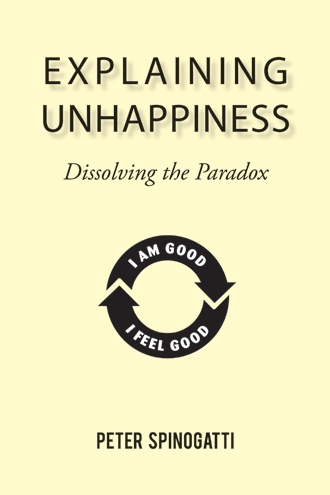
Serious books inevitably start with an embryonic question and the question that this book answers is “What are you afraid would happen if you weren't unhappy?” It is not a question of my own making. A former teacher, colleague and friend asked me that question and at the time it struck me with such forceful significance that it eclipsed any existential question I had ever heard before or since. What is there about this question that prods us to intuitively recognize its dead-on relevance? I believe it is a question that we have been asking ourselves all our lives in one form or another without fully realizing it. A question only engages us when we sense that the assumptions contained within it to be valid. So what are we assuming when we ask “What are you afraid would happen if you weren't unhappy?” First, it is possible, in principle at least, not to be unhappy regardless of the present circumstances in which we find ourselves, that unhappiness doesn’t just happen; it may be self-imposed. Second, this chosen state may have less to do with what is happening in the present and more to do with warding off a fearfully anticipated future. Third, if we believe that, we must also believe that unhappiness pays off. And if that last statement is true, we are forced to conclude that unhappiness is valued which would, in turn, qualify it as the apogee of human contradiction. It would mean that people who seek help actually value what they hate. They are souls in pain hitting their heads against the wall in their therapists’ offices perversely ignorant that they are choosing to do so and asking their therapists to treat their headache. This book is like no other you may have read in the field of self-help psychology. Its pages contain no surveys as to what groups of people are likelier to be happy, no exercises, quizzes or personal inventories designed to give the reader a deeper understanding of what is wrong with them. It does not offer self-improvement, realizing your potential, personal growth or increasing your ability to cope because these traditional goals of therapy assume that there is something about human beings that has to be put right. What I am proposing, instead, is that human beings are not defective. I believe that emotional problems-unhappiness, if you will- are produced in a way that might be likened to a person holding his breath. Such a person does not have to be taught how to breathe since his ability to hold his breath would imply that he already knows how to do that. Think of the old joke that goes “Doctor, it hurts when I do this (he raises his arm)." To which the doctor replies, "Don't do that." My approach to unhappiness is similarly passive. It seeks change through inaction. My analysis makes no appeal to religion, mysticism or the supernatural, not because these approaches to peace of mind are necessarily misguided. In the end, it may well be that the bliss we seek may, indeed, lie with the transcendent. My only interest here is to present a strictly earth-based psychological analysis of human self-definition and that will only be possible by reexamining human self-consciousness at its foundational level. A book about happiness, at its best, is easily understood and helps people to feel better about themselves. It is intended to be inspirational. At its worst is its simplisticism. It rehashes the obvious, stitches together off the shelf psychological nostrums, repackages homilies, offers encouragement instead of reasoned analysis and fails to satisfy those of us who long for both. This is not to say that there have not been sages who voiced profound insights and fresh perspectives on the subject but they were often neither easily accessible nor systematic. This book will try to remedy that. It also strives to be inspirational but in the original sense of its intended meaning which was to breathe life into what is comatose. If successful, the inspiration will be derived from sterner stuff-new knowledge. If you agree that whatever else happiness may be, that it is inextricably bound with knowledge, then what do we know now that our philosophic ancestors didn't? What have we learned about grief, anxiety, jealousy, anger, resentment, self-esteem, rejection, and loneliness that make these issues one jot less painful for us than it was for them? What can we point to in the entire field of psychology that can be called real knowledge-that which eliminates unhappiness? Even Freud, the premier psychologist of the 20th century, believed that psychoanalysis could do little more than replace “hysterical misery” with “everyday unhappiness." In response to that dismal prognosis many post-Freudians argued that psychological change wasn't simply a process of building better defenses against threats to one's self-esteem. Real change, they said, must allow for positive growth. The first problem with “growth" is that it is a term borrowed from biology and simply declared to exist in psychology. Biological growth is an observable process because it lends itself to measurable change. In psychology, growth is only a metaphor for change, meaning that rulers and clocks cannot measure it. Nevertheless, "growth" became the buzzword that promised a whole new frame of reference for how we might view ourselves. So sanguine a view could hardly fail to find favor with anyone. The second problem with the notion of growth is that it implies that how we see ourselves will always be an unfinished business. Self-doubt will never disappear and complete self-acceptance will remain forever beyond our reach. “Growth,” in actual practice, is just another word for “coping,” a new label stuck on the same old bottle. Happiness, on the other hand, is an ongoing subjective experience of being inwardly peaceful and that only happens when self-doubt has been removed from our reflections. To anyone who is happy the idea of growth is superfluous. Probably the best example of this knowing state can be found in a spiritual context. Whether it’s the Buddha receiving enlightenment under the Bo tree or a conversion experience like Saul of Tarsus on the road to Damascus having the "scales fall from his eyes," it is knowledge of this kind that produces happiness. Whether or not you choose to see these epiphanies as mystically inspired is not at issue here. What matters is the ability to fully experience the kind of mindset that is free of self-doubt because that is what reveals our true nature and lies at the heart of what it means to be happy. Its absence, as I hope to show, underlies every manifestation of human discontent. Consider, for example, the experience of a mother or father embracing their baby for the first time. Why is such an experience blissful? The answer is that when we love purely, it frees us from even a hint of self-doubt and all is right with the world because we are right with ourselves.
Formats

Book Details
About the Book
Serious books inevitably start with an instigating question, and the question that Explaining Unhappiness answers is this: What are you afraid would happen if you weren’t unhappy? Why? Because this is the question that everybody asks all their lives, without ever fully realizing it. We are deeply engaged in the assumptions contained within it. What are we assuming when we ask that question? First, we’re suggesting that it is possible to be happy regardless of the present circumstances in which we find ourselves—that unhappiness doesn’t just happen, but that it may be self-imposed. Further, this chosen state may have less to do with what is happening in the present and more to do with warding off a fearfully anticipated future. Finally, we must also believe that, somehow, unhappiness pays off. We are forced to conclude, then, that we value unhappiness. Explaining Unhappiness was written for anyone who has come to realize that “realizing your potential” and “increasing your coping skills” have become old chestnuts that never really gave you what you really wanted—namely, a definitive answer as to why you need to believe that something is wrong with you.
About the Author
Peter Spinogatti is a native of New York City, where he was the director of the Riverdale Consultation Center. A psychotherapist, college instructor, and corporate consultant, he has appeared on public television both as a participant and advisor on cultural and mental health matters. He lives on Long Island with his wife and son.