
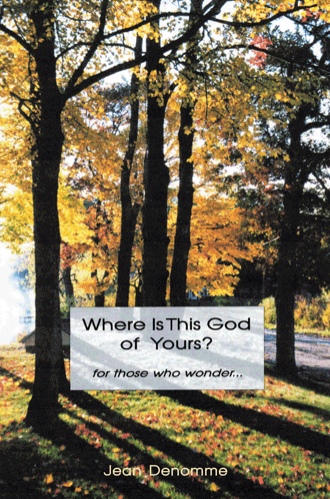
Where is This God of Yours?
For Those Who Wonder …
by
Book Cover & Preview Text
Excerpt from Chapter II Why is it important that we, seekers of God, learn something about the universe and more accurately, re-image it? Since the time of our Cro-Magnon ancestors, humans have expressed their awareness of a spiritual dimension to existence. Through art, dance, and myth they couched their sense of the sacred in terms of the world they experienced. Earth, water, sky, mountains, fire - each was revelatory, numinous, god revealing. Life was filled with mysteries that teased the mind and engaged the spirit. Beginning with Thales, 600 B.C. who first predicted an eclipse, the early Greek astronomers were fascinated by the heavens that “seemed to possess an eternal regularity and luminous beauty that established them as a realm of an entirely different and superior order [to that of earthly life]. The universe was to them “the living manifestation of divine Reason . . . the source of the world order.” From Thales to Aristotle, the apparent harmony of the heavens was revelatory and astronomy became a necessary study for philosophers. 5 As the human mind evolves and consciousness deepens, it still draws upon its understanding of the universe, the sense of what is and how things are, to express its spiritual understandings. Our concept of the universe forms, almost inadvertently, a mental construct within which we tend to image God, ourselves, our purpose on earth, what constitutes good and evil, theories of power, eternal life – most of the basic premises that give structure to our lives. When we envisioned earth as the center of the universe, positioned between heaven and hell, spiritual images conformed to this physical landscape. God was above, running things and all would be well. The Enlightenment scientists who envisioned the universe on the model of a clock believed that God certainly did get things started, but it was up to humans to keep it working. Modern science went further, suggesting that once it figured everything out, God might not be necessary. Inadvertently, adopting a purely empirical mode of thinking, we became linear thinkers, proceeding logically from cause to effect, to secondary cause and effect and so on endlessly. Somewhere the modern mind lost its mystical imagination. Serendipitously insight flashed the day I read that the desk I was working on was held together not only by nails and glue, but more essentially by the intense interaction of millions of sub-atomic particles. In the attempt to understand this contradiction to what I saw, I became intrigued by what scientists were saying, as far as I could understand it. I began taking a fresh look at the universe, at what scientists are telling us of this awesome entity. My mental images began shifting, stretching to accommodate new understandings. The Universe In the 17th century Galileo with his famous telescope probed space for answers about the earth and universe. In presenting his findings, he contradicted the long standing belief of most Christians that earth was the center of everything. Since that time astronomers with increasingly powerful telescopes have explored the heavens and revealed a universe of astounding beauty, immense beyond imagination, full of surprises - some strangely weird and bewildering. At the same time this larger home of ours seems cold and distant, even dangerous because of the unknowns it flaunts. Despite its mysterious qualities, scientists have come up with an amazing array of new concepts and images that force us to re-formulate our ideas about the universe, and, I add, those religious beliefs predicated on ancient and medieval cosmologies. For example, think about a universe so large that its alleged edges are 13.7 billion light years beyond us. A light year is astronomers’ unit of measurement for distance; it is equivalent to 5,878,630,000,000 miles. Now multiply this by 13.7 to find the distance in miles to the present edge of an expanding universe. Such dimensions are mind boggling and raise questions about locations – heaven, hell, angels, etc. Using “supersensitive instruments”, astronomers are able to go back the 13.7 billion years and snap photos of the then “baby universe”. To the non-scientist it appears magical that the further the lens of the telescope probes into space the further back in time it sees. This is why scientists refer to the universe as a time machine.6 The immensity of the universe is further evidenced when one realizes that it hosts at least a billion galaxies - massive clusters of stars and interstellar matter; each galaxy contains anywhere from several million to several trillion stars. Until recently astronomers spoke of our galaxy as THE galaxy. Astronomer, Edwin Hubble, 1927, disabused us of that minimal concept. Through his uniquely powerful telescope he ascertained that there are a hundred billion galaxies, each flaunting billions of stars and all of them are speeding away from us.7 Dwarf galaxies, holding millions of stars, have a mass range several times the size of earth’s sun while giant galaxies with their trillions of stars are several trillion times the size of our sun. Earth’s sun is 109 times the size of the earth; if the sun were likened to a basketball, the earth would be the size of a pin head. So what does this suggest about the size of galaxies that populate the universe? The largest of the giant galaxies is the Milky Way which contains our entire solar system besides trillions of stars. Such magnitudes befuddle the imagination. One further observation regarding our solar system emphasizes the essential connection between life and the sun. It is said that inside the sun, every second, the equivalent of four million elephants are being transformed into light; in other words, the sun it slowly exhausting itself on our behalf. When the sun does finally burn out, the energy of the solar system will eventually lose its source and everything will die.8 It is disconcerting to even think about this wondrous, delicately balanced system dying. Because of the millions of years it has provided light, warmth, and stability to the existence of life on earth, we tend to think of it as permanent - forever. It is theorized that our universe will expand for trillions of years; long after the earth has burned to cinders because its sun star glows more brightly and burns more hotly as it ages. Astronomers estimate the earth will be habitable for another few billion years; this does not assure human existence for that long. Consider a universe without the earth, without humans? Who would know it? Or are there intelligent beings out there somewhere that do know it, perhaps differently, perhaps better than we? And if there are, what could they tell us of a God? Is it a threat to our sense of significance to consider the possibility of conscious life elsewhere in this or some other universe? Thinking about the universe is daunting. Its mysterious formation, rapid expansion, immensity, potential collapse, dark holes and energy, incredible beauty –these concepts and images provide the fundamental contours of a fresh mindset teeming with new questions. These concepts are especially important because, for most of human history, we have focused on earth as the primary reality of our existence and the singular arena for human activity. The thought of conscious life other than ours was not entertained. Even when Darwin proposed his theory of evolution, he did not extend it to propose an evolving universe or universes. While the universe still teases astronomers with mysterious behaviors, what we have learned gives us a compelling reason to pause and think about some disturbing questions. If heaven does not exist as a place in space, what do we mean when we use the word?
Formats

Book Details
About the Book
Offering both intellectual refreshment and spiritual encouragement, Where is This God of Yours? explores the potential of evolutionary theory to transform how we see ourselves, our relationships, our belief systems, and our purpose for being here. Gathered from years of research and reading, Jean Denomme has woven her interests in history, science, and theology into this thorough discussion of evolutionary theory, the nature of human consciousness, and the nature of God. Where is This God of Yours? raises questions of God and presents basic evolutionary theory in regard to the development of the universe, earth, and humans. It examines Catholic teachings, human behavior, and human purpose within an evolutionary context, while providing insights into the sources of human suffering and consequent personal and social responsibility. This exploration of science and faith is geared for Catholics and other Christians who are looking for a way to believe without turning off their minds and for those who want to find a more engaging purpose for living on earth than the hope of some mythical life in another world.
About the Author
Jean Denomme is a lifelong educator and student of history, science, and theology. She divides her time between Michigan and South Florida. In addition to writing, Denomme enjoys gardening, opera, and, above all, reading.