
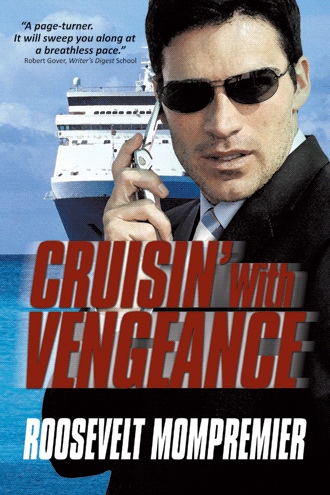
Cruisin' With Vengeance
by
Book Cover & Preview Text
Spring 1994 At eight-thirty Friday morning, twenty-nine years old Rick Solomon was dismissed from the Miami Federal Correctional Institution, a pent-up rage within him. A rage that scorched his firm body from head to toe. What he felt was no ordinary hate or anger; it was something much deeper, much darker than even he could understand. He'd just done time for a crime he didn't commit and was filled with such a burning lust for revenge, he could barely contain it. He was five feet and eight inches tall, weighted 160 pounds of pure muscle. He had brown hair, brown eyes, a round face and an easy smile. As he walked out of his cell, Mosby, a neighboring inmate shouted, “Hey! Another innocent man is escaping.” Laughter erupted from the nearby cells. Rick went solid, his muscles stretched as his cold look hid his desire to cripple Mosby for life. “You wouldn’t have said that if I wasn’t getting out!” Mosby opened his mouth to smile with a mishmash of gnarled yellow teeth. “Bye, sweet meat. I’ll miss you.” The guard broke up the moment. “Shut up, Mosby. I’ll bring you back fresh meat that’s not so tough.” The other prisoners continued to laugh. Rick looked at the guard as his fists started flexing again, wanting to hit him just one time for old time’s sake. “You wouldn’t have said that either.” The guard barked back, “Hey! Get your stuff. They don’t let you out of prison every day.” The guard looked into the cell. A series of hand drawn caricatures of women with various parts of their torsos missing were sketched no higher above Rick’s bed, then if he had drawn them as he was lying prone. During his years in prison, Rick Solomon did not dream, he drew. Several of the drawings on the wall have had their bodies completely inundated with jabs marks from some sharp instrument. “What about your girlfriends on the ceiling?” Three different newspaper clippings of three women were taped to the ceiling. A faded headline alongside the pictures read, Justice Is Served. It also had multiple jab wounds. Rick was impatient. “Keep the bitches. They’ve already given me enough wet dreams.” By the time Rick stepped onto the pavement, he was on the verge of tearing himself in two. His rage had built to such a high peak; he could actually feel the green dragon rise up. I'm going to find the female scum and her friends and exact my pound of flesh. But he suppressed the urge and fled because if he thought once more about the beatings and the vile degradation he’d suffered, his anger might grow beyond containment and hysteria of a sort might grip him. Now he realized that the clause in the Pledge of Allegiance that mentioned "and liberty and justice for all" was sheer nonsense and hogwash. Because if he had been falsely locked up for a crime he didn't commit, it meant the judicial system in America was undeniably wrong. In order for justice to be served, one cannot rely on authorities; they were too damn slow, some too racist and had too much paperwork to begin with. You have to make it personal, take justice into your own hands, bypass the screwed-up system entirely, become an outlaw and punish harshly, very harshly any scumbag who trespassed against you. ***** Rick Solomon hailed a cab and pooled his money. The cab driver said, “Where to?” “I have ninety-six dollars and twenty-seven cents to get me to 61 West 13th Street,” Rick said. His voice was deep and disturbed. “That’s Hialeah, right?” “If that’s not enough then let me out.” The cab driver started the engine and pulled away from the curb. He gazed at Rick through the rearview mirror, shook his head like Rick was crazy. In his fifties, the cabbie was Haitian. The I.D. over his visor revealed his name. Eric Dupuis. “Everything’s cool, man,” Eric said in French Creole-accented English, “everyone needs a second chance.” Rick felt like his character had been assassinated without cause. He wondered if the cabbie viewed him as a felon with a list of heinous crimes on his rap sheet. Now he was mad as hell. He said, “I’m not a criminal…yet. And what do you know about second chance?” At a red light on 152nd street, Eric swung around. Rick noticed he was wearing a cross necklace almost identical to that he used to wear as a kid. To Rick, a cross necklace was a symbol of peace, strength and harmony. Eric said, “I apologize if you thought I was insinuating. No disrespect. Your trip is approximately twenty-two miles. Figure it would run you about fifty bucks, sir. As for second chance, I, too, had been given a second chance. And not a day goes by I don’t thank God to bless the United States of America.” An awkward moment was born between them. Almost a mile later, Rick felt some sort of connection with the cabbie. He said, “Didn’t mean to jump down your throat back there, bro.” Eric was cool as a cat. Typical islander. “No harm done. It’s all good, my brother. It’s quite all right.” Rick relaxed. “Your point is well taken; everyone needs a second chance, indeed.” They drove silently on 874. As they merged onto 826, Eric said, “Another time, another place.” Rick wasn’t quite sure what he was leading up to; he played along. “How so?” “Well, here you get food, drinks, a bed to sleep in and you even get paid – however small it may be. Back where I’m from…” Rick waited. “…they’d even force convicts to eat their own stool, drink their own pee.” Shocked, Rick wondered if Eric spoke the truth. But when he met his eyes through the rearview mirror, Rick was convinced he was for real. “This happened to you?” Eric hesitated, let out a sigh and then launched into a revelation: “Fifteen years ago, it seemed as though the world has turned its back on us. We had one political party. You either supported Baby Doc with the Tonton Macoutes or you were dead. Rick pinched the bridge of his nose as Eric recounted his life story. “And then one night, I found myself living a nightmare when four soldiers whisked me away from my home in the middle of the night and brought me downtown for questioning. They said I was a member of an organization planning to overthrow Baby Doc.” “Were you?” “No. Never.” Rick thought about the coincidence. “Couldn’t you prove your innocence?” “There was no trial. Trial was for the civilized world. I was thrown in prison to die. And what I had to put up with was more gruesome than you can imagine. Certainly worse than you want to know.” For a moment Rick wondered about the man’s plight and why life had to be like this. “How did you survive?” Eric’s voice shook. “Faith. Hope. Courage. Nothing is impossible, you know? They had my body…true…but they couldn’t take my spirit.” Rick blinked twice, disbelieving what he was hearing. “When did you come here?” “Seven years ago. When they released me, my immediate family was already killed. With the help of friends, I boarded a crowded boat out of La Tortue bound for Miami. After eighteen days at sea with no food and hardly anything to drink, the Coast Guard picked us up. I barely made it.” “I knew the trip was dangerous,” added Eric. “But I was willing to die to be free – no matter what the cost.” As they drove on the 826 freeway, Rick thought about the depth of the statement. Though he wasn’t afraid of death, he, too, was going to need luck, faith and hope. Finding one and not the others would bring him no relief of pain. No relief of his nightmares. No relief of the embarrassment. No sense of victory. They drove east on 934, off on Red and zoomed up 13th street. Rick said, “Must be tough for you to let go, uh?” Eric smiled and said an emotional, heartfelt, “Oh, I did let go. In the beginning it wasn’t easy. But as you get older, you learn to forgive your enemy. Because If you don’t…” The cabbie shook his head as he pulled the Crown Victoria towards the driveway. Now face-to-face with Rick, he said, “Hell, never mind, young man. You’ll have to figure that out on your own.”
Formats

Book Details
About the Book
Rick Solomon sits in the Miami Federal Correctional Institution, and the only thing he can think about is how the audacious Rachel Tolar and her friends falsely pegged him as a rapist. When he’s set free, he’s a different man. He’s been degraded and beaten in prison, and he wants someone to pay. He starts by going after Rachel’s girlfriends. After seeing what is happening, Rachel boards a cruise ship named Redemption to escape a deadly confrontation; she has no idea that Rick is waiting for her. And neither of them knows that Ross Leblanc, a veteran of the Miami Shores Police Department, is also on the ship with his seventeen-year-old daughter, Kim. Ross’s co-workers have sent him away on a sabbatical to get some rest and relaxation, and they hope that maybe he’ll find someone special. They have no idea what waits for him on board. This will be one vacation that no one forgets. Enjoy a dangerous adventure with a surprising conclusion in Cruisin’ With Vengeance.
About the Author
Roosevelt Mompremier, a native of Haiti, is also the author of Cruisin’ With The Dreamers. A former slot technician for Carnival Cruise Lines, he has chronicled the cruising world with devastating accuracy. He now sells real estate and lives in Las Vegas.