
A Line Out the Door
Strategies and Lessons to Maximize Sales, Profits, and Customer Service
by
Book Cover & Preview Text
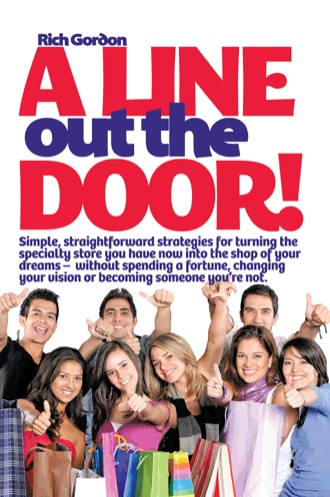
People don’t buy from places and people they don’t like! How we get customers to not only like your store but love your store is at the heart of what this book is all about! One of the things that helps make the Disney experience special is their attention to the little things to which others might only give average attention. Disney is constantly cleaning and hiding the background things you’re not supposed to see. What about the environment you create on a day-to-day basis? Is trash taken care of throughout the day or just at the end of the day when things are overflowing? How about the build up of clutter around the register or just outside of stockrooms? Can people see into your back areas? What does the bathroom look like? Does it reflect the class of your store? Some customers don’t care about saving money. Some don’t like buying imports from China. Some people want a unique shopping experience and still others want to be waited on, hand and foot. Many customers want quality and are willing to pay for it. For every merchant that loses a customer to the big bad Wal-Mart, I can show you a merchant that to some extent, lost sight of exactly who they were and what their job was, as a retailer. If another retailer can do it better than you out there, you’re going to lose business. That’s the way it’s supposed to work in a capitalist society. For every 10 customers out there who are in love with Wal-Mart, I can show you at least forty or fifty others who are waiting for someone to give them a better or different retail experience and to fill their needs and wants in other ways! Unless your business is brand new, your business already has an image, whether it’s by design or by accident. It may be good or it might not be too hot. . . Your image is the brand, your look, your personality, the quality of your employees’ performance and actions and how you’re perceived by your customers. If it were me, I’d rather my image be by design and have some control over that image. Your image (the perception held by your customers) is very powerful and determines possible sales gains, losses and even the prices you can charge for services or product. It also determines what customers expect of you before they even do business with you. I’d want to know what my image is before I go making changes. “Considering the fact that you are leasing retail space (the most expensive space in any given part of town), why wouldn’t you do everything in your power to get customers in the door, keep them inside for as long as possible and get them to come back often—as in, again and again and again?” A common practice to creatively approach problems and ideas involves reversing the problem or issue. For example, instead of asking “How can I improve service to customers?” you ask “How can I make the service so bad that it scares customers away for life?” Or, “What could we do with our front windows that no one would ever want to do?” It may sound crazy, but it really does help with ideas and solutions. Remember, “success is failure turned inside-out.” We may spend a lot of money trying to do things in the best way we know how. We may even do all of these things in a first-class way. We may even buy the best quality merchandise available and put it in a location and store that we pay top dollar to have. And yet, after all this, it can be totally wasted by the remarks, inattention, indifference, poor mood or poor choice of words from one employee. Like it or not, you are dependent on the words, actions and even attitudes of your employees. If they’re not trained well, treated well, chosen well or supervised well, ALL IS LOST! “Try to find and emphasize the small things you can do for your customers that let them know that they’re very much appreciated! Replace the usual experience with the pleasingly unexpected.” You can create a memorable or remarkable moment in your store by working to ensure that your customers experience something special, emotional or outstanding that makes a lasting impression on them. When a customer can tie this special experience in their memory to your store specifically, it can be an unbelievably powerful connection with them over the long haul! “Have you ever walked in a store where the owner or a clerk greeted you enthusiastically by name and let you know how glad they were to see you back again? You almost feel obligated to buy something when you feel that welcomed!” My question is this: Why would anyone want to open up a store that is not much different or substantially better than one down the street? Why put up with all of the aggravation and negatives of retail just to have another mediocre me-too store out there? Wouldn’t you like to believe that, after your customers decide what they’re looking for, they would research the market and product information and add up the pros and the cons to see where would be the best place for them to shop based on affordability? . . . DOESN’T HAPPEN! . . . at least not with most customers. I’m sure you would still like to believe in the tooth fairy, too! If that’s not how it works, then how do customers decide all of a sudden where and when to buy something? Experimentation and change have always been important in retail, and they are becoming more and more important to stay in business and ahead of the competition. You simply cannot do what you have always done and expect to survive, as employees from the big boys of retailing like K-Mart, Montgomery Wards, Western Auto, Woolworths, and W. T. Grants will tell you. Think of your website as one more weapon or tool in your quiver of arrows (so to speak) to fight the marketing and retailing wars. Not necessarily for internet sales, but for the minds and hearts of your customers. It is not the employer’s responsibility to pay every worker enough to support family, lifestyle, gym membership, big screen TV,or anything else. Raises should not be automatic. They are for people who make themselves more valuable to you (the employer). If an employee doesn’t become more valuable to you (the employer) then that employee is easily exchangeable for anyone else out on the street. Giving someone a raise is not in the constitution or the bill of rights. The more valuable any given employee becomes to you, the more profitable they are to you and thus the more they are worth to you.
Formats

Book Details
About the Book
If you are a retailer that wants to take your business to the next level, you need quick answers that you can put in place today. You need to read this book if:
• your store has hit a plateau that you can’t seem to overcome; • your marketing dollars aren’t getting the job done; • your store gets many browsers but few buyers; • your customers are not finding what they want at your store.
Richard L. Gordon, an expert retailer and marketer, relies on concise case studies and decades of experience to show what works. With him as your guide, you’ll find out how to hire the best employees, deliver excellent customer service, and build your brand and business to new heights.
Don’t trust the success of your business to a manager or employees who haven’t delivered results. When you take control of your store and equip yourself with solid, tested strategies, you’ll end up with A Line Out the Door.
“… filled with ideas and strategies that any specialty retailer could us if they want to take their store to the next level. Rich Gordon truly understands the strategies and concepts that are so necessary to excel as a retailer in today’s environment. If you want to be taken seriously as a retailer today, read it and by all means act on what you learn!”
—Maxine Clark, CEO of Build-A-Bear
About the Author
Richard L. Gordon, a retail and marketing veteran, understands and welcomes creative challenges. With decades of experience in direct retail and sales management, he’s worked with Fortune 500 companies and as a consultant with small independent retailers. His own retail business includes wholesale and corporate clients.