
Camping, Simple and Cheap
by
Book Cover & Preview Text
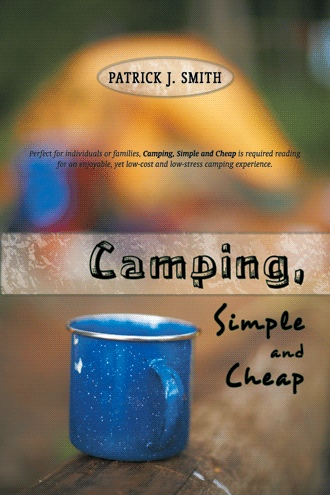
This book is targeted at three types of people:
1. Those who already camp occasionally and enjoy it most of the time, but still find the preparation and packing grueling and time consuming, and dread the occasional mishap. They’re looking for a way to simplify and improve the experience.
2. Those who have camped only a few times, but discontinued it for some reason. Perhaps they had one bad experience camping and just don’t want to risk another similar experience, or are just unconvinced they can ever have a nice time camping.
3. Those who have never camped before but are willing to give it a try, either for the experience, economic reasons, or both, but just need a little coaching or encouragement.
I also am writing this book for myself. After many years of camping, including many great and a few not-so-great experiences, I feel compelled to share my experiences and what I learned so others can enjoy camping either more or more often.
I often discuss my camping trips with friends and relatives and I give a totally balanced account, telling them about the good things like family togetherness, the warmth of a campfire, or beautiful starry nights, as well as the challenges like rain, cold, bugs, etc. Most of the time after hearing my stories, they look somewhat envious and tell me they would like to go camping too, but then give me one or more reasons why they don’t. After exhaustive non-scientific research, here are the top six reasons many people provide for not camping more often, or at all:
1. My spouse hates camping.
2. My spouse hates camping.
3. I don’t know where to go.
4. It’s too big a hassle getting ready and packing.
5. I don’t have the necessary equipment and can’t afford to buy it.
6. My spouse hates camping.
I won’t take responsibility for selecting new spouses for these people, but I am confident I can help resolve some of the above issues and, hopefully, that will also resolve issues for the spouse.
Principles of this Book
This book is based on two principles that I think are necessary for camping to be not only tolerable, but enjoyable. The goal is not just to “survive” camping, but to enjoy it and want to do it again and again. These principles are:
• Camping must be Simple; and
• Camping must be Cheap
Let me explain what I mean by both of these.
Camping Must be Simple. By simple, I mean that every step, from planning the trip, preparing gear, packing, unpacking, and setting up and taking down camp should take very little preparation and time. I also mean simple in terms of keeping the whole experience flexible, unrushed, and uncomplicated. For example, a camping trip is usually not the time to rush around trying to squeeze as many activities, tours, shows, etc. into as little time as possible. If camping requires hours of planning, preparation, and packing, just to drive someplace for one or two nights, and then return and spend more time unpacking and recovering, it will quickly get tiring and unappealing.
Some camping trips do require a little more planning, but most trips don’t need to be like mobilizing for a military deployment, but rather just taking thirty minutes to throw some gear in the car and take off. In fact, that is my definition of simple and my goal for a one or two-nighter— I expect to be able to pack up and leave within thirty minutes. Likewise, upon reaching the campground, I expect to be able to unpack and set up tents, make fires, etc. within thirty minutes. And when we return home, I expect to be able to unload and unpack in thirty minutes. Not surprisingly, you’ll find that the more often you camp, the simpler and more efficient it becomes because you know where everything is, what to take, what to leave, and how to pack.
Camping Must be Cheap. You’ll notice that I’m not afraid to say “cheap” instead of the more socially acceptable “inexpensive” or “great value”. As I write this, the United States is suffering one of the worst recessions in memory; friends who used to eat out several times a week are now eating at home; those who used to take expensive vacations to tropical places are now staying home (staycations), or worse, just going to visit the in-laws. “Cheap” is in vogue again. Besides, if other authors can target their books at “idiots” and “dummies”, I can certainly target mine at “cheapskates.” However, I’m confident that once they try camping, they’ll want to do it more regardless of their vacation budget.
I see camping as not only a fun activity, but as a way to save huge amounts of money on vacation, or to get more vacation out of the same amount of money. Most of us have more need for vacation than budget to pay for it, so we end up either making the mistake of going into debt to meet the vacation need or we shortchange our vacation to stay within budget. For example, we all probably know somebody (maybe it’s ourselves) who took big vacations only to end up spending the next five years paying for them on expensive credit card debt. Or, conversely, to save money, maybe we used most of our vacation days staying home and watching reruns of Seinfield and The Simpsons or even overstaying our welcome at relatives. Camping is a way to satisfy that need for a real vacation and also pay the rent on time.
Don’t get me wrong. My family and I enjoy nice hotels as much as anybody else and, given a choice, we will sometimes choose to sleep in a nice hotel bed over a sleeping bag in a tent. However, most of us don’t have the money to do that and, if camping allows us to get out more and do more things, it’s worth it. For some people, the low cost of camping makes possible longer or multiple vacations away from home in the same year. For other people, camping may determine if they can afford any vacation at all.
Formats

Book Details
About the Book
The one portable camping source for the occasional or new camper who wants to minimize the planning, preparation, cost, and stress, and focus instead on the enjoyment of the camping experience. No need for encyclopedic books and manuals explaining every kind of gear, knot, boot, and campfire meal; Camping, Simple and Cheap is an easy-to-read handbook that cuts through the confusion and focuses on the basic principles:
• Camping must be simple
• Camping must be cheap
• Camping must be enjoyable
Distilling years of practical experience in a small, portable handbook, it covers such useful topics as:
• The benefits of camping versus hotel lodging (and they’re not all financial)
• Planning the trip and acquiring equipment
• Fast and simple meal planning
• Camping with children and pets
• Dealing with weather and common discomforts
• Fun activities while camping
• Off-season and backpack/canoe camping
Perfect for individuals or families, Camping, Simple and Cheap is required reading for an enjoyable, yet low-cost and low-stress camping experience.
About the Author
Pat Smith is an active outdoor enthusiast, enjoying biking, running, hiking, and, of course, camping. He has been a regular camper with his wife and five children for over twenty-five years and a volunteer leader for the Boy Scouts of America for over ten years. He has camped in over twenty different states and four foreign countries, almost always keeping it simple and cheap, in a tent. His experience includes both leisurely auto-camping and “roughing it”-style backpacking and canoe camping; and he has camped in many state, provincial, and national parks, as well as private and wilderness areas. With a family of seven, plus a dog, he has tested the limits of packing a minivan and learned the secrets of how to keep spouse, kids, and pets happy while camping. Born and raised in northern Utah, he now lives in the Chicago area with his wife, Christine, and children.