
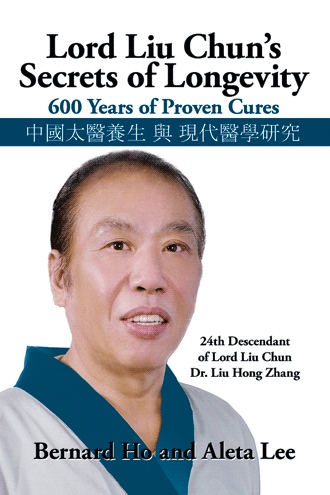
Lord Liu Chun's Secrets of Longevity
600 Years of Proven Cures
by
Book Cover & Preview Text
Sixty-Six Years of Experimentation Lord Liu Chun spent two years discussing and planning the experimentation with his colleagues, three hundred medical doctors who had been assigned to him by the Emperor. Lord Liu also received the assistance of several thousand soldiers from the Imperial army. All his research was funded by the Emperor. He collected 2,000 years of medical history, classified 2,175 diseases, and listed more than 5,000 types of herbs and ingredients and 61,739 recipes and formulas. His first step was to organize the diseases in sixteen classifications ( 证候群 ). He created two more categories based on the lack of hunger and appetite and the proper consumption of food. He divided his staff into eighteen teams to study the eighteen classifications. These experiments were conducted repeatedly over a span of several years. At the same time, Lord Liu Chun tested each of the 5,611 herbs to identify the best applications. The experiments were conducted over a period of sixty-six years and required the participation of hundreds of thousands of death row inmates. The results were kept secret by his family and the Imperial Physicians. Only in recent years have these secrets been revealed by his twenty-fourth generation descendant, Dr. Liu Hong Zhang. In 1409 there were five thousand death row inmates in Nanjing and Lord Liu began eighteen simultaneous experiments. All five thousand prisoners were used; three thousand six hundred people (eighteen groups of two hundred people each) were initially assigned for research. In the process of inducing illness in patients, some patients died prematurely and were replaced. Additionally, some patients did not become sick because of genetic predispositions, and those patients were also replaced. After a prisoner completed his trials, he was pardoned and released on the northeastern border of China. Every year, additional death row inmates were added. Each area of experimentation involved many years of trial and many thousands of prisoners were used. Some prisoners participated in studies of ingredients that were not effective and they were not cured by their test treatment. Lord Liu ordered that they should be returned to health when the most effective cure for their illness was identified. Subsequently, they were pardoned and released. Subject of Research 1. Cancer—shark gallbladder 、 bovine Achilles tendon 2. Diabetes 3. Lethargy and physical weakness 4. Energy in the stomach (hunger) 5. Influenza 6. Erectile dysfunction 7. Hepatitis 8. Cholera 9. Bruise and injuries 10. Epilepsy, schizophrenia, drug addiction 11. Chronic enteritis, gastric ulcer 12. Aplastic anemia, endometrorrhagia 13. Preventative food therapy 14. Nephritis, cardiomyopathy 15. Acne, appendicitis 16. Arteriosclerosis, coronary heart disease, apoplexy, stroke 17. Ten points to enhancement of life 18. Rheumatoid arthritis, lupus,hysteromyoma 19. Bronchitis 20. Pregnancy 21. Problems with alcohol 22. Advantages of meat soup and the disadvantage of eating meat 23. Study of human Yin and Yang energy 24. Methods of pain relief 25a. Study of chemical calcium tablets 25b. Negative side effects of chemical calcium tablets 26. Treatment of patients with multiple diseases 27. Aphrodisiac drugs and early death 28. Water intake 29. Study of 5,611 herbs a. Research on drugs b. Drug therapeutic effect 30. Study of acu-points and acu-meridians ........ Shark Gallbladder Historical Chinese Research Nine hundred years ago, in the twelfth century, an ancestor of Lord Liu Chun, Dr. Liu Wansu ( 刘元素 ), found that shark gallbladders could be used in the treatment of cancer. Lord Liu Chun used shark gallbladders in the treatment for cancer for the Empress Yong Le. The treatment prolonged her life by seven years, and she died in 1407. Fresh shark gallbladders, however, caused many side effects, including diarrhea, vomiting, and a loss of appetite. This was corrected by the procedure of soaking the gallbladders in rice vinegar for five years. Another discovery was that shark gallbladder, when used singularly as treatment, was not sufficient in inhibiting the spread of cancer. It required the combination with four other ingredients: Stigam goci ( 西红花 ), Ligum aguilariae resinatum ( 沉香 ), Cornu saigae tartaricae ( 羚羊角 ), Radix notoginseng ( 参三七 ). In addition, Lord Liu discovered that deep flexor tendons in the Achilles tendon were crucial in the prevention of the spread of cancerous tumors. Western Research A steroid substance called squalamine is found in sharks. Squalamine is an aminosterol compound found in the bile-producing organs, such as the liver and gallbladder, of the dogfish shark. Squalamine was first identified in July 1993 by Dr. Michael Zasloff. He was particularly interested in the immune systems of sharks. He worked with Karen Moore, a medical student, in a search for antibiotics that are produced in nature. This research was done initially to find a treatment for infection. Dr. Zasloff performed another study for the National Academy of Sciences in 1993 on the aminosterol antibiotic qualities of squalamine from sharks.1 In the 1990s, Dr. Henry Brem researched squalamine for characteristics that would help in the fight against breast cancer. Dr. Brem found that squalamine affected blood vessel proliferation (angiogenesis), the process by which tumors nourished themselves by creating circulatory paths.2 Another team of scientists led by Dr. Richard Pietras of the University of California, Los Angeles, was working to isolate the traits of squalamine. This team found that squalamine was antiangiogenic in ovarian cancer xenografts and that the compound had the ability to enhance the cytotoxic effects of cisplatin on ovarian cancer cells.3 This finding revealed that squalamine had the ability to inhibit the growth of blood vessels in an ovarian tumor and to render the cancer cells more susceptible to the chemotherapy drug cisplatin. Many more studies have been performed to identify the chemical benefits of squalamine, as interest in this animal product has become heighted by the recognition of its potential importance. In 2001, the Lombardi Cancer Center of the Georgetown University Medical Centre in Washington, D.C., and Magainin Pharmaceuticals (currently Genaera Corporation, in Plymouth Meeting, Pennsylvania) performed a “phase I and pharmacokinetic study of squalamine, a novel antiangiogenic agent, in patients with advanced cancers.”6 ......
Formats

Book Details
About the Book
Six hundred years ago, Chinese Imperial Physician Lord Liu Chun dedicated his life to finding cures for common ailments and solving the mystery of longevity. Today, modern researchers continue to pursue cures for the same ailments. Currently, experimentation is being conducted on the same substances that Lord Liu identified six hundred years ago!
For centuries, the Liu family has guarded the secrets Lord Liu discovered about healthy living and disease prevention through experiments he conducted in order to ascertain the most effective treatment of a wide range of diseases and health issues. Recently, Dr. Liu Hong Zhang, Lord Liu’s twenty-fourth-generation descendant, published a portion of these family secrets in three tomes—Lord Liu Chun’s Enhancement of Life, Your Lifestyle is the Cause of Disease, and Beware of Medicine.
Dr. Liu wrote the books despite opposition from family members who didn’t want him to reveal the secrets. His vision was to share the family’s wealth of knowledge, and the three books disclose a tenth of Lord Liu’s research. The words of Lord Liu Chun and his twenty-fourth-generation descendant, as well as the Liu family recipes, formulae, and history that appear in Lord Liu Chun’s Secrets of Longevity are taken and translated from these three books.
About the Author
Bernard Ho was born and raised in Hong Kong. A world traveler, he has studied in Italy, Canada, and the United States. For more than ten years, he has scoured China in search of techniques and methods passed down through the masters, accumulating a wealth of knowledge in Chinese medicine.
Aleta Lee has spent decades in the pursuit of nourishing food, organic gardening, and happy living. A graduate of the University of California, Berkeley, the Universite de Paris, Sorbonne and Golden Gate University, San Francisco, her greatest joy is traveling and learning about different cultures.