
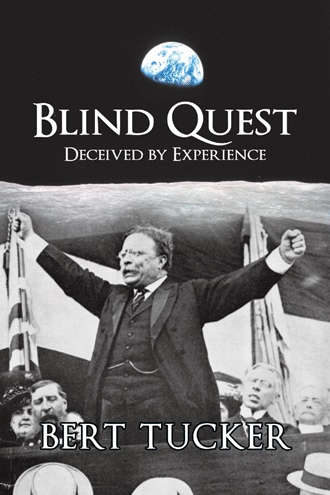
Blind Quest
Deceived by Experience
by
Book Cover & Preview Text
The Jungle There was one piece of business in Chicago that weighed heavily upon Anderson. It involved a young, twenty-seven-year-old author and socialist activist, Upton Sinclair. Sinclair’s family had suffered enormously in the slums of New York while he was a child. His father died young and broken. They had struggled against great odds just to avoid starvation. Meanwhile, this child had seen the wealthy enjoy luxuries. He felt deeply the injustices in the exceedingly abusive economic system of the time. For the past year, Sinclair had been researching the lives of people laboring under the most miserable working conditions in the meatpacking firms associated with the stockyards of Chicago. The two most prominent of these firms were Armour and Swift. Sinclair was writing a book about the impossibly difficult lives of the meatpacking workers and their families and about the conditions they endured in their work. The book would normally be serialized later that year and published in book form in 1906. Anderson had prevailed upon TR to locate Sinclair. He had been given an address in a slum section of town. Anderson wanted to speak with this activist on terms he would appreciate. TR assigned a Pinkerton to accompany Anderson and Will Hoffman into this hive of lost souls. They had dressed down to avoid standing out, but the workmen’s clothes that covered them still revealed their status by their lack of taters and patches. The three men threaded their way past howling babies and bone-lean, smudged children. The small shop owners and the shoppers for their meager wares turned to watch as the two passed. There was no number on the door to the fourth-floor walk-up. Anderson knocked. “Yeah, who’s there?” “Someone you need to meet.” “Look, I don’t have my rent yet. Come back tomorrow.” “I don’t want your money. We just need to talk.” The door opened a crack, revealing a nearly bare room. “OK, so who are you?” He had noticed the clothes and clean faces. “Mr. Sinclair, I presume?” “I’m not Dr. Livingston.” “Well, I’m Dr. Charles Anderson, or General Anderson, if you prefer. This is Dr. Will Hoffman, and our escort is Thomas Caldwell. He helped us find you.” “You are those fellows in the papers that came down from the sky out in Utah?” “The same.” “Come on in. I don’t have furniture, so please just sit on the bed.” Sinclair pulled his straight-backed chair from the crude table where he had been writing. “What brings you into the midst of God’s lost people.” Actually, Upton Sinclair was already impressed. Very few people would have dared to seek him out here. “I want to talk to you about your work and the book you're working on.” “So the man from the future wants to change history by denying these people once again.” “I know you are a pessimistic and bitter man. Just hear me out before making up your mind. I’m actually very sympathetic.” “So socialism does overcome the greed of the wealthy?” “Actually, the result was different from either this or that. Let me explain. “You are writing a book you call The Jungle. I’ve read your book through from cover to cover. I have studied it because it tells a story of this time that most people would rather forget. Quite frankly, your problems have faded with history as the working people of America were able to rise above these evil times. That is not to say that some didn’t continue to survive only at the subsistence level, but most men and women who were able and willing to work did receive adequate compensation.” “You are not encouraging me.” “Let me cut to the chase. Your book seeks to arouse the public to the plight of these people. It does accomplish that, but the route is unexpected. You describe the intolerable conditions in the meatpacking industry. Your description of the foul and diseased practices in the industry is what draws attention to the book. You get your point about the horrible lives of the workers in through the back door. You later say that you ‘aimed at your readers hearts’ and ‘struck their stomachs.’ That may be so, but it got their attention. “I’m here simply to encourage you in your endeavors. Do not change your plot, except perhaps to be careful in the latter part of the book against preaching. Remember, you are writing a novel, and you must keep the focus on your characters and their lives. “Your book does strike an effective blow. The president reads your book straight through and is inflamed by it. Public pressure allows him to push through America’s first pure food and drug law. Industry does bend a little.” “But what about these people? It is their lives I want to change.” “There are three areas of change that are needed—pure foods, pure and effective drugs, and a better lot for the working man. Day after tomorrow, the president and I shall meet with the tycoons on Wall Street. I shall then strike a blow for your working people. It shall be the opening blow in what I expect to be a long struggle. I shall fight on another front than you, but I shall be there, nevertheless. “Please understand. I’m not a socialist. This century experiences the realities of socialism and communism, and they just do not work. Those isms lead to stagnating bureaucracy. Bureaucracy stifles innovation and promotes top-heavy business operations. Bureaucrats are political animals. They do not demand efficient operations, nor will they take the chances needed to promote radical change. They are timid. “Whichever economy you have, it must reward initiative, and these isms just do not do that. These isms also stifle the free expression of the people. They do not encourage a dynamic political and economic environment. Under these isms everything stagnated, and we came close to losing our freedoms.” Upton Sinclair was clearly reeling. “On the other hand, our future did undertake numerous and very expensive social programs. By the end of this century, more than half of our national budget was devoted to social causes. So much so that the populace as a whole felt we had created a nonworking dependent class. The difference between what you want and what we got is that the economy itself remained a free-enterprise economy, albeit with many restrictions. You will have ample opportunity to express yourself in promoting your beliefs.” This brought a slight smile to Sinclair’s lips. “We are already moving on the medical front. I expect you have read of Dr. Cromwell’s efforts and the manuscripts we sent to the AMA. What you do not know is that we will be placing strings on the medicines we provide. We will demand purity and efficacy in those products. “Publicly, we shall stay away from your personal war with the meatpacking industry, although we shall be working behind the scenes in support. That is very important because The Jungle will establish you on the American political scene. It is also a war you can win.” Sinclair was just catching on. “So you do not want to change anything?” “We think your book is a good thing. We want to encourage you.” “Thank you. That is certainly not what I was expecting.” “You are welcome to contact us. We may not be able to take a public stand to support you, and there may be causes you espouse that we disagree with, but there may be times when just talking things out will help.” With that, Anderson, Hoffman, and their Pinkerton departed.
Formats

Book Details
About the Book
Much impressed with the scope of your story, kept me entranced, a compelling and intriguing read, ability to mingle past, present and future is a rear trait.
—LTG David Palmer Superintendent West Point
In an era when terrorist actions have become increasingly uncontrollable, seven contemporaries travel back to the days of the early twentieth century carrying twenty-first century knowledge, technology, and experience to influence historical leaders and thus change the course of humanity.
Blind Quest is an historical work of science fiction that illustrates how poorly equipped the people of 1905 were to meet emerging global challenges. This expansive adventure not only recounts the state of the world in 1905, but also of the condition of humankind through the twentieth and into the twenty-first centuries. It places historic events and conditions in perspective as the fictional characters interact with that history and make it real to the reader.
Traveling with the experience of knowing the future of ten later decades, General Charles Anderson and his six colleagues are brought face-to-face with real historical personalities of the last century. As their paths cross, the story is woven into an exciting adventure traversing the country and encountering the visionary and the tyrants of days gone by.
About the Author
BERT TUCKER a former military airplane pilot, helicopter pilot, and engineer he graduated from West Point with a bachelor’s degree and holds a master’s degree in physics from Louisiana State University. He now chairs ‘West Point Leadership and Ethics Conferences’ presented by academy officers, graduates and cadets for high school faculty and students in New York and New Jersey.