
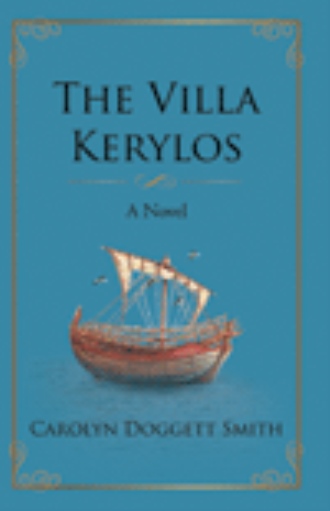
The Villa Kerylos
A Novel
by
Book Cover & Preview Text
He paused to watch the clouds as they boiled up to form huge mountainous shapes, gray, then darker, almost black. “That’s not a rainy day in Crete,” he said grimly. “That’s a storm heading our way. We’ll go on as we are as long as we can, but we can’t outrun it. Before long we’re going to have to stow the sails and try to stay on course. I hate to say this, but you’ll be in the way.” His words were marked by a sudden gust of wind, and Gaius took refuge in his cabin. Soon the sunlight was blotted out by roiling clouds. There was thunder, a distant rumble, then louder, booming closer. The sea turned from indigo to a steely gray, and lines of ripples moved toward them like the front ranks of an invading army. Before long these were engulfed by heaving, frothing waves. There came a sultry blast of wind from the south, accompanied by floods of rain gusting across the ship as the flapping sails were lowered and stowed and anything loose on deck lashed down. It was too late to jettison cargo. Two crewmen gripped the tiller, struggling to keep the Clodia heading northeast toward Thera. But the chances of doing so were slim. The rain was pouring down in sheets; there was nothing to distinguish between air and sea. The wind howled through the rigging, and the ship heeled, cringing before the onslaught of wind and water. There was nothing to be done but pray that the storm would pass quickly. But it did not, and soon it was clear that only a benevolent god could save them from disaster. Gaius, alone in his cabin, wrapped himself in a blanket and lay on his bunk, but not for long, as the waves tossed the ship wildly forward and sideways. He knelt then on the floor, leaning against the bed and burying his head in his arms in supplication to all the gods, and especially Neptune. Why didn’t I visit all the temples when I had the chance? I kept going to the Temple of Concord because she’s the one I worship most, but why didn’t I beg Neptune—or Poseidon—why didn’t I pray to Poseidon to protect me on my voyages? Why, why, why? And why have I never prayed to Aphrodite to forgive me for desiring her priestess? But wait, didn’t she offer herself to me? And the other one, the woman in Tyre, after I said I would never… Are they punishing me, all of them? But no, it can’t be that. Men do that all the time, and the gods don’t care—they’re worse than men! It must be fate, just fate, that seizes one ship and lets another go in safety. Why do men sail upon the sea, when the wind can swoop down at any time and send them, helpless, to the bottom? He was going to die. He closed his eyes, and his mind became oddly calm. Thoughts of his impending death faded away, replaced by a series of images that floated through his consciousness like dreams: his mother in her warm kitchen; the launching of the Ariana; his uncle’s beautiful villa on Capreae; the lovely Artemisia with her mysterious smile; the sheer glory of the Parthenon; Korinna’s laughter as he tried to free himself from a blanket of moths… At this he laughed too, finally seeing the humor of the situation. He felt the ship moving crazily beneath him and cried out, “I’m not ready! I’m not ready yet!” Then, as if some god was protecting him, he drifted back into a calm, dreamlike state. He saw the soft evening light bathing the stone lions on Delos; a Syrian chariot flashing with bronze; Galatea, milk-white Galatea on her silk-strewn couch; Petros with his carved animals; his first night of lovemaking with Korinna; Aurelia as a baby in her mother’s arms. The images followed one another more and more quickly until they merged into a stream of light and color, rudely halted by the crash of a huge wave against the ship, the impact throwing him to the floor. There was no longer any hope of steering the ship. Androkles sent the crew below and went to get Gaius. He grabbed him by the hand and they struggled across the deck to the hatchway. Huddling in the hold, among the amphoras of oil in their sodden beds of straw, they said nothing, each occupied with his own thoughts and prayers. Gaius recalled the story of Halcyone and thought of Korinna. Will she see my body floating toward her? Will she leap from the cliffs, crying out in her grief, and be transformed into a bird with shining feathers, enfolding me in her wings and kissing me? There was a flash of lighting and an almost simultaneous crash of thunder, accompanied by a splintering sound as the mast shattered and fell onto the cabins at the rear of the ship. The Clodia wallowed helplessly in the troughs of the waves. Some of the crew were sobbing, others praying or simply moaning in terror. The darkness hid the tears streaming down Androkles’s cheeks; Gaius was weeping too, thinking of Korinna and Aurelia and the unborn child he would never know. Looking out through the hatch, Androkles thought he saw the sky grow lighter, though only momentarily. Perhaps the wind would die down, but even then there would be little hope for the wrecked ship. If the steering oars were still intact and they could get to them… He shook his head. They were probably gone by now, or else hopelessly tangled in the remains of the mast and cabins. But again he saw the sky lighten, the clouds diminish. Was a gap forming in the cloudbank? Would he see the sun again? There was indeed a gap in the clouds, and the storm was becoming less ferocious. But now Androkles glimpsed a new danger: the dark shape of a hulking cliff, with the sea raging at its base. Angry waves were flinging themselves onto the rocks, sending gusts of spray high into the air. The ship was driven inexorably onward; soon she, too, would be thrown against the rocks, there to be broken up and inundated by the heaving waves. [
Formats

Book Details
About the Book
During the eruption of Mt. Vesuvius in 79 A.D., many citizens of Pompeii fled their doomed city to settle elsewhere in the Roman Empire. Among them were Gaius Tullius, his wife Ariana, and their infant son. They traveled to the family's estate in the hills overlooking Agrigentum in Sicily. There "Little Gaius"--Gaius Tullius Junior--grew to manhood, and it was expected that he would eventually take over his family's olive oil exporting business.
But the business held little interest for Gaius Junior. As he approached his nineteenth birthday, he found himself increasingly drawn to the sea. He yearned to sail across what the Romans called "Our Sea" and visit strange and foreign lands. In time he prevailed upon his parents to let him go.
The Villa Kerylos tells the story of Gaius's journeys--both his ocean voyages and his own voyage of self-discovery--not just from his perspective but also from those of his family, his ship's captain and friend, the merchants he deals with, and the woman who loves him. It tells of his dream of building a villa on an island: the Villa Kerylos, named for the sea-swallows that swoop and dive in the wake of his ship. It tells of his courtship and marriage, and the enduring truths he learns along the way. It is a tale of love and loss, adventure and peril, hope and despair, and the sheer joy of coming home at last.
About the Author
Carolyn Doggett Smith spent her childhood in Rome and Athens and majored in classical civilization in college. A freelance editor and writer, she is the author of The Absentee American; The House of the Faun: A Novel of Pompeii (to which The Villa Kerylos is the sequel); and In the Tales of the Bards: A Novel of Roman Britain (with Marilyn Berkon). Smith lives with her husband in Putnam Valley, New York. [Editor: Please make sure book titles are italicized.]