
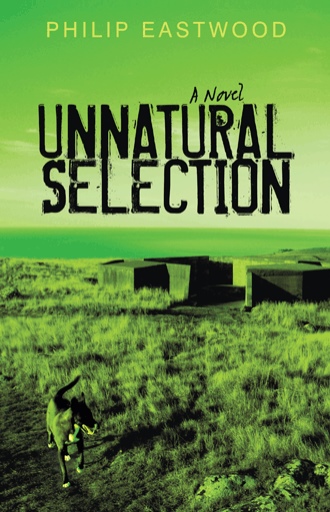
Unnatural Selection
A Novel
by
Book Cover & Preview Text
– ONE – She can’t even hear herself cough. Every now and then the motorized saws fall silent all at once, but other noises take their place: the clatter of hooks sliding, loads thrown down, entrails slopping into the waste channel. The racket's so constant no-one can shout above it. Instead there’s a sign language used by everyone who works on the rendering floor. They signal each other across the conveyor line, over the slabs of streaked gristle that glide between them. Sometimes they laugh so hard they can hardly keep up. The cough grates in her throat again. Unwilling to touch her face with her greasy gloves, she holds her forearm to her mouth. The coughing seizes her whole upper body like a fist, squeezing and squeezing. When its grip loosens she lowers her arm. There are flecks of red against the dark skin. Of course her whole body is smeared with blood, but this on her arm is not the brown, semi-congealed stuff from the carcasses. This is bright crimson. It’s time she went home. She leaves her place on the line. A couple of her fellow workers look up from their tasks but they know better than to ask questions. Peering into the murk she finds her supervisor. She taps him on the shoulder, points to her open mouth and jerks her thumb sideways. He nods, and adjusts her timesheet on his clipboard. Heading for the exit she peels off her gloves and the muck-spattered apron and hairnet, tossing them in a bin by the door. Her feet clang on the steps outside. On her way up to ground level she has to stop twice and rest, to catch her breath and fight back another coughing fit. The security guards show no interest as she leaves through the workers’ exit holding up her pass. She walks straight into a pall of smoke left behind by a departing locomotive, which starts her coughing again. This time the fit lasts twice as long. When she pulls her hands away from her mouth the palms are dripping red. The journey back will take weeks. She reckons with her reduced lung capacity she’ll manage only half the speed she mustered on her journey to the Bay two years ago. Unfortunately, although the peninsula's not wide, she can’t take a direct route. There are wetlands and highlands directly inland, so she’ll have to head along the coast to begin with. She’ll have to trek the black sand beach, which winds south like tarmac for many leagues, before she can turn inland. Then she’ll cut through the Cisterns district – fortunately she knows her way through the maze of lakes – to the west coast. From there it'll be only a couple of days’ walk north to her home in the forest. Initially she’s surprised by how well the journey goes. Away from the chemical broth of the rendering floor her lungs regain some elasticity. Perhaps they’re soothed by the salt breezes of the coast, and after that, by the humid air of the lakes and forest. In the first week or two she catches up with several others who are making the same journey back to their homes. They are all in worse condition than she is, and after a few words of comfort she continues past them. More commonly – every few hours in fact – she meets people coming the other way, mostly youngsters full of excitement. She stops the first few and tells them everything she can think of, but they just smile and shake their heads, and keep going. So she decides to save her breath. By the time she reaches the western shore she’s exhausted. She camps on the beach, well above the high-tide line in the lee of a boulder. To recover some strength she spends the next day and night dozing beside her driftwood fire. Next morning she packs up and heads north, leaving the shore behind and making her way slowly into the coastal forest. About midway through the afternoon, she finds herself in familiar territory. Her village might be close enough to reach by nightfall. She increases her pace, ignoring the grip in her chest as she starts to breathe harder. Disappointingly, dusk comes while the village is still hours away. But she’s made it this far in better shape than she'd hoped and now she can’t bear to wait another night. She knows the way from here well enough to travel it in the dark. This was the track she used to follow as a child, running through the forest with her brothers. It's part of the structure of her brain: the hair-pin turn by the bluff, the rise where you see the valley opening out through a window of foliage. And not far from here an arch formed by two trees fallen against each other in some long-ago upheaval. Despite the darkness, which is complete now, her feet recall the camber of the path without stumbling. When she reaches the archway under the giant trunks she decides to sit awhile to relieve the tightness in her chest. She inhales slowly, taking in the loamy night-time scents of the forest. Leaning back against the tree she considers sleeping here and walking the last few hours in the morning. Then without warning, for the first time in days, a cough erupts from her chest, and more follow. Insects flitter through the archway in the morning light. The calls of cloudrunners drip from the canopy. Beneath, sharp tusks tear at the humus under the lean-to trees. The owner of the tusks is searching for sweet potato tubers. But the whiskered muzzle finds something unusual, something not to its taste. The leaf-mould is clotted with blood. The beast startles when it finds the body of the young woman on the path. But she remains motionless, so the tusked face pushes forward cautiously. Two wide nostrils pass over her hair, which spills over the ground like a pool of oil. They sniff and blow at her feet and back, passing without interest over a dark stone pendant which, still looped around her neck, has fallen to one side of her body.
Formats

Book Details
About the Book
No one alive can remember seeing the sun, the sky or the stars. For centuries they've been hidden by an oily blanket of cloud that never breaks or disperses.
This is the city of Luxor. When the oceans flooded and fossil fuels ran out, Luxor rose out of the chaos, becoming the most powerful city in the world – thanks to its industries, fuelled by the fat of animals. As the fumes from burning tallow spread outward, so did Luxor's influence ...
Loki Blake has lived his whole life in Luxor and he knows nothing else. But now he's going to a place beyond the clouds -- a place where the sunshine will dazzle his eyes and the stars will scramble his brain. He's traveling to the faraway colony of Trasmundo to search for exotic and perhaps mythical animals, trying to save them from extinction before the smoke of Luxor's industry spreads further.
But there are people who badly want Loki to fail, and they're prepared to kill to make sure he does. Before he knows it, Loki is on the run in the cloudforests and marshes of Gondwana, his survival dependent on Mera Ness, his frustrating and elusive guide. He doesn't know who to trust or whether he'll make it home: all he knows is that he hasn't been told the full story …