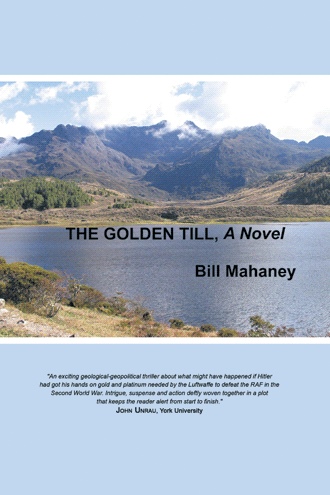
The Golden Till
A Novel
by
Book Cover & Preview Text
PROLOGUE Students milled around in the hall outside the lecture room at the far end of the Institute waiting for classes to start. One of the resident archaeologists in the museum, Jack Ford, stopped briefly to look at the crowd of students. Not spotting any familiar faces in the crowd, he threaded a path that would take him to his laboratory. It seemed to him that student numbers had swelled somewhat during the last few months while he had been off recovering artifacts in South America. At the far end of the hallway, he noticed Reuben Porter, a cantankerous and windy colleague coming out of his office, fumbling with his keys. Not wanting to indulge him, Jack crossed over to the door leading to the second floor, and bounded up the stairs two at a time. At the top he turned left, hoping he had evaded Reuben, and walked quickly to his office at the end of the long corridor. He had an hour before his class started and wasting time on idle conversation with one of the gossip artists in the place was the very last thing he wanted to do. Pulling on his lab coat, Jack settled onto a stool in front of his laboratory bench and searched for the keys to the lab cabinet. He unlocked the storage cabinet and took out the latest gold specimens, icons collected from a site near Machu Picchu in Peru. He placed them on the table and studied them at length. These icons had nearly cost him his life and he was lucky to have escaped in one piece, to return to the normalcy of lecturing in anthropology. Staring at these ancient relics, he asked himself, half out loud, “What is it that makes them so sought after, so valuable?” The earth around them, in which they were found encased, might yield valuable clues to environmental change and even age, but the relics, people would fight over or even die for. For many, they were prized beyond all value. A knock at the door interrupted Jack’s reverie and brought Cedric Caine, wearing a broad grin, into the laboratory. His former professor, Cedric was also his colleague, trusted friend and advisor. An archaeologist in his own right, with an international reputation, Cedric spent most of his time trying to finance Jack’s excavations in South America and elsewhere around the globe. Jack studied his face, noting a mixture of anticipation and fear, borne of wonder that the icons had been recovered at all and anxiety over what the museum board would say about how they had been collected. Jack had no doubt Cedric would eventually get round to asking where and how he had managed to collect the icons. Above all, he knew he would have to come up with some creative answers. Yes, he ought to smile, Jack thought. The tremendous find brought back to the museum from Peru would ratchet the museum up a notch or two in the academic world. They were the first icons of their kind in North America and supposedly unattainable despite vigorous searching by many archaeologists all over the world. Jack had recovered the Incan gold icons from sites radiating out of the center of Inca culture at Machu Picchu, a civilization destroyed by the Spanish invasion of the Sixteenth Century. Turning to look at Cedric once again, Jack could see he was stupefied, mouth open and clearly unable to speak, overawed by the beauty of the icons that lay before him. Anticipating Cedric’s quizzical look, Jack said, “Yes, Cedric, Dad will analyze the gold content. The conquistadors searched for the source of the gold, but could never find it.” “Does your father know you are back in town?” “I talked with Dad last night. He’ll be in later today to do an analysis on the samples but I have no doubt the gold content is the purest to have ever come out of South America. Truly beautiful and truly amazing.” The Incas had not only found the placers, but exploited them by mining the gold and little silver (called platina by the Spanish, now called platinum), producing some of the most beautiful art forms ever made in South America. As they sat looking at the figures, Jack thought, Pizarro had searched for the source of the gold, but could never find it; he didn’t understand the geology well enough to put it together. Concentrating on the vein gold, when most of the accessible sites were at lower elevations in the placers, was a big mistake. As Cedric continued to study the figures, he turned them around to inspect every facet, his fingers following every suture. Jack watched the intensity build in Cedric’s face, thinking, The people who made them were extraordinary craftsmen. Their descendants worshipped the icons, believing they contained supernatural powers so terrible they could be unleashed on nonbelievers. Just then Cedric looked at Jack and said, “The Indians will have put a curse on you, especially since you don’t believe in the supernatural.” “We are not ‘believers’ exactly, Cedric, but most of us respect the religious significance of the icons. I certainly appreciate their beauty and exquisite craftsmanship.” Jack watched Cedric’s reaction, thinking he might be spooked by the thought of a curse, but Cedric seemed willing to drop the subject. The gold alpaca and llama statues, together with a wooden ceremonial vase and star-headed mace embellished with gold, formed the newest additions to the museum collection from Machu Picchu, the last Inca refuge. Looking at Cedric, Jack said, “Dad will ask about the source of the gold and this time I think I know the answer. The Incas were collecting it around the margins of the great Pleistocene glaciers in the Andes. Find the great glacial terminal moraines and you have the placers. We dug two of them and brought the samples back that should prove the theory.” Watching Cedric grow more intense, Jack waited a few precious seconds and added, “Want to finance an expedition to find the source of the gold?” Cedric weighed the question for a minute or two, and then said, stammering slightly, “Can you find it Jack, do you think, the actual source? If you could match the source to the gold figures it would be a coup for the museum.” “It can be done, Cedric, it can be done,” Jack said, with a wry smile. The two scientists looked long and hard at the figures without uttering a word, and then Jack locked them away in the sample cabinet. As Cedric went off to a committee meeting, Jack thought, At least I am spared meetings; teaching is wearying enough and nothing like field work where discovery can come at any time. An important find might catapult one’s reputation, from the dark abyss of the unknown, to the known, perhaps even the widely known. But, fame is not the driving force, he thought. It’s the adrenalin rush of the find, the exuberance brought about by new evidence that ultimately provides proof for a new theory. Debunking a popular theory, advanced by someone who has never dug a site, has a certain appeal. And, oh yes, there are many archaeologists with clean, unworn hands, Jack thought. Archaeology, the embodiment of interdisciplinary science, is the field of learning which draws upon knowledge in many disciplines, from physics to history. Thinking of the interconnectedness of several disciplines, Jack was strangely reminded of Alexander von Humboldt, the great German explorer-scientist of the New World. The natural sciences had come a long way from the pioneering days of von Humboldt and Jack wondered why he had suddenly thought of the New World and von Humboldt. It must be the icons, he told himself. Then, after thinking about the icons for a short time, he puzzled over what the great explorer would have done with them had he found them. As Jack thought more about it he decided to write up the results and publish when the time was right. Dropping the thought from his mind, he checked to insure the gold figures were locked safely in the cabinet, and picked up his briefcase.
Formats

Book Details
About the Book
In 1939, Europe stands on the brink of war, and Germany is desperate to find new sources of gold and platinum to fuel its war machine. When a cache of iridium, a platinum metal used in the production of the Spitfire fighter plane, is discovered in the Venezuelan Andes, Adolf Hitler personally authorizes a mission, codenamed Aguila Negra, to recover the ore and ship it back to Germany. Carburetors built with the Andean iridium would boost the Messerschmitt’s velocity, giving the Germans a decided technological advantage in the battle for air supremacy.
To carry out the top-secret operation, Hitler sends a submarine force along with a small band of elite paratroopers. They successfully extract the precious metal and proceed to make a run for the Caribbean coast. Only Jack Ford, an American archaeologist working for U.S. military intelligence, stands in the way of a Nazi victory. Uncertain who to trust and which way to turn, Jack decides to take the future into his own hands—and with it, perhaps, the future of the entire war.
About the Author
Bill Mahaney is emeritus professor of geography at York University in Toronto. A specialist in glacial geology and geomorphology, he is also president of Quaternary Surveys, a company specializing in Quaternary geology and environmental geomorphology. He has written numerous nonfiction books, including Hannibal’s Odyssey: Environmental Background to the Invasion of Italia,, 2009 and a novel, The Warmaker.