
The real life of Jesus Christ!? - parallel reading, comparison and harmonization of the four Good News (Gospels)
by
Book Cover & Preview Text
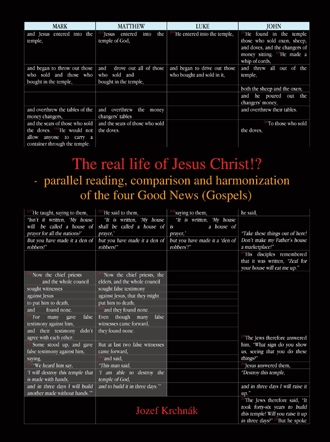
PROBLEMS AND “CONTRADICTIONS” WHEN COMPARING THE FOUR GOOD NEWS In compiling this book, several issues were raised before me, some of which I will try to briefly describe. Apparent contradictions When scrutinizing all four Good News we find two apparent inconsistencies: a) Statements and parables of Jesus as recorded in various Good News, in most cases differ slightly among themselves. While their meaning is the same, used words or word order is different, in some cases some words are omitted or added. E.g. What “Our Father” prayer is correct? Is it the one recorded by Matthew (Mt 6:9-13), or the one that Luke wrote (Lk 11:2-4)? b) Jesus often used statements identical in meaning, but on different occasions. These differences, however, I consider apparent for two reasons. 1. Jesus’ audience did not have to remember his words word for word. Much more important was the fact that they remembered the meaning of his words, which is proven in textually different, however, spiritually identical morals recorded in the four Good News. 2. We assume that Jesus often used statements textually different, however identical in meaning on different occasions, since all four Jesus’ biographers witnessed that Jesus went throughout all Galilee, Judea and surrounding countries and preached his teaching. During his ministry, therefore, he had to make tens and perhaps even hundreds of sermons. We cannot assume that he was saying always only new ideas in every place, on the contrary, we must presume, that he was mostly repeating his teaching. Thus he presented his ideas many times, but at the same time he could change their text. So he could say the “Our Father” as it is recorded by Matthew, sometimes in the shortened version as Luke wrote, and an another time he could present this prayer in other variants. Another example. Did Jesus made his famous sermon “on the mountain” as Matthew says or “on the level place”, as Luke writes? As earlier mentioned, Jesus had to make tens of sermons on the mountains, the level places, in synagogues, squares, etc. during his ministry, whereby he was varying his ideas, sometimes adding something, and sometimes omitting. Of course, probably the most impressive, thus also the most monumental, were his sermons in large open spaces, whether on the mountain meadows or the level places, where many thousands of people could listen to him, which was proven by all four Jesus’ biographers. In this case, Matthew and Luke write about two different events, which were during Jesus' ministry repeated in different variations a couple of times. Indeed, as we consider most likely that neither Matthew nor Luke recorded only one particular authentic sermon, but in the story “sermon on the mountain” or “sermon on the level place” they described an event, which reiterated during Jesus' ministry more times, where the best known Jesus' ideas, he said at such events, were recorded. And the last example: Jesus could say to his audience: “You are the light of the world” (Matthew 5:14), and on another occasion, about himself: “I am the light of the world” (John 8:12). Real contradictions Mentioned reasons show, that there are a few real contradictions among the four Good News. As an example of a real contradiction we can introduce the story of Jesus anointed with oil (see chapters 87, 221, 252). Mark and Matthew write that the event took place in Bethany, in the house of Simon the Leper, and Jesus was anointed by an unnamed woman. According to John, the event happened also in Bethany, but in the house of Lazarus, and the woman who anointed Jesus was Mary, the sister of Lazarus. Besides the contradiction, where the event happened (whether in the house of Simon the Leper, or Lazarus), in the rest of the events these three stories agree. In contrast with these three stories is the description of the event recorded by Luke. Luke’s interpretation of the event matches fairly with the other three biographers only in the beginning. According to him, the event took place in the house of Simon, the Pharisee, and Jesus was anointed by a public sinner. Further continuation of this story is totally different compared to Mark’s, Matthew’s and John’s interpretation. Ambiguities There are both slightly different and at the same time similar stories narrated by individual Jesus’ biographers, where it cannot be clearly determined whether it is a single story, or different stories. E.g. Did Jesus heal a centurion’s servant, as written by Matthew and Luke, or was it a son of a nobleman, as recorded by John (see chapters 22, 52 and 83)? Is this a single event, or are these two different events? Diversity of the characters (the centurion and his servant versus the nobleman and his son) and some other details of the story suggest that these are two different events. On the contrary, many common details are in favor of a single event. Another example: Did the so-called miraculous fishing take place twice (see chapters 56 and 295), or only once? Should it have taken place only once, would it happen at the beginning of Jesus’ ministry, as Luke writes or after Jesus’ resurrection, as John says? HOW TO READ THIS BOOK You will find four Good News (Gospels) in this book, arranged in an original style, where, as many of you already know, the life and teaching of Jesus Christ is described. There are as many as four different narrations about Jesus that remained from the 1st century – the Good News according to Matthew, the Good News according to Mark, the Good News according to Lukas, and the Good News according to John. These four narrations are similar in many respects; they mutually complement each other, however, sometimes they also contradict. And the detailed comparison of their mutual coincidences and differences allows this special edition. As you will see on the following pages, texts of the four Good News are arranged in two ways. The four Good News are recorded in four single columns, so each Good News is recorded in a separate column. At the same time, there are for comparison with the other three Good News, recorded relative texts from the remaining three Good News in another three columns to the particular text in the column of the particular Good News. Upper mentioned text arrangement enables up to three possible ways how to read the Good News in this book. 1. Traditional reading – reading of each Good News independently. You read only one chosen Good News. Thus you read only one column selected, while only reading a text in bold. Do not read text written in normal font but skip it. 2. Harmonized summarized reading – read all the bold written text simultaneously in all four columns. Text written in normal font you do not read again, but skip over. 3. Comparative reading – read all the text in all four columns simultaneously, regardless of the font. Eventually, you read and compare only a selected story from the Good News. For better clarity, the texts in this book are printed in several fonts. Their meaning is as follows: The original text of the particular Good News is always printed in bold fonts (bold or bold italic). As already mentioned, if you want to read only a particular Good News, just read the text written in bold fonts. Do not read other text written in other fonts, skip it over. On the contrary, the text for comparison is always printed in normal font types (normal or normal italic font). Direct speech, whether Jesus’, his disciples’, the Pharisees’, scribes’ or other people’s is always written in italic fonts (italic bold or italic normal font). Very exceptionally, you will find text written in some type of strikethrough font in this book (strikethrough bold, bold italic strikethrough). These strikethrough fonts are always used in the text, which is not present in the oldest preserved Greek manuscripts, and very likely it is a complement of the ancient transcribers, who tried to synchronize forms of the individual Good News, or to improve c
Formats

Book Details
About the Book
Four Good News (Gospels), describing the life and teaching of Jesus of Nazareth, are likely to by the most influential works of human history. For nearly 2000 years, they are still the most searched, the most translated, the most quoted, the most studied, and perhaps even the most read.
Life of Jesus is documented from many sides, as no other ancient personality. We have four biographies, and many other reports. In paradox, this variety of information requires its exploration, because the four Good News are similar in many respects; they mutually complement each other, however, sometimes they also contradict.
And now, this book with a special arrangement of the Good News let’s you explore them in detail. The text arrangement enables up to three possible ways of reading: - traditional reading of each of the Good News independently, - harmonized summarized reading, - but especially, it allows parallel reading with a mutual very detailed comparison of the four most influential books of the world.
Read this and you will be better.