
Under the Wolf Moon
A Novel
by
Book Cover & Preview Text
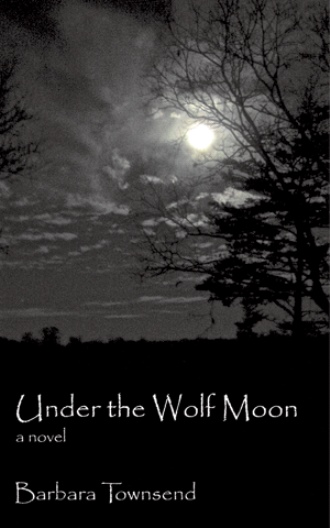
Ireland’s Western Shore 1835 The dock was crowded with people shrouded in woolen shawls as they huddled from the cold wet mist. Seamus was sickened by the thought of leaving. He’d go for now, but he’d return. He had gone down to the sea and raged, shouting his anger into the waves. The salty water splashed over his face as if slapping him in retaliation. Whose fault was it after all. The dampness only increased his discomfort. As the water trickled down his face, he remembered the murderous blood. Crimson rivulets of blood tracking down the bayonets from the spiked heads. Their eyes were open, glazed, puzzled by death. The heads were marched around the close family neighborhoods by strutting, jeering British soldiers. Seamus was stunned by the faces he recognized. There was Jem, then Davy, people he had grown to respect. County Cork’s best hope. They were the ones who promised to fight. They were the ones who would cast out the oppressive Protestants. Now they glared back from blind eyes like puppet heads on sticks, their lives made into a joke. Just three short days ago, his uncle Fergal was hanged as an agitator. Anyone related to the Malone family was considered a threat to the British government. On the eve of the hanging, soldiers stormed into their humble cottage and ordered the family outside. They searched their home for guns and hidden rebels. Finding none, they turned the table over, smashed dishes, and ransacked the cottage for valuables. Two soldiers, with guns pointed at the family, interrogated Padraig and Deidra and their sons, Seamus and Conchuir. “Bloody hell, where were ya tonight? Did ya see yer Uncle dancing at the gallows? Speak up! Give me yer names. They’d best be in English, or we’ll shoot you faster than you kin say yer Catholic prayers.” Deidre went first. “I be Eva.” Padraig followed.” Partrick’s me name. “ “I be James,” mumbled Seamus. “Speak up or you’ll not see daylight again,” shouted the soldier. “James be my name,” spoke Seamus as his mouth filled with bile. “Connor’s me name,” replied Conchuir. His Gaelic name was so close to the English pronunciation that it mattered little that he said it the usual way. When they were finally alone, Deidre went to the hearth and removed the loose stone. Bending down, she reached in and pulled out a folded leather pouch. “’Tis the money and jewelry we have. Enough to pay passage on the ship to America. Pack yer clothes. We’ll leave before the sun rises.” Seamus protested. “Our cause is not yet lost. I’m needed here fer the love of Christ!” “Sweet Mother of Jesus, we need yer help. Me brother’s dead. Do ya need to add yer body to me grief?” cried Deidre. Padraig caught Seamus’ eye. It was clear without another word spoken, they would be leaving together. Seamus joined his family on the platform as they entered the bowels of the ship, climbing down to the crowded sleeping births where cowards fled to a land called America. The Cave The burning embers dimly lit the smooth rock walls of the cave. As the fire flickered, it shone off the dark, bear-greased skin of the Indian. Rawhide and feathers criss-crossed the long dark braids that hung down his chest. He kneeled beside the blackened stone circled pit. His body rocked back and forth as if he were in pain. In his hands were tightly wrapped bundles of wild hemp and sage. These were placed onto the hot coals until wisps of pungent smoke spiraled up and filled the air. “Ga-lv-la-di-he-hi, ga-lv-la-di-he-hi, a-yo-tli, ah-yay-la, ah-yay-la ga-lv-la-di-he-hi,” Over and over again, he chanted his tribal incantations until the herbal scents put him into a deep trance. Next to him, wrappped in a blanket of soft beaver fur, moaned a sallow faced, dark-haired child. The Indian stood and with his powerful, sinewed arms, lifted the frail girl into the air, high above the swirling smoke. The Indian implored the Great Heaven Dweller, “Ah-yay-la, ah-yay-la, ah-yay-la. The smoke carried his prayers into the dark evening. They merged with the howling song of the wolves and rose into the night sky.
Formats

Book Details
About the Book
Turbulent times pit North against South, new immigrant against old in the 1850’s Potomac Highlands. Under the Wolf Moon has passion, life, death, and redemption.
The haunting sound of a mountain dulcimer channels its way through the hollow, softly echoing off the rocks and trees. Because of that, lives are drawn together like the confluence of two great rivers.
An embittered drayman, seduced by bigotry, acts out his revenge. Zebediah, an injured child, is a wounded healer who becomes the pivot between rage and redemption. Woven into the tapestry are an ancient Indian and a black midwife who guide people as shamanic wisdom holders.
Under the Wolf Moon is the story of a man and a woman whose lives are held in tension between cultural and personal prejudice and the nobility of the human spirit. Under the wolf moon, the January moon, life and death come full circle.
“An historical fiction worthy of its place in the genre.”
—Norma Blacke Bourdeau, writer, poet, professor of Creative Writing, Frostburg University
“Quick and precise character development and a fast moving story line…a real page turner.”
—Col. Frank Roleff, US Army, Ret., past President of Mineral County Historical Society
About the Author
Barbara Townsend is a West Virginia award-winning storyteller and preservationist. Shepherd University honored her in the New Writers Fiction Competition. She is the curator of the Ashby Fort Museum 1755 and lives with her husband and flat-coated retriever on top of a mountain in the Potomac Highlands.