
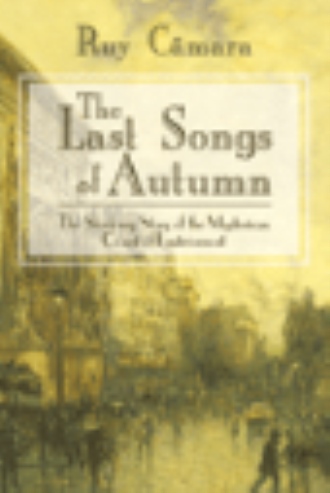
THE LAST SONGS OF AUTUMN
The Shadowy Story of the Mysterious Count of Lautréamont
by
Book Cover & Preview Text
The melancholy that penetrates deep into the soul is always more intense on the dreary nights of the Christmas season. Those nights seem endless for one who stares into the fire with generously lashed eyes warmed by tears. It is not worth crying as the fire slowly burns until only the embers seem alive. The cold, damp wind that left the fields moist in this springtime is not the same one that will soon blow dry leaves around empty streets. No one around here dares defy Him who manipulates with tenacious accuracy these strange climatic metamorphoses, nor will anyone insinuate that the apocalyptic elements are sustained only by prophetic words resounding beyond the mountaintops. She who continues with bowed head, considering her dilemma, has a feeling that she should treat whatever may fall from on high with parsimony and respect; otherwise her words will freeze on dry lips and her tongue will be trapped in a withered mouth, forever prevented from speaking ill of the arrival of the next season. The city is illuminated by bolts of lightning and trembles at the start of a macabre symphony, orchestrated by chains of thunder that tumble over the old roofs, almost always mended at the last minute. Not even the highest strains of the violins are able to muffle the far-off rumbles. It has long been said that at these wistful moments those who should open their eyes to take a peak at what is happening within will see clearly, in the frightening color of the lightning flashes that punctuate the black skies with silver veins, that one must never curse life nor that which is being remade for one’s benefit. It is also nighttime in the immensity of Célestine’s thoughts, as she continues to seek purification in a sorrowful idea, ruminating on an aggressive bitterness each time she chews opiate leaves to try to contain the shuddering that arises from the depths of her inner being. In those moments of dilemma in which she begins to hear the hallucinating bells of the dew-covered foxgloves and the belladonnas, only just recently picked from the garden, the darkness continues blotting out the colors of her life, allowing just a single, undefined color to predominate. But since darkness is the mother of all shades, and not really a color by itself, nor even just the absence of light, it cannot be translated by these words. The starless firmament, laying its encircling gloom upon the troubled minds that cross Yerbal Street and arrive at house no. 9 on Camacuá Street, the Ducasse family mansion, seems to produce a strange sensation of spiritual torment that lingers in the air. But all of this remains in silence, so that anyone who would try to guess what will come from on high will feel as trapped between the wet ground and that immense empty thickness, as does Célestine. After sensing a remote fear of changing her plans due to the effects of the belladonna, she once again lowers her eyes and gets the impression that somewhere in that darkness there is a sinister power defying some secret intelligence, opening up shortcuts in her path, to the point of leaving her indecisive between staying where she is and entering the house. Just as the last guests arrive, the rain begins with such intensity and violence that the dousing from heaven becomes a threat capable of inundating the river beds, already empty of feeling and content. Then the sound of hail hitting the roof invades the large ballroom, choking out the bizarre whispers being shared among the most intimate of listeners, probably over some scandal involving Consul François Ducasse and his secretary. Quickly, the atmospheric cover-up brings out the aroma of food coming from the kitchen, as well as accentuating the nervous, pathetic expression of the hostess. She feels ridiculous, not only because she guesses the thoughts of each one of the dames and damsels murmuring around the corners of the hall, but also because of the formality of her dress: long, navy blue with full sleeves and a high neckline, the waist tapered by a silk strip that gives her the austere appearance of a pious woman in decline, or of a long-suffering wife submissive to her husband. “So lovely, but at the same time, so unhappy,” mutters a gentleman to himself as he approaches her, full of expectation. As he greets her he senses the harsh hostility of her gaze, a malign look, revealing intimate things, maybe a morbid torment, or something even more frightening, which seems to match the whiteness of her face, as she sits there, forcing a tepid smile. But noting that the unwelcome gentleman had plucked a handful of perfumed clematis with amaryllis from the jar, she walks off in a faint-hearted gesture without apparent motive and without giving any excuse. In these times of universal get-togethers and immutable conspiracies among such complicated beings, no one will dare shatter the luster of a Christmas party by making nasty comments about the sudden intervention of a storm. But among the new arrivals are those who declare, in an attempt to allay the general anxiety, that the rain is welcome because it is heaven-sent. Thus, the sudden gusts of cold wind are made to appear to transform the individual lives of Christians, atheists, pagans, heretics, and agnostics into a divine miracle. So great is the deluge that washes across the hard ground and deifies the general conscience, that the most faithful among the guests may confuse it with a collective baptism. But they will never take it as a grotesque punishment from heaven, as will soon be said of what is about to happen in the estuary of the River Plate, a pleasant place in the southern part of the American continent, in the southeast corner of South America. Much less will it be insinuated that all of those who grope through the darkness are also sons of the Eternal and of universal doctrines, beliefs that explain nothing on a philosophical and moral plane, but which all people must accept, just as death is accepted by those who believe in the depths of their souls that the spirit is immortal. Because it is eternal it will come eventually into a splendid port, a paradisiacal place conceived by the inventive genius of the dying of the past who created, in the amalgam of rites and dogmas, a sovereign nature for man with the gift of perpetuating the imposition of the believing, and tracing the tragic destiny of the lost. At this moment when conversations mix together so that no one can tell from afar who is the loudest or the most ridiculous, Célestine hesitates in answering when asked why she is being so quiet, so awkward, and whether she would not like to open up to an understanding friend. With great effort and claiming to be tired, she stops and thinks for a moment, pulling the string on her blue satin bag, and then putting it down, thus covering the golden initials on the cover of a red notebook, and limits herself to muttering that the sound of the rain is not being indulgent. At another question she pulls those belongings together and says severely that she hates to celebrate Christmas on dark nights. Another lady from the neighborhood, believing that Célestine is hiding something, or perhaps that she is under the effect of belladonna, comes up to her and says in a friendly tone that she misses the lovely hostess in the ballroom, not just her person, but her smile, her modest conversation, and a show of friendship and consideration. Célestine manages a hollow smile and looks into the large ballroom, but then lowers her eyes. She is seated next to a soft light, so that the left side of her face is only precariously lit. She is probably not reading the words which only a short time ago she had written in her red notebook, but rather hearing the hallucinating bells of the foxglove, or trying to guess what will happen as soon as she makes her decision. “What could be bothering her so? Is it the rain?” her husband wonders. Only he and their closest friends know that Célestine detests having..
Formats

Book Details
About the Book
Tragic fate pursues Isidore Ducasse from his childhood. On Christmas Eve, 1847, at the age of two, he witnesses the suicide of his mother, Célestine. Eleven years later, with epidemics and wars tearing at Uruguay, his father, the diplomat François Ducasse, puts the boy on a ship and sends him to the south of France to be educated. He suffers horrific anguish there and resists the approaches of pedophiles within the scholastic prisons of Tarbes and Pau. At the age of eighteen, holding a baccalauréat degree and with some of his unfinished songs in hand, he takes on the pseudonym the “Count of Lautréamont” and enters the literary world of Paris and Brussels. Rejected by publishers, the young writer abandons his studies and takes on a life of luxury at his father’s expense. When everything seems to be going well for this precocious dandy, his father, angry at his exuberant lifestyle, deserts him. In 1870, the Franco-Prussian War breaks out. Decadence overtakes his guardian, the banker Jean Darasse, who goes into bankruptcy and takes along the elder Ducasse, now practically penniless in wartorn South America. Will Isidore Ducasse be able to survive these tragic turns of events or will they change his life forever?
About the Author
The novelist, playwright, script writer, and sociologist Ruy Câmara was born in 1954 in Brazil. Graduated in mechanical technology, he studied operational engineering, philosophy and specializing in drama for theater, cinema and television. In 1992 Ruy Câmara brought his family together and announced that he was quitting his business career to devote himself entirely to literature. “The Last Songs of Autumn”, his first novel, was a first Finalist for the Jabuti Prize 2004 of the Brazilian Book Chamber; was awarded the Fiction Prize by the Brazilian Academy of Letters as the Best Novel of 2004 and Prize of Translation 2009 by Writers’ Association of Bucharest. The author lives in Fortaleza, state of Ceará and his book, called by critics a contemporary classic, has been translated and published in 60 countries.