
Misguided Justice
The War on Drugs and the Incarceration of Black Women
by
Book Cover & Preview Text
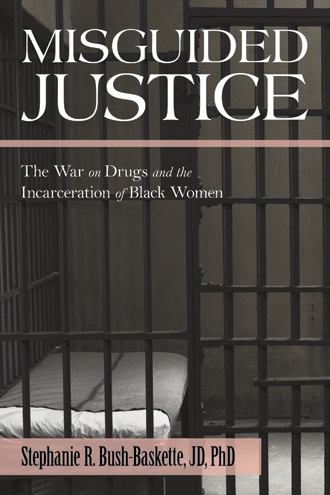
In 1995, I read an article by Marc Mauer and Tracey Huling in which I discovered there had been an 828% increase in the percentage of Black women who were incarcerated for drug offenses between 1986 and 1991. This statistic shocked me for two reasons: (1) the magnitude of the increase and (2) the fact that I had never before heard or read about any relationship between Black women and drug laws. As an attorney, former state legislator and gubernatorial cabinet member, I was quite familiar with how the enactment of laws and the implementation of public policy impact individuals and society in unexpected, unpredicted, and unpublicized ways. This one statistic, however, would direct me to the next path in my professional career. My goal in life had evolved over the years, informed and supported by various experiences, with the common theme being to help people to empower themselves to improve their lives and society. As an attorney, I used my skills of advocacy to represent people in contract negotiations, trials, real estate transactions and adoptions, to get them closer to where they indicated they wanted to be. As a state legislator, I had the opportunity to change some of the policies and laws that impacted individuals and society. One of the major policy changes I sponsored was the Family Leave Law. That was in 1988 when the first President George Bush vetoed it at the federal level, and I was able to negotiate it through passage in New Jersey. Years later the federal government would use New Jersey as a test case to determine if the policy should be enacted nationwide; it was. I left the New Jersey State Legislature to join Governor James Florio’s Cabinet as the State Commissioner of the New Jersey Department of Community Affairs. In assuming that role, I was able to implement policies that were closely related to many of the bills I had sponsored and committees I chaired or sat on while in the legislature. I also became more keenly aware of the relationships between policy, politics, bureaucracy, and power. Prior to leaving public life, I was concerned about the absence of informed public participation in the legislative/public policy process. As I advocated in 1990 for raising the minimum wage in New Jersey to $5.05, I found that as a prime sponsor of the bill, I was one of a handful of people present at a committee meeting to argue why this was important to working people in New Jersey, as business lobbyists retorted that there was no need to do so because they already paid their dishwashers $17.00 an hour. I also became intensely aware of the power the media had on the formation of public opinion. What was most disconcerting was that the media’s influence was not just through newspaper articles that may have been written from sometimes biased and uninformed perspectives, but equally influential were headlines, bumper stickers, billboards, and the ranting and raving performed by many talking heads on television “news” programs. I began to understand how important an active informed public is to the development and implementation of good public policy. It is not about “government they” it is more appropriately “government we.” This recognition led me to earn a doctorate, as I determined that a very good place to transfer the tools by which people may empower themselves and society was at a university. It was my goal not to tell people what to think, but how to think. Now, years after teaching at a university, being a researcher for a national nonprofit research institute, and directing an academic research center that is tasked with bridging the research divide between community and campus, I realize that it is not simply about teaching people how to think, but it is equally important to provide information that they can use in their personal and professional lives to make informed policy decisions. Thus, I share my experiences and expertise as a policy maker, lawyer, politician, educator, researcher, and person who believes that we all have a role to play in the development, implementation, and review of policies that impact our society. This book is not about me, but as a researcher and author, I believe that it is important that the conveyor of information provide relevant background to readers that explains who they are and how they come to the research. As human beings, we all have our perceptions of reality and something to share; all are important in the development of policy. My purpose for writing this book is to provide information by which we may answer the questions: Shortly after its inception, was the war on drugs a war against Black women? Now, more than twenty years later, and the general public’s and media’s attention to the war on drugs have diminished, do the drug policies continue to impact the incarceration of Black women, and if so, how? When the initial drug laws were passed, there was no research available to either support or refute the underlying assumptions of the bills that were being enacted. In the past 20 years, not only is there research by which to evaluate the policies, but there have also been various methods approved by which to circumvent the perceived harshness of the laws in specific situations. The question that must also be asked is: Have these “safety valves” or remedial alternatives lessened the harshness of the application of the drug laws on Black women? Once the reader has completed this volume, it is expected that they will understand some of the demands that led to the enactment of the original federal drug legislation, as well as the ensuing remedial alternatives; the political process that responded to the demands, including who the governmental actors and institutions were who did and have been playing an ongoing role in this policy development and analysis; the decisions and policies that resulted from the political process; the impacts the outcomes or impacts these policies have had on Black women in the federal system, as well as an idea of who these women are; and , how these outcomes have or may lead to new or continuing demands and support for further political involvement. I have included before most chapters, a short description about a Black woman who has been incarcerated in the federal system for a drug offense related to crack cocaine. I do so to continuously remind us that this discussion is about real human beings and not some academic debate about policy, politics, and statistics. After reading each case, I suggest that you ask yourself: Assuming the facts as presented are true, did the punishment this woman received fit the crime or was it misguided justice?
Formats

Book Details
About the Book
Stephanie Bush-Baskette was astonished when she read that between 1986 and 1991, black women experienced the greatest percentage increase of any group, including black males, in imprisonment for drug offenses. Not only was she stunned by the statistic, but also that the impact of the war on drugs on black women is almost never discussed. As a legislator, attorney, and gubernatorial cabinet member, Bush-Baskette is familiar with the development and implementation of public policies as well as the enactment and application of laws. This obscure fact concerning the status of black women in the criminal justice system became her touchstone as she earned a doctorate in criminal justice. In Misguided Justice, Bush-Baskette uses her expertise in the law and the legislature to investigate and then discuss the affect of the war on drugs on the incarceration of black women in the federal system. She provides an overview of what the war on drugs is; how it has impacted women and black people in general, and then focuses on black women specifically. She provides background and context regarding how the laws were implemented and how they have affected the likelihood and length of incarceration of thousands of black women for more than two decades.
About the Author
While an attorney practicing law, Stephanie R. Bush-Baskette, JD, PhD was elected to the New Jersey State Legislature and resigned in her third term to join the Governor's Cabinet as the head of the New Jersey Department of Community Affairs. Upon leaving public office, she earned a doctorate in criminal justice. She has taught at Florida State University and Rutgers University, as well as has been a senior researcher for the National Council on Crime and Delinquency. Bush-Baskette is a researcher, speaker, professor, and professional mediator. She lives in New Jersey.