
The Life of the Solar Pioneer Karl Wolfgang Böer
by
Book Cover & Preview Text
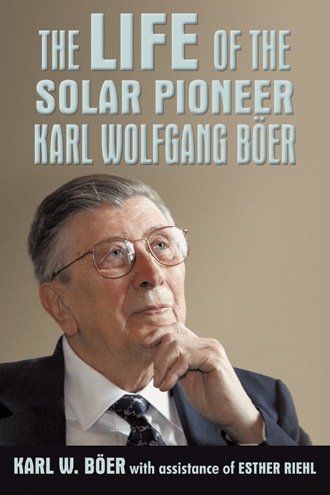
The Life of a Solar Energy Pioneer, Karl Wolfgang Böer Preview The book describes the life of the solar energy pioneer, Karl Wolfgang Böer, his research and inventions, and his leadership toward the application of solar energy for the future of mankind. It provides an inside view how he grew up as the only child in a sheltered life of a caring, highly educated family that provided constantly new challenges to him and gave him the uncommon freedom to develop his own science education. It also shows an insight into the closeness of his family with the letter exchange between him and his parents when he was a pilot and soldier in World War II. After returning to his hometown Berlin he found himself alone because his entire family had not survived the last days of the war. This chapter of the book gives a vivid picture of Berlin after the war, the struggle for food, the means of survival, earning the living expenses, and the first weeks, trying to travel to his University over bombed out streets and the first semesters sitting in nearly ruined classrooms. I spite of all these difficulties he graduated in physics summa cum laude after seven semesters at the Humboldt University. A year later he started to advise his first graduate student. After his Ph.D. in 1952 and his Dr. habil. in 1955, he became the first director of the division of Dielectric Breakdown at the German Academy of Science, and, two years later, he also became the director of the 4th Physics Department at the Humboldt University that was created in his honor. He managed to have a remarkable house constructed for his laboratories, workshops, classrooms and offices in a year when other institutes of the University and Academy still struggled to survive. It describes the close relationship to his teacher and mentor, Professor Robert Rompe, who had the influence and ingenuity to find the resources for his star student. A full professor in 1957, he now directed a group of 100 students and associates, all engaged in research of the photo-electrical properties of cadmium sulfide (CdS). Only 3 years later in 1960, at the age of 35 he became the youngest distinguished professor, the highest professorial rank at that time in Germany. This chapter also highlights the unusual closeness with his coworkers and students, his daily involvement with their research and the most exciting moments of achievements and discoveries. Also, in 1960 he created physica status solidi, now the largest and fastest publishing international Journal in solid state physics, and became its firs editor-in-chief. It gives an inside view of the complex processes and negotiations that lead to the founding of such a Journal that had its goal of cutting the publication time of all other Journals in half and succeeded. Living in West Berlin and teaching at the Humboldt University in East Berlin, the building of the wall in Berlin in 1961 brought an aprupt end to his carrier in Germany, and he accepted a professorship in the USA where he spent all his academic life at the University of Delaware. The book describes the most interesting years of adjusting to a different life style and mentality of his new home country and how he established himself as a leader again within a new Institute His goal of learning rapidly his new environment included a short teaching interlude at Stanford University, and many consultant appointments in government and industry laboratories. He became a fellow of the American Physical Society in 1975. During his sabbatical in 1969 he decided to change the direction of his academic professional career to fully devote his life to solar energy conversion in recognition of its global importance for the future of civilization. He felt that his entire academic and intellectual work prepared him well to contribute significantly to the slowly evolving field of solar energy conversion and, for him to become a major force of accelerating its progress. He took the well-known fact of limited fossil fuel resources as a driving factor, anticipating shortage of supply in the future. As a consequence he initiated a major effort at the University of Delaware, creating the Institute of Energy Conversion (IEC) and simultaneously as commercial arm a company Solar Energy Systems (SES), Inc. The oil-embargo that followed a year later helped to speed up his effort and to substantially increase the financial support. He also was able to secure the interest of the Shell Oil Company to provide the necessary venture capital. The primary hard ware, namely the CdS/Cu2S solar cell was based on Böer’s two decades long research in CdS. As a first internationally visible step he planned the creation of a unique solar house which incorporated his solar cell and pioneering parts to convert solar energy simultaneously into electric and thermal energy. In careful preparation, with the best scientists, engineers and architects in his team, they designed this house which was inaugurated in 1973 as the Solar One House of the University of Delaware and it made international headlines. With the overwhelming success came hundreds of invitations to present the results internationally, in Radio, TV interviews, local and international conferences. Solar One was introduced in many countries of five continents in the following years. The book describes how in the meantime the research on the solar cell proceeded rapidly in IEC and its commercial development in SES, Inc. This became the base for the future years of Böer’s activities. At the University of Delaware he became a Distinguished Professor of Physics and Solar Energy. He then accepted an election as the president of the Solar Energy Division in USA and turned it into the American Solar Energy Society with its professional office and publication arm, creating its own professional periodicals. After summarizing his life’s academic work and hundreds of his publications in a series of four books, the last two only printed in 2009, and dozens of books on Solar Energy, he began systematically to stimulate the introduction of solar conversion worldwide. He published reviews, gave keynote addresses and many invited presentations at international conferences. He was awarded the prestigious Solar Energy Medal of Merit in his name in 1991. This award with a substantial endowmentis given by the University of Delaware that is presented biannually, together with the International Solar Energy Society to the world’s leaders in solar energy, the first recipient being the former President Jimmy Carter. Professor Böer created several international Journals in his field and in solar energy with him as the chief editor. And he sought close contact and personal friendship with influential political leaders. Above all, he never retired from solar cell research, and only recently succeeding to solve the decade-long puzzle why his crystal, the CdS is such an excellent partner to many other thin-film solar cells, improving their performance substantially. Recipient of many prestigious awards in his field, inducted into the world’s solar energy hall of fame, a fellow of four professional societies, he has untiringly moved solar into the forefront of public recognition and to commercial success. A pioneer in solar, in publication, in the development of professional societies, ground breaking in interrelation between university and industry, Professor Böer was always at the forefront of aggressive development and has achieved lasting impact on every front of his activities. The book also deals extensively with the diverse, highly organized personal life of Professor Böer, his intense personality, his wonderful active relationship with his beautiful and very successful wife, his caring relationship with his family, his pride of seeing his two children and two foster children very successful in their lives and his close and never ending relationship with his students and coworkers.
Formats

Book Details
About the Book
In 1973, Dr. Böer created the Solar One house, the first house to convert sunlight into electricity and heat. His leadership made a lasting impact on science, engineering, and the solar industry. The Life of the Solar Pioneer Karl Wolfgang Böer describes the life of one of the most influential and recognized solar energy pioneers. It is a must read for anyone interested in the modern development of solar energy, Böer’s dynamic life as one of the key movers in the field, and his world authority in CdS (Cadmium sulfide).
It provides rare insight into the personal life of a scientist growing up in turbulent postwar Berlin. After his emigration to the USA and his transformation as a leader in solar energy, he set the direction for the future in significant ways:
• Bridged the divide between academia and industry
• Wrote over 350 science publications, dozens of books, and patents
• Created the most successful international solid state physics journal
• Promoted worldwide implementation of solar
energy
About the Author
KARL WOLFGANG BÖER, born in Berlin, Germany, a Distinguished Professor at thirty-five, immigrated to the United States in 1961. World authority in CdS, pioneer in solar energy, he created the Solar One house at the University of Delaware in1973 thereby initiating the modern movement of solar in the early 1970s.
A collection of dramatic poems by the author, written in 1945/6 is published by iUniverse under the title War and Peace, by the Young Wolfgang Böer in original German with English translation.