
If I Won 25 Million Dollars in the Lottery
A Book about Money, Hope, and Happiness
by
Book Cover & Preview Text
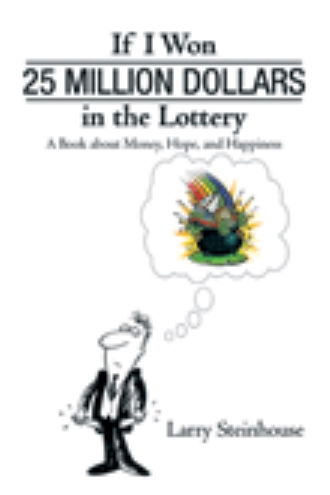
Table of Contents Chapter One Where Are We? Chapter Two Money Makes the World Go Around! Chapter Three A Fool and His Money are Soon Parted Chapter Four The Balanced Budget Chapter Five The Lottery Chapter Six My $25,000,000 Chapter Seven I Forgot to Buy My Ticket Chapter Eight Fear vs. Desire Chapter Nine Overcome the Fear and Reach For the Stars! Chapter Ten Your $25,000,000 Chapter Eleven What we think about… Chapter Twelve Income Chapter Thirteen Don’t make a living, make a life Chapter Fourteen Happiness is… Chapter Fifteen Destiny Chapter 1 Where Are We? It is the year 2009 and it is a good time to be broke! Why, you ask? Because everyone is broke, or in fear of being broke. The heyday of the late nineties and the easy money-lending of the 2000s made it easy for too many people to spend or invest borrowed money. Let’s take a bit of a time shift and later I will explain again why it is a good time to be broke. I remember hearing a story, a long time ago, that may even be an urban legend. This is how I recall it. William Rockefeller, easily one of the richest men alive in the late 1920’s, was said to be getting a shoe shine at a shoe shine stand. He over-heard the man shining his shoes bragging about how he (the shoe shiner) was going to be rich because he found “the secret” to investing in the stock market. As the story continued, Rockefeller immediately went to his office and sold all of his stocks after that day. The stock market crashed and the Great Depression happened soon thereafter. Of course, Rockefeller retained his riches because he sold all of his stocks. He took the sign of the shoe shiner’s enthusiasm as a clear warning that the stock market was no longer the place to invest. Let me explain. You see, as Warren Buffett puts it, “be fearful when others are greedy.” If that story was non-fiction, then it is easy to understand that Rockefeller was very fearful. After all, if a common shoe shiner could brag about the riches he could make in the stock market, then how could the highly educated and learned people like Rockefeller be smarter or richer than a common shoe shiner? Not that there aren’t stories about people pulling themselves up in society, but this clearly was not going to be one of them. The Great Depression happened simply because the value of anything material has a current value. With time, the right effort, and, most importantly, demand for an object, anything should increase in value. Unfortunately, when the demand for an object is artificially inflated, the price of the asset also becomes artificially inflated. This creates artificial wealth and, most importantly, the greed factor! The greed factor is simply the notion, “If he could do it, so could I.” So if your neighbor has come over one day to tell you of the brilliant stock pick he made at $7/share and it is now $107/share, you decide you can do this as well. After all, he is of the same education and social status as you, so you must be as smart as he. Of course he neglected to tell you of the last ten poor stocks he invested in and that he is still down thousands for the year. All you know about is the mega gain, so you try it! Of course the stock you buy at $35 a share, expecting to go to $350 a share, goes down to $20 and get you extremely disappointed. I know this because it has happened to me several times. You don’t lick your wounds and give up; you continue to try to make it rich in the stock market because you continue to replay in your mind your neighbor’s joy in telling you that story of his making all that money, even though you have little to no knowledge of the stock market and why a stock goes up or down. Now you think about the equity you have in your biggest asset: your home. Interest rates are down, so you borrow the money and invest in stocks and real estate. As the common man, why wouldn’t you do this? After all, you could borrow the money at about 5% per year interest while most stocks appeared to be going up over 35% per year, for a net profit of about 30%! Some stocks were going up over 100% per month and if you picked one of these, well that could be a lottery winner right there! I wonder how many people reading this are laughing at themselves, for they have thought this very thought and borrowed money from all kinds of sources—like equity loans, or credit cards, or other sources—just to pay the “ticket” to ride the “gravy train” of future wealth. Think about the possibilities. You could start with a small amount of capital, let’s say $1000, pick the right stock or stocks and your money could double every month. If my math is correct, that would be over 2 million dollars by the end of the year. Isn’t this what we expect when we go into the stock market? Jealousy, and the idea that “this is America, the land of opportunity,” makes the common man do very stupid things with his money. The Depression was said to happen because too many people borrowed money on margin to buy stocks. The demand for stocks stopped because people could not borrow any more money. This made the demand for stocks decrease and the stock prices started to fall, triggering a downward spiral of stock prices. Simply put, you had the stock holders watching the stock prices go down and selling stocks, which of course lowered the price of the stock, which of course made more stock holders sell, which lowered the stock price more, which of course caused more people to sell, which of course… …I think you get the point. Unfortunately, there was another problem: leverage. Leverage is when you use other people’s money to invest in or buy something. Leverage is an investor’s dream! It is simply borrowing or using money that is not yours. You will pay a fee for that money, usually interest or maybe an upfront fee. You then purchase your investment asset, sometimes using that very asset as collateral for that loan. So in the Roaring Twenties (that’s the 1920’s for those who are too young to have heard that expression), many people borrowed money to invest in the stock market. As the stock prices started to fall at the end of the 20’s, the “lenders” started to demand their money back. Now the investors had to sell whatever stocks they had to try to repay these loans. Well here comes another selling frenzy, causing the stocks to dive further in price. Now we have several banks and investment houses out thousands of dollars that they lent to the “shoe shiners” and other average people with no chance of ever recovering this money. This caused banks to literally close their doors and everything from small life savings to fortunes were lost by millions of people and corporations. Even the people who were responsible with money lost everything they had because the banks were irresponsible with the assets of these depositors. Next, the corporations who lost millions because the stock price tanked had to do something to increase profits, so they simply “cut the fat.” They lay off thousands and thousands of people. Now millions were out of work, leading to less money flowing into the economy, lowering sales estimates for many companies, causing demand for everything to go down, causing prices to go down, causing more losses, causing more fat to be cut and the vicious cycle continued until there was a recession and then a depression! A depression, as it is defined, is a severe economic downturn that lasts several years. In July 1929 the Dow Jones industrial average closed just at the peak of about 347.47 dollars. Then it all came to an end. In December 1932 it was about 59 dollars. That is about an 84% loss in value. Imagine that! That means, in today’s economy, the stock market which peaked in 2007 at about 14,000 dollars would be at about 2,100 dollars.
Formats

Book Details
About the Book
Do you ever wish you would win the lottery? Would it surprise you to know that you can win the lottery without buying a ticket? By using the metaphor of winning twenty-five million dollars in the lottery, author Larry Steinhouse will guide you to a better and more successful life in the areas of money, hope, and happiness.
If I Won 25 Million Dollars in the Lottery describes several ways to take your destiny into your own hands. You will learn how to:
- Harness the power to put money aside for retirement, for investment, or for the right opportunity
- Understand the rules of money that will help you control your financial future
- Control your feelings and avoid distractions from your true meaning of life
- Make your pursuit of happiness a joyous pursuit
- Live a better life and break away from this recession
- Move forward and avoid any future recessions
- Have the power to control all that you want in your life
About the Author
Larry Steinhouse was born and raised in Canarsie, Brooklyn, NY. He found his way through New Jersey to his current home in Bucks County, Pennsylvania. Larry is just a regular guy. He has had his ups and downs and like most people, he is suffering through the current economic turmoil. He has no special degrees or titles. He is a graduate of the school of "Hard Knocks". He believes in himself and believes he can help you make a difference in your life. Successes and failures have a part in the story of Larry's life. In this book, he shares with you the keys to his success and his future success and helps guide you to yours. Visit him online at www.25milliondollarmasterminds.com.