
Crossing the Threshold of Confusion
by
Book Cover & Preview Text
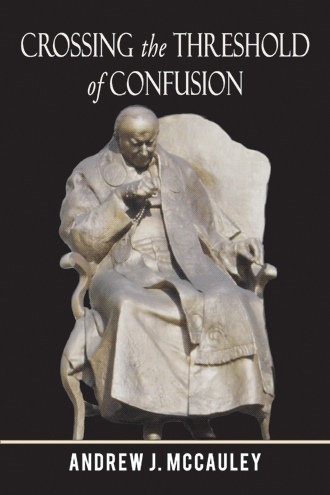
The main purpose of this book is to present the case against the canonization of Pope John Paul II. Despite all the hoopla about the Pope, I believe that he has, in many respects, been an unparalleled disaster in the history of the papacy and of the Church. Rather than canonization, his record would seem to warrant condemnation, as was done to a previous pope, Honorius, for negligence in opposing a heretical view. And, it is maintained herein, what Pope John Paul II has done, and has failed to do, is far more egregious than any fault attributed to Honorius. But before going into his record, both before and after his election as pope, this book tries to explain (and we think successfully) how the guidance of the Church by the Holy Spirit is still compatible with both a harmful Church Council and a poor pope. There is a risk, of course, to the faith of Catholics in exposing the misfeasance of a pope. Catholics believe that the Holy Spirit guides or at least influences the selection of a pope. Could the Holy Spirit then be involved in the selection of a bad pope? On the other hand, the canonization of a bad pope would have a very far greater negative impact on the Church and the faith of the people once the full truth about this pope came out. A similar problem exists as to ecumenical councils. Catholics believe that the Holy Spirit guides such councils, yet many Catholics believe Vatican II was a disaster for the Church. This problem is addressed in Chapter II of this book. As explained, Vatican II probably prevented a much greater disaster. It was, I believe, Fr. Charles Davis, a liberal theologian, who may have supplied the clue that explains this problem. He said that if they (the dissenters) had five more years in which to consolidate their power and influence within the Church before Vatican II was held, they may have been able to have taken more complete control of the Council, and so greater control of the post-Vatican II Church. Of even more importance, the Council then most likely would not have been substantially a pastoral council, but rather one proclaiming infallible dogma, thus jeopardizing the claim of infallibility by the Church in its teachings. Pope John XXIII would have been dead by then, and his successor would probably not have limited it to the status of being a pastoral council, as did Pope John XXIII. While the Holy Spirit may also guide and influence the selection of a pope, man still has free will, and human factors may also have played a role here, including the spiritual state of the faithful. I believe it was St. Teresa of Avila who said, “We get the kind of pope we deserve,” indicating that the human factor is involved, for good or bad, in the selection of a pope. But only God knows all of the factors involved in the selection of a pope. Some popes were probably chosen because they were especially effective in dealing with certain problems then threatening the Church, such as Pope Gregory the Great and St. Pius X. The latter dealt with the threat of Modernism in a manner that would be considered imprudent, if not draconian, today. He did more than denounce it, and then go back to philosophizing. He ordered that “Councils of Vigilance” be set up in every diocese of the Church worldwide in order to extirpate the errors of Modernism. The body of this great Pope has never undergone corruption. But the truths he fought to defend and preserve have undergone much corruption in many precincts of the Church today, thanks in a large measure to one of his successors, John Paul II. Therefore, it could be said that a morally decadent people would, in the words of St. Teresa, get the kind of pope it deserved. Further, as is pointed out in the second chapter of this book, St. Paul explains even further how not only a pastoral council but also a pope could cause some harm to the Church and its people, despite the Holy Spirit’s influence on both. He than talks about how “even the elect, if possible, will be led astray.” He said that the time will come when the people will no longer have “the love of truth that they might be saved.” Therefore, he says, God allows a misleading influence so “that all may be judged who have not believed the truth, but have preferred wickedness” (2 Thessalonians 10-12). As is said in Revelation 3:15, 16, “Because you are lukewarm, neither cold nor hot, I will spew you out of my mouth.” And so both Vatican II and the pontificate of Pope John Paul II may be part of God’s pruning operation of what were already dead and lifeless branches. St. Theresa and St. Paul, then, may have given us some insight as to how a pastoral ecumenical council, and the selection of a poor pope, a successor of Peter, could still cause harm to the Church and its followers without being basically opposed to the will of God, by preventing greater future harm, or by bringing about the justice of God. As also indicated, the selection of a good pope could be a useless gift to a twisted and perverted generation. The key phrase in the above is that the people no longer have “the love of the truth.” Just as God would not perform useless miracles for a faithless people (see Mark 6:5), so too it may be that God would not intervene to give us a good pope who would not be effective in dealing with a turncoat generation addicted to delusions and lies. In other words, God probably would not provide a good farm manager for a barren and arid land. God does not do vain things. These problems are explained more fully in the text of the book, and hopefully the reader will see more clearly how God sometimes writes straight with invisible ink. The rest of the book is primarily devoted to the record of John Paul II and the harm he has done, or has allowed to have happened, not only to the Church, but also to Western civilization. This preface will give a brief summary of his disastrous reign. Probably his most notorious acts of negligence and pontifical moral misfeasance was his handling of the priestly sexual abuse scandal and his creation of the milieu from which it sprang. And his handing of the case of Fr. Maciel of the Legionaries of Christ demands some explanation. It has now been revealed in New Oxford Review that when Pope John Paul was informed that a candidate for bishop was reported to be a homosexual, he would tend to appoint him. The reason given was that in Poland when the regime wanted to portray someone as an enemy of the state they would spread the rumor that he was a homosexual. It is alleged that Pope John Paul II was reacting against this policy, an explanation that strains creditability. It at least indicates a failure to appreciate the evil effects of allowing this perversion to take root and flourish in the Church of God. Whatever his motives, there did appear to be a good number of homosexuals among the bishops he appointed. Moreover, he appointed many bishops who have undermined Catholic moral teachings and the doctrines of the faith, allowing seminaries to become homosexual havens, and allowing heresy and depravity to flourish in the American Catholic Church. As such, Pope John Paul II, who coined the phrase, The Culture of Death, probably has done more than any person of our time to unwittingly promote The Culture of Death. Consider: Barack Obama may not have won the election without the organizing efforts of ACORN, which was supported by the Campaign for Human Development until about six months before the 2008 election. But this was perhaps not a major contribution to the Obama campaign. Right to Life activist Randy Terry said that, “Their silence and cowardice over the last 12 months paved the way for Obama’s victory, and will cost millions of innocent babies their lives.” But cowardice, if such be the case, may not have been the motivation of some for their silence. What may have been almost as useful to the Obama campaign was a weak and at times ambiguous opposition. It is also even possible that some were, in eff
Formats

Book Details
About the Book
Despite all the hoopla about Pope John Paul II, some believe he has been an unparalleled disaster in the history of the papacy and of the Church. In Crossing the Threshold of Confusion, author Andrew J. McCauley examines the record of this pope and discusses the harm he has done or has allowed to have happened not only to the Church but to Western civilization. McCauley uncovers countless faults many Catholic leaders have overlooked, including: • Pope John Paul II’s failure to enforce discipline in the Church, especially against widespread sexual abuse by priests; • his statements alleging and implying universal salvation; • the destabilization of marriage caused by his theology of the body ; • the conflicting messages that confuse the Church’s position on capital punishment; • his stance on the nature of the Church as a result of Vatican II. This exploration of recent Catholic history studies the ideas, writings, and policies of Pope John Paul II, from his life a young priest to his final days as pope, and examines their compatibility with traditional Catholic doctrine and practice. Crossing the Threshold of Confusion presents a case against the canonization of Pope John Paul II and demonstrates how his record warrants condemnation.
About the Author
Andrew J. McCauley was formerly an attorney for the Catholic League for Religious and Civil Rights and a contributor to Latin Mass magazine and The Wanderer. He was admitted to the New York State Bar in 1956. Retired, he lived in Florida until his death on April 9, 2010.