
Yom Kippur
The Day of Atonement
by
Book Cover & Preview Text
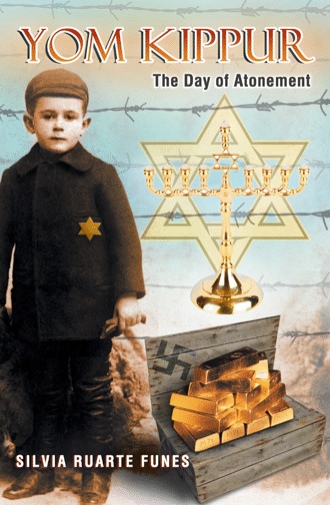
The story begins in Varsovia, 1940, with the Yon Kipur celebration, for peace and forgiveness. The Asser family is seated around the table, where a gold menorah is viewed and which will become a symbol of their family union (as it will also reappear at the end of the story). The family is composed by Gabriel, his wife and their three children, Elias, David, and Sarah. Gabriel has a business of antiques and art objects, assisted by Sarah. The persecution of the Jews has already begun but the Assers have not wanted to abandon their city.
That night they are preparing to begin the celebration when the Nazi officers burst into the home and the family is arrested.
They are taken to the “ghetto” where they spend a year of sufferings. The oldest son, Elias, finds a way to leave and bring food for his family, but he is discovered and is brutally executed in front of his family. Finally they are taken in trucks and train to Auschwitz, where they are admitted into one of the four concentration camps. The family is separated, mother and daughter are together and father and son are also together elsewhere.There they will spend four years. The mother will be the victim of the gas chamber, the father will disappear without a trace, until the end of the story. Sarah will be placed in the section of control and classification of clothes and valuables stolen from the victims, and she will not suffer much, while David, almost a child, will witness the hospital horrors and torture chambers, having to clean this sinister places in addition to polishing soldier’s boots.
At the time of liberation the double plot begins. The problem of the transfer of the nazi treasure arises, to which the officer Hans Muller is assigned, who meets David and then Sarah. He grows fond of both of them and decides to help them escape and take them with him to South America.He is able to introduce both in a submarine bound to Portugal as a first stop. There he obtains false identifications for everyone and they continue towards the southern coasts of Argentina. During the journey Sarah and Hans fall in love.
Once disembarked, they recover the treasure and sink the submarines. Aided by the Germans residing in that location they take refuge first in an estate, then they head for Bariloche, where they rent a house. Hans and Sarah decide to marry. They remain in Bariloche during various years, until having a family of two children, Esther and Juan. During that time various nazi leaders also enter the region as residents, like Mengele and Eichman. The ODESSA organization controls what was administered by Hans, overtakes the management of all of these refugees, selling the art objects, in complicity with and under the government’s protection.David, Sarah’s brother, has never forgotten his sufferings under the Nazis and does not accept his sister’s situation, despite owing his life to Hans. He decides to move away and head to Buenos Aires with a friend.
The situation in Bariloche becomes difficult due to the appearance and harassment of Mossad Israelites agents, which persecute the Nazi war criminals. Hans decides to leave and look for another place to settle. They go to the southern part of Chile, where they remain for a while. Finally they reach Santiago of Chile where they will reside indefinitely in a beautiful home.The children grow. Esther now studies journalism and Juan engineering. They are both unaware about the truth about their parent’s identities. The family enjoys a privileged social and political status, due to Hans close ties with the government. However, an indiscrete conversation heard by Esther forces her mother to confess her past and his father’s true identity, as the whole family was known by the adopted name of a deceased swiss man.
Despite the government’s protection, the Mossad continues their attack attempts. Hans suffers a first attack by the Israelite agents, that he is able to repell. But a second attempt scares Sarah, since it involves their son. Fortunately he comes out uninjured but it provokes Sarah’s decision to move away from her husband as she did not tolerate so many years of tension and anguish. She travels to Buenos Aires to stay with her daughter. Her son, Juan has married Judith.In Sarah’s absence, Hans remains by himself in the Santiago residence until one night the Israelite agents attempted another attack. This time, more successfully. Hans as well as his assistant Klaus are shot and their bodies disappear without a trace.
Sarah, Esther and David hurry to Santiago at the news of the attack and Hans’ disappearance. All of the investigations become fruitless and Esther and Juan return to Buenos Aires. Sarah remains in Santiago with the hope of her husband’s return. One night, she hears someone approaching the home, and a letter is slid under the door. Sarah thinks she recognizes Klaus, Han’s assistant, through the window. Upon opening the envelope she finds some documents and a letter from Hans; he explains to her that he has not ceased loving his family but he renounces them to prevent more suffering. He leaves her his property and asks her to turn into the german government the major portion of her fortune, for the open account used to compensate the concentration camp victims. With the rest he asks for her to fund an orphanage for deprived children.Time passes. Sarah lives again with Esther; Juan has had children and grandchildren. A granddaughter, Ruth has prepared for them a very special birthday with a surprise. Mid-celebration Ruth calls for their attention, and upon Sarah’s and David’s surprised gaze, a little old man enters the living room, Gabriel, the father that had disappeared so many years ago. Ruth explains that thanks to a television program that searches for persons they had been able to locate Gabriel, who has settled in Israel.
At the same time, this episode is being watch in wonderment, by Hans and Klaus in some remote part of the country.The family decides to visit Israel and celebrate the Yon Kipur this year in Jerusalem in gratitude of the happiness of having been newly reunited. Like in Varsovia, the family begins the ceremony when someone knocks on the door; a messenger brings them a package. Upon the enthusiastic gaze of the whole family Gabriel discovers, upon opening the package, the same golden candelabra where he had engraved the names of his daughter, sons and wife 50 years ago. Sarah approaches it and reads a little card hanging from one of the seven arms and reads the word, “Forgiveness,” at recognizing Hans’s handwriting she runs out to the street. From faraway she perceives a silhouette that she recognizes as her husband’s. She runs after him, reaches him and both enjoin in an embrace. Gabriel, having followed them, approaches them and takes both of their hands and joins them in an act of forgiveness and reconciliation.
This story, taken from real life, has an epilogue. In it, it is discovered that the writer is Esther Asser Mulet, Sarah’s own daughter. Her work has been shown on the big screen with great success. In the premiere the journalists surround Esther asking her about her opinion about the main theme of the movie: forgiveness and the reconciliation among the peoples.Sarah appears, very elderly, and they both move away; Sarah’s last words to her daughter express her eternal unconditional love towards her husband.
Formats

Book Details
About the Book
Birthed from a mixture of real life testimonies and fiction, YOM KIPPUR unfolds as a Jewish family suffers the horrors of the Holocaust. Through the cruelest of separations in which survival is a daily miracle, only one thought unites them: They must live to be reunited! Enduring pain in the most terrible conditions, their feelings fluctuate from hatred to love and from calm to storm. Will the child ever forget the scenes he witnessed in the “operation room” of the concentration camp? Could an enemy really help him escape? Could a love be strong enough to overcome the barriers of animosity and rancor and to arise out of the post-war chaos and destruction? Must their lives be forever bound to the cursed war booty? Could uniting themselves to the itinerary of the Nazi gold be their path to freedom? Yom Kippur will lead you step-by-step through the answers to these questions to its surprising outcome, enveloping you with its plea for love and forgiveness while bringing you to tears.
About the Author
B,>Silvia Ruarte Funes: (BIOGRAPHY)
Born in Mendoza, Argentina, Silvia has been a docent for 24 years. She perfected her studies in the area of theatrical writing. In 1991, she was presented as a writer in the Municipal Hall of Culture in her city. Her writings were broadcast on FM radio, producing a warm response from listeners. She has participated in cultural events, such as an exposition of paintings and poems entitled, Painting with Words the Beauty of Life. After many years, she now presents her novel, Yom Kippur: the Day of Atonement. She currently lives in Texas where she continues to express her experiences through her writings in which each word and line becomes a direct message that reaches deeply to nourish the spirit.