
The Lord and The Weedpatcher
by
Book Cover & Preview Text
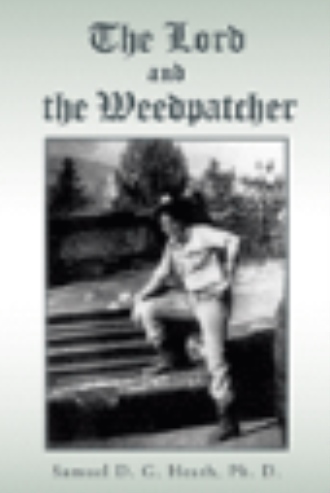
I often wish my grandparents had written the stories of their past that my brother and I were told as children. Since they didn't, I made the decision I wouldn't make this mistake and wrote this book in order that my children would have the stories of my wilderness adventures in hand. For example, my years spent on a mining claim without any conveniences like electricity, gas or indoor plumbing. The thousands of acres of the Sequoia National Forest, the wild and untamed Kern River that ran through the valley in those days, these were my personal playground and made for many an interesting incident and adventure. The collection of stories grew into this book in the hope that they will not only be entertaining to others, but will inspire some of that pioneer spirit in people who are too easily caught up in a concrete and plastic world. I also include stories of my experiences in the Camelot of the fifties California South Bay area of Redondo, Hermosa and Manhattan Beach when the air and water were pure and the beaches clean and uncrowded. In this environment, we were the Lotus Eaters of our generation. In such places, I lived a life the great majority of people have only known through the vicarious titillation of films. Sadly, it was a life the present generation will never have a chance to know apart from books like this. But it makes such books important for the sake of keeping the pioneer spirit of our heritage in this nation alive, a spirit that reaches out to the stars as our heritage and our destiny. I was born 1935 in Weedpatch, California. That was the year Billy Sunday and T. E. Lawrence died, Hoover Dam was completed, Huey Long was shot and President Franklin D. Roosevelt signed the Social Security Act. It was also a year of great films. Hopalong Cassidy made his first appearance in a movie, Nelson Eddy and Jeanette MacDonald in Naughty Marietta and Roberta, Fred Astaire and Ginger Rogers in Top Hat, Clark Gable in Mutiny on the Bounty and Call of the Wild, Errol Flynn in Captain Blood, and a real thriller The Bride of Frankenstein- and Bruno Hauptmann was found guilty of kidnapping the Lindbergh’s baby. Apparently my mother, who was only sixteen at the time, didn't like seeing doctors and the hospital in Bakersfield was out of the question. So I was born on a kitchen table in the little farmhouse surrounded by cotton fields. That might have been just as well. At least I escaped circumcision. However, the lack of prenatal care led to complications that caused some doubt of my surviving birth. But having survived, when I was older, my grandparents told me they had dedicated me to God if he allowed me to live. My name was to be Samuel in honor of the prophet because of a somewhat similar situation in the Old Testament. Since the day of my birth I believe there have been angels attending me else I would not have survived many things throughout my life. But for some reason, perhaps our mother's resentment of her parent's religious beliefs, I was called Donnie, my full name being Samuel Donald Glenn Heath, rather than Samuel. I would never be called Sammy. My brother, Ronnie, was born a little over 11 months after I was. My birthday was December 4th, his November 16th. But for some reason I never learned, probably because of my difficult birth at the farm, he got to be born at the hospital in Bakersfield. As a consequence, his birth certificate read Bakersfield. Mine read Weedpatch (in small, crabbed lettering a doctor who was called in at the last minute, Talbert E. Scherb, M.D., had noted: Near Bakersfield). Weedpatch had a few ramshackle shacks, an irrigation canal, dirt roads and its cotton. That was all; hotter than Hades in summer and freezing in winter. Like most of the San Joaquin Valley. The fine, alkali dust was all-pervasive. Our grandparents named our mother India Joyce. The India came from our grandad's Indian heritage. He wasn't ashamed of this and wanted to remind his only child he wasn't ashamed of it. But I don't think mom agreed because everyone called her Joyce. I never heard anyone call her India. I remember my father being a tall, lean Texan. My birth certificate gives his birthplace as Big Springs, Texas, and his occupation as farmer. It further states that my mother was born in Carlyle, Arkansas. I also remember the farmhouse had a big, ancient cottonwood in the front yard. I vaguely recall my baby brother and me playing under it. A rope hung down from one large branch. Maybe I swung on it. I don't remember. But I remember my father making me a toy airplane. It looked like it was made of a rough lathing slat. Or it might have been made of a strip of wood from an orange crate. It had a propeller and the wing was fastened to the top of the fuselage by wire wound around it. Maybe my love of airplanes started with this crude toy. We also had a metal top; one of those multi-colored ones that had a spiral piece of metal coming out of it with a wooden ball at the end. You placed the top on the floor, pulled the metal spiral up by the wood knob and as you pushed it down, the top would begin to spin. I'll never know how I did it but I got my lip caught between the spiral and the opening in the top. I remember crawling onto the bed with that top drooping from my lip. Mercifully, I don't remember how my parents got it loose. I was standing in the front of the house one day. I couldn't have been but about two years old. The road was built up at the front of the house to around ten feet above the end of our yard to accommodate a large culvert. I watched as a car came off the road and rolled over twice before coming to rest on its wheels. It was a brown sedan. The driver got out and shook his head. I don't remember any blood. Ronnie and I got on that road once. I was calling him Dee Dee by then. I don't remember when I started calling him Ronnie. There were small holes in the road about one-inch in diameter and spaced at about one-foot intervals. They continued up the road and we began to follow them. Eventually they stopped and we climbed down from the road into the cotton field below. But we didn't know where the house was. We couldn't see it over the high cotton. Our mother spotted me jumping up trying to see the house and came and got us. I don't remember this but my mother told me I got my father's straight razor one time and came downstairs with a bloody face and was saying: I bin shabin'. Our grandparents would visit often. Grandad always brought his bolt action .410 single-shot shotgun. He would lay the gun on the ground and sit. As a flock of blackbirds would fly over, he would pick up the gun and shoot at them. I loved the smell of the burnt powder. When he had enough, our mother would clean the birds and fry them. Sometimes, when the weather had been just right, the folks would pick mushrooms. Some of these would be over six-inches in diameter. Mom would butterfly and sauté them in butter. Marvelous. Grandad was especially fond of these and so was I. Our grandmother, Lorene Caldwell, was very fat. Maybe this is why Ronnie and I called her Tody. She would never be grandma, always Tody. We loved her dearly. But we had a great-grandmother, Mary Hammond Smith, Tody's mother, who lived with our grandparents. And we called her grandma. We loved her best of all. She bought two New Testaments with Psalms from the Jewel Tea salesman for Ronnie and Me. She underlined passages in each of them that she hoped we would pay special attention to as we grew up. There was a dance once. I remember our mother and father in the front seat of the car outside the dance hall, Ronnie and I in the back seat. They were drinking beer and drunkenly singing You Are My Sunshine over and over. Our father was wearing a gun. It looked like a cowboy pistol. I wanted to touch it but somehow knew I shouldn't. Our father left us when I was three
Formats




Book Details
About the Book
Throughout my life The Lord has been my constant guide and companion; and along the way I have found He has a sense of humor, some of which I disclose in these pages. Another thing; no matter how far I have drifted from the straight and narrow The Lord remained with me along with attending angels and love does indeed cover a multitude of sins. I can only account for my having lived as long as I have on this basis. The reader will understand what I mean once getting into this book.
Along my journey with the Lord I discovered many things, one of them being Einstein’s famous equation E=MC2 is incomplete because it does not account for life and death, yet these remain the two greatest mysteries they have ever been denying us thus far a “theory of everything.”
Some years ago I removed from the greater part of society to live in semi-seclusion alone with my books and thoughts in a quiet part of the Sequoia National Forest devoting myself to contemplation, speculating about many things and committing my thoughts in writing fulltime. As a writer and author given to much introspection and fascinated by human behavior, nature, and our universe it was important to me to simplify my life as much as possible as anyone given to philosophical speculation about many things must. That much of my writing covers some metaphysical thoughts about God, angels and demons, an afterlife and Biblical stories of origins, of prophecies of the End Times and so much more have been absorbing studies as well and I freely share my thoughts about these in this volume.
About the Author
Throughout my life The Lord has been my constant guide and companion; and along the way I have found He has a sense of humor, some of which I disclose in these pages. Another thing; no matter how far I have drifted from the straight and narrow The Lord remained with me along with attending angels and love does indeed cover a multitude of sins. I can only account for my having lived as long as I have on this basis. The reader will understand what I mean once getting into this book. Along my journey with the Lord I discovered many things, one of them being Einstein’s famous equation E=MC2 is incomplete because it does not account for life and death, yet these remain the two greatest mysteries they have ever been denying us thus far a “theory of everything.” Some years ago I removed from the greater part of society to live in semi-seclusion alone with my books and thoughts in a quiet part of the Sequoia National Forest devoting myself to contemplation, speculating about many things and committing my thoughts in writing fulltime. As a writer and author given to much introspection and fascinated by human behavior, nature, and our universe it was important to me to simplify my life as much as possible as anyone given to philosophical speculation about many things must. That much of my writing covers some metaphysical thoughts about God, angels and demons, an afterlife and Biblical stories of origins, of prophecies of the End Times and so much more have been absorbing studies as well and I freely share my thoughts about these in this volume.