
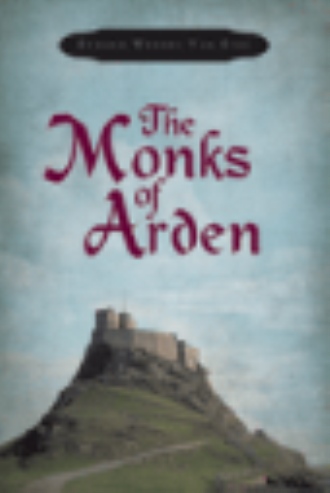
The Monks of Arden
by
Book Cover & Preview Text
A courier from London galloped up to the Kenilworth gate, demanding an audience with the prince. Sir Malcolm sounded the gong that would summon Lord Philip, Edward, and other members of the court. The chamberlain stepped forward to receive the dispatch. “Wait for a reply,” he said to the courier. Lord Philip, Prince Edward, and Piers Gaveston hurried to Pen’s privy chamber. “A dispatch from London, your grace,” said the chamberlain, handing it to the prince. “It is from the queen consort,” said Pen. “She reports that the king is in rapidly declining health, but is determined to make another raid on the Scots. We are to come quickly. Signed, Marguerite of France.” The prince hastily penned a reply and handed it to the chamberlain who took it to the courier. “We must leave immediately,” said Pen. “A day of reckoning is upon us.” The prince ordered fast horses for a journey that would take two days. The next morning, he, Edward, Gaveston, Eldric, Sir Guy, and six mounted men-at-arms set out for Windsor. They covered half the distance the first day, sending a rider ahead to notify a shocked innkeeper in the village of Aylesbury that the prince and his retinue would be arriving within the hour. The innkeeper’s boy ran to the church and told the warden to ring the bell. Quickly the street filled with people wondering nervously what was happening. “Get the pigs and dogs out of the street,” commanded the reeve. “There is a haunch on the spit over at the tavern. Clear the place out and put out the tables. Anyone have any silver? Grooms, where are they? Someone go to the stables and fetch them, and tell them to clean the mud and manure off their boots.” “The prince is coming,” someone whispered. Pen could see through the trees that everyone in town was scurrying about in preparation for his arrival, and so he slowed the procession to a leisurely walk in order not to startle the populace overmuch. It was not every day that the villagers saw eleven richly caparisoned royal riders come through town. The entourage entered the village between wagons parked in neat parallel rows. The villagers, hastily dressed in their finest, lined up on each side and bowed as the prince passed by. Pen reigned up in the middle of town. “A farthing to each child, and a penny to their parents,” he said to Eldric, who dismounted and opened his purse. The anticipation of the crowd was palpable. One child tried to rush Eldric, but his mother yanked him back by the hair. He almost tumbled backward as Eldric approached him, smiled, and handed him a coin. The lines of parents and children remained orderly. The prince dismounted, and as he strolled down the middle of the street, he watched as eager mothers shoved their nubile daughters forward to grab his attention. Young blondes and brunettes smiled shyly, curtseying to the prince as he walked by. They were little informed of what their parents expected of them in these circumstances and so their thoughts tended to wander through imaginary romances of their own creation. One saw Pen as a prince in shining armor who would rescue her from a common fate and whisk her off to the princely life in a castle. Another glowered as she looked down, imagining Pen to be an oppressive sovereign who would grind her and her family into perpetual poverty. One by one the girls, even those with the darkest imaginations, warmed to the prince as he addressed them individually. He was a noble with charm they could not resist. Pen, for his part, unmoved by their shy smiles, examined every girl as a possible candidate to join the Monks of Arden. * * * Upon his arrival at Windsor, the two princes were taken directly to the Rose Tower, since the king’s great chamber had recently burned. The Rose Tower was part of the greater royal residence with its own special entrance from the courtyard. The king occupied a suite of nine rooms, and the queen consort a suite of two. The princes presented themselves to the king. “My sons,” he said. “You have come to join my campaign in Scotland. God bless you.” Queen Consort Marguerite joined the audience. “Edward, I sent for them. You are not well and should not be going off to war again. You need to talk with your sons.” “I am quite fit, my dear,” he said, which set off a spell of coughing. “You don’t sound well, Father,” said Pen. “A few days in the saddle, and I will be as good as new. My sons, you are now of age. Today we hold a private ceremony to confer upon you the title of knight.” With difficulty, Longshanks hoisted his six-foot-two frame from where he sat to his full height. “Go, prepare yourselves.” The chamberlain escorted the princes to an adjoining room. There they were dressed in white vestures covered by red robes, with black hose and shoes. Bishop Augustus Ballantyne welcomed them to the royal chapel where they prayed. The bishop offered his blessing. “In nomine Patris, et Filii, et Spirtus Sancti. Amen. Lord, bless these two young noblemen of spotless character, heirs to the kingdom, keepers of thy Covenant. May their lives be long and illustrious. In nomine Patris, et Filii, et Spirtus Sancti. Amen.” Upon the princes’ exit, the court armorer delivered two swords and shields to the bishop who blessed them. The swords were straight, broad, and double-edged. The cross-pieces were curved toward the blades. Rounds were heavily jeweled and decorated with the lion rampant signifying the House of Plantagenet, as were the shields. Having completed the blessing, the bishop turned them over to the castellan Sir Arnaud, who would maintain custody until the presentation. The seneschal announced the entrance of the king and Marguerite. Piers Gaveston followed. King Edward sat beside the altar in a chair upholstered in red velvet. The queen consort stood at his right side. Sir Arnaud took his place to the king’s left. The king took the sword and shield intended for Pen. The bishop administered the Oath Knighthood. The knight does not traffic with traitors. He treats women with respect and never gives them false advice. The knight swears to observe all feasts and holy days and to attend Mass every day. Above al,l the knight swears undying allegiance to his sovereign. “Kneel,” said the king to Pen. He turned the sword to its flat side and firmly tapped Pen on the shoulder. “I dub thee Sir Knight.” Pen rose and Prince Edward took his place where the ceremony was repeated. Sir Edward was ecstatic, Sir Pen reserved. “Your brother will inherit this throne,” said the king to Sir Edward. “My wife thinks sooner rather than later. I prefer to be optimistic. I hope that your years at Kenilworth have stiffened your spine, else you will be a royal flop. When the time comes, I propose to send you off to be abbot at Combe abbey in Warwickshire. There, you will serve your sovereign by providing shelter for travelers, doing good works of charity, seeing to the religious education of the country boys, and overseeing the copying of documents and keeping the history of the realm. And be sure to take Gaveston with you.” * * * Sir Pen and his closest associates retired to the royal apartments. “The time has come. We must prepare ourselves,” he said. Sir Pen summoned Sir Edward and Piers Gaveston, and in the company of Sir Guy, requested an audience with the king and Marguerite. “Father, and Your Ladyship, I have something of great importance to tell you. For the first fifteen years of my life I accepted the role of your son and heir-apparent to the throne, but then I had a revelation which I have kept secret from all save a few.” “Like Paul on the road to Damascus?” said Marguerite. “Not exactly, Your Ladyship. It was of a different sort. For fifteen years you treated me royally. I have received the benefit of education, training in the martial arts, and the privilege of serving as master of Kenilworth Castle.
Formats





Book Details
About the Book
In the year 1269, Prince Edward kidnapped the newborn offspring of the last prince of Wales Llewellyn ap Gwynedd. Edward named him Penfelyn, the boy with fair hair. Being the older son, Penfelyn grew up as heir apparent to the English throne, but the plan unraveled when a bizarre secret was revealed and the course of Pen’s life changed forever. Going his own way, he accepted four, young female wards to be his pupils. Tutors and martial arts masters trained them to become highly polished warrior women. Upon completion of their education, Pen and the four young women formed a band calling themselves the Monks of Arden. They championed the poor and brought down the treacherous illegitimate sons of the Earl of Lancaster. In the course of their adventures throughout Europe they came to recognize a great unmet need among the people. There they left their imprint, which was ultimately lost to history beneath the shroud of the Black Death. Their great contribution was only resurrected in the twenty-first century when archaeologists uncovered a codex, The History, beneath the ruins of Beaudesert Castle.
About the Author
Ethard Wendel Van Stee is the author of nine books of fiction, plays and non-fiction. This is his seventh novel. Mr. Van Stee has been the director of the Beaufort Writers organization for fourteen years. He lives in Beaufort, South Carolina with his wife Gwen. You may contact him through his website at www.ethardvanstee.com or via e-mail at evanste@islc.net.