
Still Not Forgiven
by
Book Cover & Preview Text
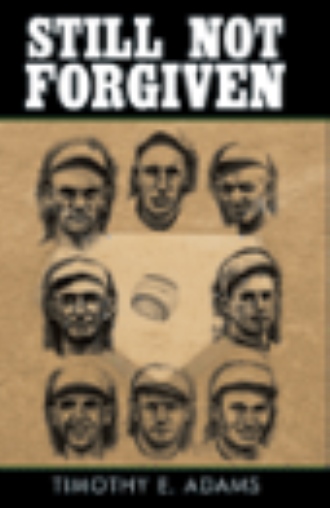
I am not sure that I totally agree with Edmund Burke: “Those who do not learn from history are destined to repeat it.” For example, I am reasonably sure that I will never be able to change the wheel on a covered wagon- or need to. This having been said, I believe that there are many interesting and enlightening chapters in the past. Properly told the lessons from these happenings can be conveyed to a reader in such a way that the material may be enjoyed enough that the “moral of the story” can bring true pleasure to the reader. Baseball has long been considered our “National Pastime.” On the professional level the sport is much more than that. Baseball is an entertainment business that attracts millions of customers every year. The revenue of this product now numbers in the billions of dollars annually. This has not always been the case. The evolution of the “game” has been a long, slow process. Professional baseball faced possible ruin nearly a century ago. Subsequent to the 1919 World Series no one could say for sure that baseball as it was then played would survive the largest scandal in its then brief and rather sordid history. In the months following the conclusion of the baseball championship it was alleged that some of the participants had deliberately lost the games, “for mere money.” Nearly ninety years later the questions have become more complex and the answers more complicated. In my childhood I asked my father why would anyone ever lose a baseball game “On purpose.” As an adult, I still don’t know. The tale is one of athletes, businessmen, politicians, gamblers and the American public. While each had an interest, their concern was not of equal measure. The mix resulted in an interesting flavor. Gambling is a unique phenomenon. It seems as though there are Americans who would bet upon which of two crickets will jump first. There are professional bookmakers who became rich based primarily upon this theory. Some of them are included in these events. Many athletes of the early Twentieth Century were talented, underappreciated and professionally underpaid. Some of the Chicago White Sox of 1919 plotted revenge. It did not end well. In this era a man could make a living owning a professional baseball franchise- or lose his shirt. The entrepreneurs in this saga were determined not to go broke, no matter how many lives they ruined. Politicians are paid to do what they are told. Who “paid” and who “told” is a major part of my presentation. The more some things change, the more they stay the same. I believe this story deserves one more telling. More important, I believe the interest of the American reader is sufficient to support one more adventure in this area. I hope you agree.
Formats

Book Details
About the Book
The 1919 World Series contains some of the most interesting occurances in the history of major league baseball. One team was giving maximum effort to win this world series while members of the other team were making efforts to lose the same contest. The background, motivation and outcomes of these efforts have long been a mystery. While there have been numerous efforts to explain these circumstances, this work is a fresh approach to understanding how the 1919 World Series affected the participants, baseball in it's entirety and the American public as a whole. While some of these circumstances are still clouded in mystery, recent research has contributed greatly to the knowledge regarding this World Series. It is hoped that the reader will gain insight and enjoy this presentation of that baseball championship encounter.
About the Author
I'm a graduate in History from Illinois State University. I have a lifelong interest in baseball. I have done extensive research regarding the Black Sox and the 1919 World Series.