
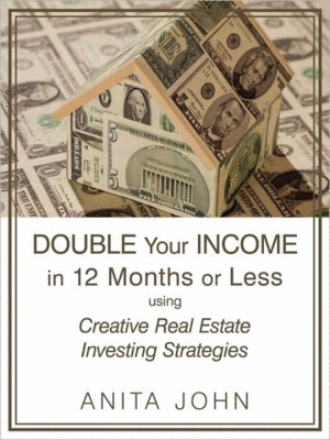
Double Your Income in 12 Months or Less
(using Creative Real Estate Investing Strategies)
by
Book Cover & Preview Text
DOUBLE YOUR INCOME IN 1 YEAR OR LESS (USING REAL ESTATE INVESTMENT STRATEGIES) Building Wealth In Communities By: Anita John BWIC Property Management, Inc. P.O. Box 304907 St. Thomas, V.I. 00803 Email: bwic777@yahoo.com www.busyrealestateinvestor.com Phone: 340-227-9637 E-fax: 305-397-2516 DOUBLE YOUR INCOME IN 1 YEAR OR LESS (USING REAL ESTATE INVESTMENT STRATEGIES) TABLE OF CONTENTS Introduction / Mentoring Program 2 Chapter 1 – Wholesaling / Make $500 - $5,000 in 30 days or less! 4 Chapter 2 – Real Estate Contract and Assignment 11 Chapter 3 – Lease Options / How do they work 13 Chapter 4 – Sandwich Lease Options / No Credit deals 22 Chapter 5 – Real Estate Investing Without Money 26 Chapter 6 – What to do 1st and Where Do I Begin? 35 Chapter 7 – How to Find Houses For Assignment /Motivated Sellers 38 Chapter 8 – A 30-Day PLAN OF ACTION (Using our 20 Step Process) 45 Chapter 9 – Contract Flips or Retailing 49 Chapter 10 –Your Support Team of Professionals 52 Chapter 11 – Pre-Foreclosures 62 Chapter 12 – Mentoring and Joint Venture Consideration 70 Appendix / Forms 71-81 I N T R O D U C T I O N “This software publication is designed to provide accurate and authoritative information in regard to the subject matter covered. It is sold with the understanding that the publisher is not engaged in rendering legal, accounting or other professional service. If legal or other expert assistance is required, the services of the competent professional person should be sought.” You’ve heard the stories! People on late-night infomercials telling you about fixing up properties and selling them for profit. Well, the truth is that you can make money using those very strategies (and it’s hard work). But, there is a better way to do it. It’s lower risk and with a smaller amount of effort from the Buy, Fix and Sell Method. Of course, anything you do will take time, effort and energy. What you want to do is work smart and reduce the potential risks while increasing your upside potential. You see, the problem with these infomercial programs is that they require a lot of time and money. How are you going to find the contacts or people with money while keeping your nose to the grindstone for the employer that allows you to put food on the table (you want excitement? – tell your employer that you need a paid leave of absence so you can go out and get started in real estate investment which will allow you to quit your employment). Obviously, quitting your full-time job is not the answer. And this doesn’t even address that matter of time. Do you dare neglect you current money-making activities to learn the complex methods and strategies that these programs require? What do you need? What you need is a means of breaking into real estate investment that needs a small amount of capital from you! Is that really possible, or is it just more hype? Keep reading and see. This doesn’t mean you can just do it any old way. There are certain fundamental principles involved. But if you do things the correct way, it can work. It involves working smarter and putting in the proper effort and motivation as well. So, what’s the trick? We mentioned certain fundamental principles that lead to success. Here is one that applies here and helps you make money without spending money and without putting yourself at a lot of risk: Strategy: You don’t need to own a property to make money on it, you just need to have control over it. What are your goals in real estate (both short term and long term): ____________________________________________________________________________________________________________________________________________________________________________________ Chapter 1 – Wholesaling: Make $500-$5,000 in 30 days or less! Real-Life Example #1: We’ll look at an example first, then the explanation afterwards. J.K. of Hartford, CT. caught the real estate investor bug while in college. He bought a beat-up old mobile home to live in, and over time painted, re-carpeted and generally made it pretty. When he graduated, he sold it for $5,000 more than he paid for it. He liked that so much that he decided to make investing his central occupation. The first deal he went after was a 6-unit apartment building in downtown Hartford. The price was great – unbelievably low. It turns out the reason for the low price was that the building had been involved in a fire. Evidently the owners at the time had failed to insure the structure and were forced into a fire-sale price. It’s always good to get a low price on a deal, but, the cost might be more that the sales price. In this case, our friend brought in a contractor to make an estimate on the needed repairs. Cost of repairs came out to $75,000. That was much more than this recent graduate of U-Conn had available to him. He was clearly in over his head. But J.K. was smart enough to know that he didn’t have to walk away from the deal. He knew that the purchase contract that he had with the owners of the apartment building gave him control over the property. How? • A real estate purchase contract provides the “Buyer” under the contract with the legal right to buy the property for the price stipulated within the time-frame given in the contract. • Nobody else may legally purchase that property for the life of the contract without getting say-so from the buyer under the contract. • The buyer under the contract will gladly give say-so formally and in writing for a fee. In this case, J.K. advertised the apartment building for sale in the two major Hartford daily newspapers for the price contracted for. As we mentioned before, this was an excellent price. This generated a good volume of callers. One of the callers was a general building contractor with both the capital and the crew to rehabilitate the building. J.K.assigned his interest in the purchase contract to the builder for $4,000. This is a true Win/Win situation. J.K. got $4,000 for his ability to find a deal and negotiate a contract. The builder got a great project without having to hit the bricks to find it: now his employees have work and he will make a lot of money off the building, either by selling it after the work is done or holding it for the on-going cash flow from rentals. The sellers got rid of the building that they couldn’t afford to repair. Bottom line: J.K. did not spend a penny to make $4,000. He didn’t lift a single paintbrush. He incurred no risk. In fact, in the unlikely event he was unable to find anyone to take the purchase contract off his hands, he would have evoked one of the contingency clauses in the contract that would have cancelled the deal with no further recourse to him. No Money, Working Smart, Proper Motivation and Limited Risk!
Formats

Book Details
About the Book
You can use what was written before here.... Include that I have 2 children and owns a successful consulting firm, through which she has provided lectures, training, and coaching services to more than 10,000 business owners. Visit her at: www.busyrealestateinvestor.com
About the Author
In this book, "Double Your Income in 12 Months or Less Using Creative Real Estate Investing Strategies." In this remarkable and revolutionary guide, you'll learn how to: • Work from your home 6-8 hours per week and spend more time with your family. • Put your kids through college with easy to manage real estate investments. • Purchase properties with no money down even if you have bad credit! • Quit your job once you’re earning the equivalence AND increase your monthly income. • Own a million dollars in real estate in less than 12 months. • Pay off all your debts – even your home mortgage, credit cards, auto, etc. • Create your customized business plan to guide you to success in the next 12 months. • Turn your business into a system that makes money over and over again! Anita John, is a Mortgage Banker. My educational and professional background is firstly an Accountant for 11 years and Residential and Commercial Mortgage Banker/Underwriter for the past 14 years. I hold a Bachelors Degree in Accounting from the University of the Virgin Islands and a Masters Degree in Real Estate Studies and Property Management from New York University. I have lived in New York City for the last 15 years, although, I currently live both in the U.S. Virgin Islands and also own a condo in New York City. She has 2 daughters, Melissa age 22 and Tiffany, age 16. My goal is to assist 1 million individuals or/and groups to earn a six or seven figure income with the knowledge gained from our Mastermind Group, online courses, coaching, mentoring or printed materials. I believe we will help you with your goals, passions and dreams with real estate investing.