
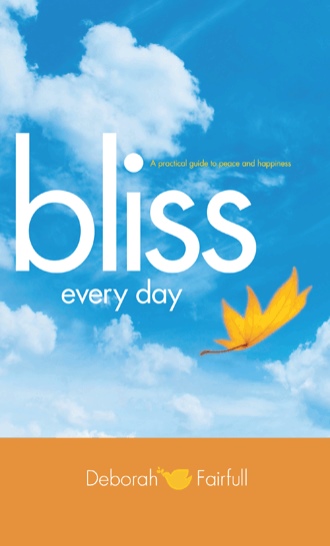
Bliss Every Day
a practical guide to find peace and happiness
by
Book Cover & Preview Text
Chapter 4 Reactions are like gold It is not natural to not like other human beings. If you feel anything other than love for your fellow human beings, that’s okay, that is your authentic feelings. However, if you have the courage to look at what your feelings are trying to tell you about yourself, you will often unlock the door to amazing internal growth. Your reactions are like gold, when it comes to expanding your awareness. The key is not to react to your reaction or, with practice, not to react to someone else’s reaction! It is possible to observe your reactions, learn to work with and understand them. Over time this process will continuously take you towards your natural state of peace and happiness. You will know when you have worked through a reaction, when you are able to put yourself in the same situation that previously would have made you frustrated or angry, for example, and are able to maintain your sense of peace. This is because working with your reactions ultimately allows you to develop the skill of emotional stability. That is, of being able to respond rather than react to a situation. To be the person who you really want to be, rather than one who frightens yourself in tricky situations! To understand the neuro-physiology of a reaction can be helpful in being kind to yourself and others, when it happens. Reactions occur due to your amygdala. The amygdala is a nut-shaped area in the middle of the brain. It assesses the environment for signs of danger through the senses of sight, hearing, taste, smell and touch. The amygdala is part of the limbic system, our “survival centre” associated with emotions such as fear, rage, anger, fright, pleasure, fight and flight. Through emotional association to past events the amygdala scans the environment for situations that create stress. Where it perceives danger, it will react with one of the survival responses. For example, you could react to conflict by withdrawing (also known as the “flight” response), unable to find the right words to say. Alternatively a “fight reaction” may result in inappropriate aggression. This survival system is lightening-fast, providing an immediate subconscious reaction to an event. You only know when a reaction has taken place when you feel some sort of emotional charge and generally don’t feel very good. Words such as “triggered”, “hooked in”, “my buttons were pressed” are often used. Usually you feel a strong physiological change within your body such as: • your heart beats strongly, • faster breathing, • increased metabolism that could make you feel shaky, • tight feeling in your stomach as your digestion centres “switch off,” • a “fuzzy” brain as your front brain and reasoning centres turn down or off. These changes give your body more energy to allow you to “run” from perceived danger. It is a survival response that may have worked well as a child, but does not often work in adulthood. As an adult you can often be left feeling out of control, confused and frustrated. For example, if a child grows up in an aggressive household the amygdala may give the child signals to withdraw (flight reaction). This allows the child to draw less attention to itself and be safer. The problem occurs when that same child as an adult finds themselves in a similar situation. Any similar aggressive situation will trigger a “flight” response as this response has become programmed and is now automatic. The adult will find themselves reacting and withdrawing even when they don’t want to. This response is not proportional to the situation and leaves the adult feeling confused and out of control. Part of the survival response is less front brain activity and that makes it harder to think clearly. Therefore when the amygdala is overactive we may feel that we over-react to a stimulus rather than providing a measured response. When you react to a situation rather than respond, it is a good opportunity to develop greater consciousness or awareness around your behaviour. It is common for people to blame others for their reaction, yet another person cannot make you feel something. A feeling is something that is going on inside your body, not theirs! By taking full responsibility for your reaction, you can begin to truly step into your empowered self. When you have a reaction, the person you are dealing with is quite often having a reaction too. If so, it is best to get away from the situation. This will give you both some space. Stay with how you are feeling. Give the feeling a name. Perhaps you feel angry. Ask yourself if you have ever felt this way before in your life? Look right back throughout your life, particularly before the age of six. Prior to the age of six the reasoning centres of your brain were not fully developed and you experienced the world more in an emotional way. If you can identify being angry in the past in a certain situation, you may begin to see a particular pattern of behaviour. For example, “I get angry when I feel trapped. I can see that this is a recurring pattern throughout my life.” Often the awareness can be enough to release the old pattern that no longer belongs to you. When new awareness is gained there is often a physical sensation or “shift” in your body, accompanied by feeling better. As you are now an adult you can use your reasoning centres in helping you to respond to a situation. For example, realising that when you were growing up, anger may have been an automatic reaction in certain situations. However, as an adult you can CHOOSE your behaviour. When feeling trapped, for example you can now choose your response rather than acting out in anger. You have choices. You could use your reasoning centres to see that you are not really trapped in a dangerous situation and that everything is really okay. It is only a perceived danger. You could choose to remove yourself from the situation. Alternatively you could communicate with the other person, so they know how you are feeling and look for options, which allow you to feel comfortable in the future. Choice and authentic communication allows you to stay in your power and feel the joy of connecting and communicating with another in a genuine way. When you have the awareness around your reaction and later find yourself in a similar situation (life is usually very good at providing these opportunities) you will be able to respond rather than react. You will have grown emotionally and be closer to developing a strong, stable core. By working with your reactions, you are evolving from being driven by unconscious behaviours to developing a life where you operate from conscious choice, ultimately allowing emotional freedom. Take responsibility for your reactions and set yourself free… Practical Support Work through the following steps when reacting: 1. Give yourself space from the person with who you are reacting. 2. Stay with how you are feeling. Give the feeling a name, for example, “fear”. 3. Establish if you have ever felt this way before—is this feeling related to a behavioural pattern for you? For example, you may have found yourself many times throughout your life in a highly fearful situations and now that has become an automatic response, a behavioural pattern. 4. If so, often the awareness is enough to release the pattern. When new awareness is gained often there is a shift in the body, signified by feeling better. 5. Additionally you can use your reasoning centres to CHOOSE your preferred behaviour now that you have new awareness around your reaction. For example, because of your new awareness you can now consciously choose to respond to situations with love rather that fear. Note: only focus on your reaction for a short period of time until you develop the awareness as to why you are having the reaction. (Where focus goes energy flows!). Then return the focus to the good things in your life. If there are ten things in your life, don’t focus on the one negative but
Formats

Book Details
About the Book
Deborah Fairfull has a gift. The gift of gently guiding us to rediscover our sense of peace and happiness. By facilitating our understanding of our inner world. This awareness of our thoughts and feelings enables us to live a life of choice, rather than being driven by unconscious patterns of behavior.
Deborah has a deep understanding of how we can use challenging times and everyday experiences to transform and reconnect ourselves to life’s true beauty and inherent joy. It’s all in our perspective!
Deborah’s approach is liberating and life-giving. The philosophies and principles of bliss every day are so simple and easy that anyone can use them, any time, anywhere. If you are currently struggling with emotional challenges that can manifest as reactions, poor health, anxiety, stress, loss of memory or feeling out of control, then this book is for you. Now you can benefit from methods proved to lead to natural happiness, by discovering how to:
• Find emotional stability
• Develop mental clarity
• Make peace with your past
• Tap into your true potential
• Create meaningful relationships.
This common-sense approach, based on twenty years of research and practical application, will allow you to experience bliss every day. Go on, try it!
I came to Deborah wanting to 'fix' myself. After years of self-improvement books, tapes, courses and self-recrimination I wanted to stop the pain and start living now! What I learned helped me start living with gratitude and joy—no matter what. Thanks to Deborah I now live every day fully and fearlessly, knowing that there is perfection in every so-called 'imperfection'—now these concepts are available for everyone to share in a book—sheer bliss! Karen Stiles ~ Client Services Coordinator
www.deborahfairfull.com
About the Author
Deborah Fairfull formerly owned and operated Brave Design Group, an award-winning design firm. She then founded Eatsmart, which she sold due to an increasing interest in psychology. A holistic kinesiologist, she believes the body has an innate ability to heal itself. She lives in Australia.