
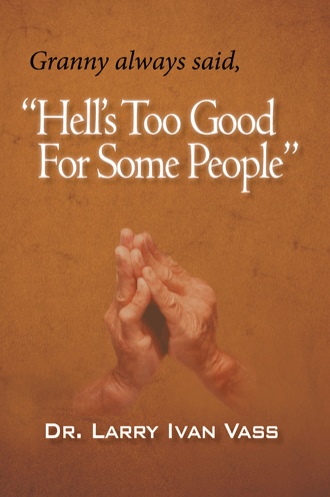
Hell’s too Good for Some People
A Memoir
by
Book Cover & Preview Text
“We climbed to the top of the lichen-encrusted rock and I insisted that Larry go out onto the swinging bridge first. Initially he was very suspicious and certainly hesitant. After all, we did have a history of questionable antics, but I convinced him that since I was older and bigger, I would be able to hold the ropes tightly and keep them from swinging. I knew that as far as the bridge was concerned, it was safe. I simply had my own agenda. As soon as Larry had reached the middle of the bridge where the water of the river ran over its wooden planks, I started shaking the ropes that supported the whole structure up and down. I knew that it was not nice, but the screaming and yelling from Larry in my mind was well worth it. After what was actually only a moment, but was an eternity in time for someone that might have been frightened, I stopped yanking on the ropes and actually held onto them tightly so that Larry could make it to the other side without further harassment. When Larry reached the other side, he jumped from the bridge onto more stable ground, turned, and screamed at me, ‘Are you crazy? Why did you do that? You know that I could have fallen off the bridge and drowned!’ “I can’t believe he even asked that question! The answer was so simple: because I wanted to scare him. Wasn’t that obvious? “There is an unwritten code by which bigger and older brothers have to abide. There are ‘rules,’ for goodness sake! Rule number one: if you are the older and bigger brother (and I think that bigger has to go along with older), you must inflict terror upon the younger and smaller brother. The senior brother must intimidate at all times, letting the younger brother know that because of your age and superior size, you are always in charge. Being the oldest also naturally makes you smarter and better looking. Finally, because the eldest is the one to appear in the family first, Mother loves you best; end of story. So when Larry asked the questions: ‘are you crazy and why did you do that?’ there was hardly any reason to have answered. ‘Older and bigger’ was all that was needed to have been said. “I walked across the rickety swinging bridge without hesitation. I knew that my little brother would not do to me what I had just done to him. It was the rule of the big brother in play here. Once we had gotten to the other side of the river, we headed in a wide swath around the cabin that sat dead center in the middle of the meadow to avoid old man Crowder. When we had climbed to an area that overlooked his house, we came across a marker that had been planted half way up the side of the hill. It was hard to read because of the gray-green lichen that covered most all the exposed stone. However, we could make out the name “Crowder” and remnants of a date. We both gasped when we recalled the stories that had circulated about Mr. Crowder’s wife disappearing a few years earlier. I can’t remember her name, but the story went that she would walk with her husband the long way around by a dirt road to take eggs, blackberries, fresh vegetables, etc. to a country store that was about three miles down Route fifty-eight from the store where we shopped for staples and waited for the school bus. One day, Mr. Crowder came into the store without his wife. When asked if she were ill or anything, Mr. Crowder simply said, “No.” “Once a week for years he and his wife had gone to the store together. Never once did he ever give an answer to why she had stopped coming with him, or if she were alright, or even if she were still alive. One rumor that circulated about was that his wife had developed pneumonia and because old man Crowder didn’t believe in wasting money on doctors, she not only did not recover from the infection, she had actually died. “Certainly not against the law, but perhaps against human conscience, old man Crowder supposedly had placed his wife in a used fertilizer sack and had buried her remains somewhere on their property. He had been overheard at one time saying that she was in a position where she could keep an eye on all that they owned. “The slope of the hill on which we stood overlooking the Crowder’s log home was relatively steep. Above us were outcroppings of rock slides and enormous granite cliffs with shallow caves sticking out above a mélange of black scrub pine, spruce, and hemlock, and a miscellany of poplar, oak, black gum, and wild crab apple trees. In the soil that was mostly barren of nutrients, grew briers and thistle, wild strawberries, Queen Anne’s lace, daisies, black eyed Susans, dandelions, and cockleburs. Patches of emerald green moss that thrived in the shadows of the rocks and trees, thrust up their tall tales, loaded with spores ready for the firing. At the base of the hill just above the Crowder’s home was a grassy down covered in heather with crowned, wiry leaves and racemes of light purple, pink, and white flowers. Climbing to this location had been difficult, for the air was heavy and thick with white downy tufts of pollen thrust off from mature dandelions and thistles and fine yellow powdery pollen that had recently been dispelled from pine trees. Tiny twirling ‘helicopters’ that had been launched from the tall, slender maple trees that grew in a ring around the middle of the hillside were carried on the wind currents created by heat rising up from the surface of the rocks. Gnats and flies and mosquitoes bombarded our every orifice, many becoming stuck in the sweat on our faces and necks. Bumble bees collided with blossoms of flowering clover, and honey bees nuzzled up to the pestles of flowering dogwoods, picking up pollen on their hairy legs and transporting it from flower to flower to fulfill God’s agricultural program. To the left of the possible grave site was a granite rock slide that ran all the way to the bottom of the hill. “While we stood gazing at the marker, there were sounds of limbs snapping, rocks being kicked about, and heavy breathing. Larry and I jumped as if being fired upon. Scrambling as quickly as possible and hiding in a thicket of nearby mountain laurel, we held our hands over our mouths to muffle the sound of our own heavy breathing. “We had hidden ourselves none too soon, for old man Crowder came up to the site of the newly discovered marker.” He was a short stout man in his late sixties that walked bent forward slightly. His head stuck out past the rest of his body and he had a significant hump on his back. Old man Crowder’s totally white hair was thin and straggly and stuck out all around from underneath a brown felt fedora that he kept pulled low over his ears. Several strands of his hair hung limply in clumps past the collar of his faded blue work shirt. His black and grey eyebrows were so thick and unkempt that they created a canopy over his eyes. From underneath those hairy bushes and from the depths of black encircled deep dark wells, it was hard to tell if he even had eyes. That’s probably why he was so frightening to us children. Like so many elderly people with whom we had been acquainted, including our own fraternal grandfather, old man Crowder’s everyday wear, summer or winter, was a worsted wool suit. The jacket of the brown suit he wore every time that I had ever seen him appeared to be two sizes too large and hung on him like a toga. The threads on the rims of the sleeves were frazzled, and black flannel patches had been added to the elbows to cover the holes that had come from wear. The flaps on the pockets of the jacket stood straight out because of all the “junk” the old man carried in them. Numerous stains from spilled soup and gravy, and dribbled juice from meats and coffee ran in streaks down the front of his lapels. “It was difficult to hold our breath and at the same time try to take in extra air to replenish our oxygen-starved lungs.
Formats

Book Details
About the Book
Life has changed forever. The matriarch of the family has died; things will never be the same. All that is left is memories of a life well lived and preciously spent. Enter a world where challenges for survival never stop. Life looms large; anything and everything is possible. Lewis and Larry, two brothers growing up on a farm in the Blue Ridge Mountains of Virginia expereince outrageous adventures as they face down bulls and hide from bears, are supernaturally protected from snakes, come face to face with spooks, and become embroiled with witches. Age twelve is not only a magical age, but a near tragic age for the brothers and their only sister, Theoa. Lewis came close to losing his head when he was thrown from a tractor, Larry was nearly shot between the eyes by a twenty two bullet from a rifle misfire, and Theoa contracted a life changing virus known as poliomyelitis that left one of her legs shorter than the other. Their story is one of survival against all odds. Love, fear, adventure, hardship, and struggles push the brothers to new highs and lows. Even during the worst snow and ice storm recorded in the mountains of Southwest Virginia, the brothers are challenged not only to save some stranded cattle, but themselves. Join the two brothers as they overcome the missteps, mishaps, and misadventures in Hell's Too Good For Some People.
About the Author
Dr. Larry Ivan Vass graduated from Virginia Tech, the Medical College of Virginia School of Dentistry, and Trinity College of the Bible and Seminary. He has been a practicing dentist since 1973. He is also the author of Temporomandibular Joint Pain Dysfunction Syndrome: Its Diagnosis and Treatment, and A Reformed View of the Sovereignty of God in a Postmodern World. Dr. Vass lives with his wife in LaPlata, Maryland.