
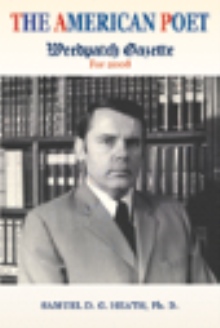
The American Poet
Weedpatch Gazette For 1998
by
Book Cover & Preview Text

How you feel, not what you know, is the folly of the universities. Then the typical liberal arts major goes out in the real world and winds up flipping hamburgers; the real world of the marketplace doesn't give a damn how you feel, only can you produce! Ok, so my windows are opaque rather than transparent; a question of the priorities of the poet. I am so often lost in contemplation, I recently wrote someone, that when I die it will probably take some time before I realize I'm dead. One of the reasons that I've never owned a Woolly Mammoth is that they drank 40 gallons of water and consumed 600 pounds of forage a day. Try cleaning up after this critter. It's obvious where the myth of the Aegean Stables originated. My antipathy to the Mammoth doesn't lessen my curiosity about the sudden end of the past glacial period. After thousands of years of ice, the earth suddenly warmed an estimated 11,000 years ago in a period of between 10 and 20 years; a mere snap of the fingers in time. But how did this happen? Did a giant space ship block out the Sun all that time then, when it took off, the Sun came beaming through? What did keep the Sun from warming the earth during that ice age? Whatever the mechanism, once removed it didn't take Mr. Sun long to warm us up. Arctic ice core studies may provide some answers. I get really excited about discoveries from ice core samples. Obviously, some critic will say, it doesn't take much to turn me on. Genetic science can produce mice that glow in the dark. The benefit to cats should be obvious. The benefit to the mice may be a little less obvious. Org used to be a very satisfactory and serviceable sound (groan) I would make getting out of bed in the morning. Now computer web addresses have stolen it. Is nothing sacred? It's too bad that intellectual growth doesn't follow the same, smooth continuum of physical growth. But no, intellectual growth is often a violent, wrenching experience. Too often it is like hitting an electric switch and suddenly a light comes on, instantly dispelling the darkness. Our minds are not, apparently, given to smooth transitions of intellectual activity. An idea, the hint or suggestion of an idea, hits us and BANG! Suddenly new worlds of mental exploration open to us. I make lots of notes. Then, at some time, the notes find their way into my writing. As Kierkegaard pointed out, the idea comes, catch it quickly for another comes hard upon the other and you lose the first. Of course, there are a few ideas we may wish we had lost. Hence the expression: Seemed like a good idea at the time. This has application to my idea for peanut butter fudge. My experiments in cookery fall into this classification. In fact, most of my experiments in this area should elicit the charitable feelings of others toward me. Wishing to expand my culinary efforts beyond pouring a can of store-bought chili into a bag of Fritos, I recently made peanut butter fudge for the first time ever. And, like my heroic efforts at chocolate chip cookies, it was a learning experience. Kind of like when I went skiing and had to visit the men's room fully dressed for the slope. Believe it or not, I actually own a cookbook. And I get an occasional laugh out of it. The peanut butter fudge is a good example. I've kidded about men disliking to read or ask for directions. The fudge proved the point. The point being that not only are we failing in the world of technical writing, there has to be a better way of explaining how to make fudge. When I was a boy, I loved to build model airplanes. Not the phony plastic kind, I mean the real things of balsa and tissue. These were real challenges where the full import of the euphemism of some assembly required had no relevance. All assembly, actual construction, was an absolute. Every child should be given a musical keyboard, a microscope, materials for water painting, modeling clay, tinker toys, erector and chemistry sets, Lincoln Logs and real balsa and tissue model airplane kits; and a cookbook. The fudge; well, the recipe was for chocolate fudge. But an addendum said you could substitute peanut butter for chocolate. The thing that made the alternative ingredient immediately suspect was the small amount of peanut butter required. Also, you could substitute margarine for butter! Heresy! And who in their right mind would want walnuts or peanuts in their fudge? Also, why in the world was the vanilla needed? There's no accounting for taste. A candy thermometer; what in the heck was that? Well, I did have a weather thermometer and one for taking my temperature. But, given an IQ above room temperature, I figured these wouldn't do. Ah, hah! The recipe said I could boil the tar out of the sugar and milk until a small amount dropped in cool water formed a soft ball. That I could do. Sure took a long time to reach this point. And stirring the goop was more than I bargained for. Constant vigilance was required; but I quickly determined it was either that or a massive clean-up of my stove. It was after the fact that I discovered (by re-reading the directions) that the butter wasn't required for the peanut butter version of the recipe. The end result was very buttery and a little too sugary; but edible. Boil it longer next time; more peanut butter; the mysteries of cookery. Americans are somewhat picky about food. The recent Nutria flap is representative. The rodents are overrunning important areas of Louisiana and Americans are being told the critters are good to eat. Now, if some of us can stand possum (I refuse to put that ridiculous "O" there. Pogo was a possum, not an Opossum), a far uglier animal than a nutria, why won't we eat nutrias? A Loyola professor thinks it has something to do with our not liking to eat things most often found as road-kill. This, of course, doesn't explain people who eat possum, an animal with a pronounced death wish on the highways. But the Emu suffered the same fate as the nutria, eating-wise. Americans stayed away in droves. Now there are EMU’s running loose in places like Texas and the entrepreneurs of cooked EMU’s are licking their wounds. I think this has more to do with the fact that Americans, more than any other people in the world, have far greater choices of abundance. We have become used to the Supermarket, Taco Bell, McDonalds, Burger King and pizza parlors where we think of food as processed, sanitized, properly dead and attractively packaged and where nothing considered wild or road-kill would be accepted. A lot has to do with the kind of foods we were taught, as children were acceptable. My grandparents had the largest rabbitry in Kern County during WWII. Beef was rationed and we ate a lot of rabbit. And goat meat, pigeons, frog legs, crawdads, turtles and catfish were staples of our diet as well as the traditional turkey and chicken in those days. As a boy raised to hunt and fish, my gun and fishing pole supplied trout, bass, deer, tree squirrels, quail, pheasant, chukker, wild duck and even black birds. But don’t ask, enjoy! won't cut it with nutrias. Americans aren't going to eat nutrias; or EMU’s. The debate over why not rages in some quarters. Some think changing the name would do the trick. Call the nutria something else. But the image remains of eating a 14-pound rat. Most Americans would take a pass and consider eating the rodent on a par with a gift certificate from doctor Kevorkian; then, by doing so, to suffer the slings and arrows of other cultures where snakes and beetles are considered food and animal eyeballs and brains are considered delicacies.
Formats





Book Details
About the Book
There is no available information at this time.
About the Author
Awarded an American Legion Scholarship I am also an award winning author and have published numerous articles and books. Having attended several colleges and universities eventually earning my Ph. D. in Human Behavior I hold several life credentials in education earned during many years as an educator together with years spent working in the Aerospace Industry and other occupations. But to call Einstein’s famous equation E=MC2 incomplete because it does not account for life and death does seem quite extraordinary, yet these remain the two greatest mysteries they have ever been denying us thus far a “theory of everything.” Something animates life and departs with death, but what this “something” is not all our science has yet discovered, though things like the Large Hadron Collider may provide needed insight, and it has been in the pursuit of knowledge about these two greatest mysteries that has compelled me into so many varied academic studies and careers attempting to make sense of the world and our place in it and how people think and deal with the issues of life and death philosophically, religiously, and politically. The things I have discovered along the way compelled me to much research and speculation about these mysteries and how they impact our lives, to communicate my thoughts about them to share with others in a daily journal and posted to my website and provided in book format each year. These writings are of importance in an increasingly dangerous world with a most uncertain future due to so much corruption, ineptitude and lack of accountability in our own government as well as that of others, the abject failure of our schools due to the very same things especially the same lack of accountability we find in government, the religious and political hatreds with protracted wars worldwide and little to give hope for world peace I believed my articles about these important enough to publish in book format. Some years ago I removed from the greater part of society to live in semi-seclusion alone with my books and thoughts in a quiet part of the Sequoia National Forest devoting myself to contemplation, speculating about many things and committing my thoughts in writing fulltime. As a writer and author given to much introspection and fascinated by human behavior, nature, and our universe it was important to me to simplify my life as much as possible as anyone given to philosophical speculation about many things must. That much of my writing covers some metaphysical thoughts about God, angels and demons, an afterlife and Biblical stories of origins, of prophecies of the End Times and so much more have been absorbing studies as well and I freely share my thoughts about these in this volume.