
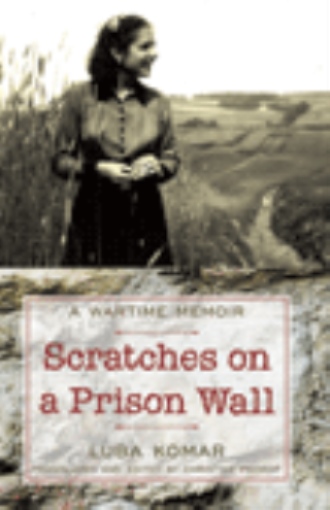
Scratches on a Prison Wall
A Wartime Memoir
by
Book Cover & Preview Text
A loud banging on the door startles me out of a deep sleep. It’s the NKVD, immediately flashes in my mind. Not a minute later, a group of NKVD, the Soviet secret police, burst into our apartment. They arrive with the woman who tends the building and demand passports from my brother and me. They check our documents and then order us to get dressed and go with them. My whole body trembles with anxiety as I hug my sister and approach my mother to say good-bye. It is September 11, 1940, just a month shy of my twenty-first birthday. I’m sharing an apartment on Bolharsky Street in Lviv, Western Ukraine, with my brother Vlodko and my younger sister Lida. My mother had come for a visit the day before and decided to spend the night. She quickly recovers from the shock of seeing the NKVD come through the door and glares at them fiercely. She asks me to take some warm clothing but I refuse. I don’t want to take anything with me. I want to show the NKVD that I have a “clear conscience,” that I have nothing to feel guilty about, and that I expect to return home right away. My mother makes the sign of the cross over my brother and me, and blesses us with a prayer. She hugs us close. We walk out. Three of the NKVD police come with us; two stay behind to search our apartment. It is cold and dark that night. A light rain is falling. We walk the length of our short street and come out onto Pelchynsky Street. There is a car waiting. My brother and I get into the back seat with a member of the NKVD between us. I see that my brother looks dejected and I feel very sorry for him. We three—my brother, my sister and I—are strongly bonded by family ties and are very close to one another. In an attempt to cheer him up, I start to joke about how smooth the ride is, how long since we’ve been in a car, and what a shame it is that we are riding at night. Our journey is quick. We drive a short distance alongside a large fairground. The end of the fairground is bordered by a tall building. In the past, this building housed a Polish electrical station, but now it serves as the regional headquarters of the NKVD. We enter the building and proceed up the stairs. Long, well-lit corridors with numerous doors on both sides exude an eerie emptiness. We stop on the third, or perhaps, the fourth floor. They lead my brother to the left along a corridor. He disappears behind a door, which closes firmly behind him. We don’t even have a chance to say good-bye. I am told to walk along this same corridor and am led into a small room almost at the end. It is then, as I walk along that corridor, that I first hear the stifled moans and screams of the ones being interrogated behind the closed doors. My blood runs cold and I am shaken to my very core. The First Interrogation The room I am led into contains a desk, behind which sits a middle-aged member of the NKVD. I am ordered to sit at a narrow table next to the desk, and he begins to record my biographical data. When I answer his questions about my family background and tell him that I am the daughter of a priest, he makes a derisive comment. But, on the whole, he is formal and polite. When he finishes with my personal history, he begins asking questions about OUN. I’m not certain whether they have any evidence against me. Besides Ivan Maksymiv and Liubov Shevchyk, no one knows of my involvement in OUN. It is just possible that my arrest was a mistake, as at the apartment, the NKVD told me they were only interested in checking my passport. It’s very easy for me to feign total naiveté, so I pretend to be tired and sleepy. I yawn. I frown. I complain to the investigator that because of him I will be too exhausted to concentrate on my schoolwork the next day at the university. I demand that they return my passport immediately, and that they allow me to leave. At first, the investigator tolerates my behavior. He says he will let me go quickly if I tell him about the organization. I begin to talk about the student trade union. “Don’t play dumb,” he cuts me off sharply, “you know exactly which organization I’m asking about.” “I don’t know what you want from me.” I look at him through sleepy eyes. “Just let me go home.” The room in which I am being questioned has a door on either side, linking it with other rooms. I sit facing a window, covered with a dark curtain. Behind me is the door, which leads into the corridor. Often other NKVD personnel come in through the side doors and participate in my questioning. During a break and a few seconds of quiet in my room, I hear not only moans but also the desperate cries of prisoners under interrogation. I am scared that I might recognize my brother’s voice among them. I realize they won’t treat him gently if they find out he’s been working with OUN for a long time. It seems to me that the NKVD investigators watch me closely as the cries begin. I realize that my investigator expects I’ll be frightened and immediately start talking. He begins to help me along. At first, he promises to let me go home quickly if I tell them all I know about the organization, who I worked with and who I met. He gets up from his desk, walks up to the window, and draws open the curtain. “Freedom is right beyond that window,” he gestures toward the city. “I’ll release you there. All you have to do is tell me everything, answer all my questions.” He talks about the university. He says that I must want to finish my education and be able to work for the benefit of the Soviet people. Finally, as if commiserating with me, he mentions my mother. ”She will need you to care for her in her old age,” he says, “and must hope for your quick return.” The NKVD investigator continues to speak to me, poignantly and movingly, about these and many other things. At first, I cannot help but listen, as there is nothing else to do. I feel my mother’s and sister’s pain very deeply and imagine how intensely my father will suffer when he hears of our arrest. At the same time, I am conscious of the fact that I dare not allow the tenderness I feel for my family and for freedom to touch my heart. I try to build a wall around my heart, a wall from which the seductive words of the NKVD would bounce off and leave my heart untouched. In my thoughts, I start to pray and focus all my attention on the words of the prayer. A moment later, two NKVD men enter from the corridor and put a stack of books on the table. I glance at the books and discover that they are our books, taken from the apartment. This means the search is over. Several more NKVD men walk in through the side doors. They all stand at the table and start leafing through the books while making frequent comments like, “Here’s counterrevolutionary material! Here’s a spy pretending to be a lamb!” My investigator holds a book in his hand, sticks it under my nose. “Yours?” he asks. Our library at home contains many books besides school textbooks. We have books on Ukrainian history and literature, as well as prewar books published during the Polish occupation. When the Soviets came to power, they labeled most of these books as anti-Soviet. “I can’t deny that some of the books belong to me,” I respond, not wanting him to ascribe all of them to my brother. Hearing my admission of ownership, he punctuates my response by slapping my face with the book in his hand, first one side, then to balance it out, the other side. The first time this happens, I’m caught off guard and I get very angry. I protest sharply but the investigator acts as if he doesn’t even hear me. After the first blow comes a second, a third, and many others, as there are quite a few books the NKVD do not like. As he is hitting me, the investigator continually repeats the same questions: “Where did the books come from?” “Who gave them to you?” “Who did you lend them to?” It is clear to me that they want names and more names, and information for new victims.
Formats

Book Details
About the Book
"In this gripping memoir of a young Ukrainian woman's encounter with Communism and Nazism, Luba Komar experiences imprisonment, torture, death row, violence, escape, resistance, and, finally, flight to the West. Throughout, Luba retains her dignity and manifests a quiet heroism—convincingly demonstrating that totalitarianism is ultimately powerless in the face of individuals with the spiritual courage to speak the truth.” —Alexander J. Motyl, Rutgers University-Newark and author of "Who Killed Andrei Warhol" Ukraine is suffering under Soviet domination in 1940 as World War II begins. Luba Komar, a politically active student at a Ukrainian university, finds herself whisked away in the middle of the night by the Soviet Secret Police. She is tortured, imprisoned and then sentenced to death in a secret Soviet trial. Fortunately, her death sentence is commuted to exile. With other prisoners, she’s loaded onto a train headed to the dreaded Siberian concentration camps. Luckily, Luba never reaches Siberia. As Nazi bombers approach overhead, the Soviets divert the train to another prison. There, the inmates courageously stage a prison break, risking their lives. Luba is witness to the dramatic events that shaped Ukrainian and Soviet history both during and after WWII. In recording her ordeal, she brings to life the stories of her fellow prisoners, and recounts her eventual escape to the West. Scratches on a Prison Wall is a powerful testament to its author and the times in which she lived.
About the Author
Luba Komar grew up in Western Ukraine and joined the struggle for Ukrainian independence while a student at Lviv University. Following her imprisonment and escape, she immigrated to the United States in 1949. She continued supporting a free Ukraine, until her death in 2007. TRANSLATOR’S BIO Christine Prokop is Luba Komar’s daughter. She grew up in New York City where she was an active participant in the Ukrainian community. She has worked as a landscape architect and rehabilitation counselor. This is her first published translation. She lives in Southern California.