
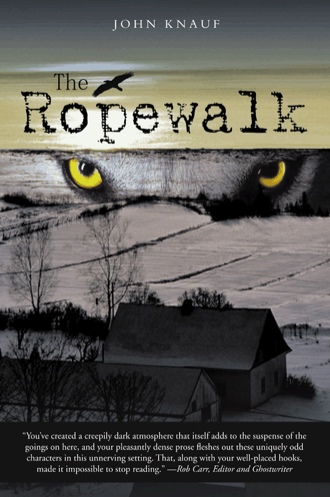
The Ropewalk
by
Book Cover & Preview Text
The northern rock-strewn coast of New England has a certain haunting beauty that has always been appreciated by generations of both artists and vacationers. But this far north on that rocky coast caused the sun to set early at that time of year and created not so much a haunting beauty as simply a haunting impression. It was already dark by four-thirty. The trees, except for the evergreens, were stark and skeletonized by the arrival of winter. Scudding clouds in the ice-blue sky heralded the onset of the merciless cold that characterized the region at that time of year. A certain frozen lifelessness was the norm and people took to their firesides—and often to their moonshine—to wait it out. No matter how certain the arrival of spring was it did not make the wait any more endurable. It seemed like every year, in some hidden corner of the landscape, someone would give up the race and end it all. On top of that, the hammering of the surf and the shrieking of the wind as it drove the sleet before it told me that the storm would last through the night, which was fine with me because I had no plans to go out and, like everyone who lived in a remote place, had enough food squirreled away for several weeks. Besides, the tinkling of the sleet on the windows was the perfect white noise for research—soothing and rhythmic, it reminded me of childhood and the simple security of a warm blanket and a cup of hot chocolate. So when Margaret told me there was someone else in the building it had a kind of cascading effect on me. The first part was surprise, because if anyone had intended to stay I almost certainly would have found out about it from one of my student visitors. Finding out about all the undercurrents, plans, intentions, omissions, and so on was one of the advantages to having so many visitors. It was how I knew that Margaret was unhappy. The second part was suspicion about the story itself precisely because of the effect the weather and the lonely environment could have on someone accustomed to a lot of social interaction. The third part was annoyance because my whole purpose for staying was to not be bothered with mundane affairs; the last thing I wanted to do now was lose precious time looking for a prowler or burglar. The forth part was resignation. I could see that she was agitated and I was the only person she could turn to. So, like it or not, I was forced into the role of father confessor once again. “You heard someone walking out in the hallway last night?” I asked. She nodded. “And the night before.” “Well, maybe it was Sil checking to see if everything was buttoned up for the holiday. He’s a pretty thorough guy.” “That’s what I thought at first, but then I thought: Why would he be walking around all night? The guy has a family and lives in town. I could see him stopping by just to make sure that no unneeded lights were on and all windows were closed and outside doors locked, but all night? For two nights? No, it wasn’t Sil.” There was an unspoken certitude in her conclusion that led me to believe there was some other aspect of all this that she had not yet revealed. What was she not telling me? “Okay,” I said, “how about this: Maybe one of the parents is doing the Ebenezer Scrooge thing with his kid and not allowing him to come home for Christmas. So, somewhere in the building is a school kid with nothing to do but walk around all night and sleep all day. You know how kids are—the moment he has the chance to do something he shouldn’t be doing he’ll do it.” It seemed perfectly plausible to me and I could tell by the way her eyes shifted away that she was thinking about it. I harbored a momentary hope that I might actually escape the need to play Sherlock Holmes. But, no, she brushed it off. “I doubt it,” she said. “Why?” “Because the school itself is also closed. Where would he eat? What would he eat?” She stepped over and opened the refrigerator door. “Is all of this your food?” “Yes.” She shrugged. “What would he eat?” I didn’t know. “Well, he’s a kid. Maybe he’s living off of crackers and cold soup. You know, canned stuff. Anything’s possible with kids.” I involuntarily glanced at Sonya, who apparently was not reacting to any of this. “Look, why don’t we do this: I’ll finish up my supper and wash my dishes, then the three of us will do our own prowling and try to find this stowaway. I’ll bet money on it that it’s a kid who’s been running around the halls all night and is probably getting himself primed to do the same thing tonight.” That idea seemed to encourage her somewhat. “What about, you know, if we actually find somebody?” she asked. “What about it?” “What do we do?” I gathered up my things and brought them over to the sink. “Invite him to dinner. The poor s-o-b must be starving.” I filled the water heater and turned it on, glancing back to see how she was reacting. She was smiling. Faintly, but smiling. And this time even her eyes seemed to smile. “Do you have a flashlight?” I asked. “Yes.” “Why don’t you go get it while I wash the dishes. By the time you get back I’ll be done and we can begin the search.” So she picked Sonya up and went down the hall to her apartment. I was finished before she got back. “We need to do this methodically,” I said. I walked out into the hall and glanced in both directions. The hall was dark, illuminated only faintly by small nightlights mounted in the walls to suggest antique gaslights. There was enough light to find one’s way down the hall but one had to use each light as a beacon the way ships used lighthouses. Between each one was a pocket of shadow. “Good old Sil,” I said. “He probably disabled the circuit breakers for the main hall lights, knowing only a couple of people would be here.” I shined the flashlight in both directions and decided that the first thing we needed to do was check to see if the front door was locked. “Okay, let’s head for the door. As we pass each room you check those on the left and I’ll do the right. Every door should be locked. We’ll check out any one that isn’t.” The flashlight beam played briefly over her hand and I saw that she had returned with something other than just the flashlight. It was a knife. “What’s that for?” “Just in case.” Once again I sensed that there was something she wasn’t telling me. “In case of what? If there is another person in the building it’ll more than likely be a student. You’ll scare the crap out of him if we surprise him and you have a knife.” “Even so. Just in case.” I let it go. I needed to get this over with. “Okay, you on the left, me on the right. Let’s go.” She took Sonya by the hand and we began. I was anxious to get it behind me and put her at ease, so I quickened my pace as I went from door to door trying each to see if I could open it. The result was I got ahead of Margaret and did not notice that she had stopped. “Egan,” she called.
Formats

Book Details
About the Book
Set in the late seventies, The Ropewalk is about the clash between ideals and unexpected realities. Egan Drummond, a twice-divorced history teacher, takes a job at a remote boarding school on the coast of Maine to escape mainstream society and pursue a long-cherished dream to complete a research project and make a name for himself as an historian.
Living in an old rope factory that serves as the school dormitory, he looks forward to being alone during the Christmas break so that nothing will disturb his research. But he quickly discovers that another teacher, Margaret Gillespie, is still there with her young daughter. Margaret’s convinced there’s someone walking the halls at night, and Egan is the only person she can turn to. Doubtful and at first annoyed, he finds himself not only caught up in the events of her life, but also on a journey back from the edge of loneliness to another chance as a man.
His life seems back on track, but as his research begins to uncover evidence that could change the nation’s perspective on Native American history, the elusive presence in the building becomes more threatening, leaving him with the choice of guarding what he’s learned, or making himself famous at the cost of everything he’s come to love.
About the Author
JOHN KNAUF is an award-winning essayist with a lifelong interest in history, mythology, and literary fiction. He also has a broad background in statistical problem solving for business and industry. He lives with his wife, Rhonda, in South Glastonbury, Connecticut. This is his first novel.