
Luck or Fate?
The military saga of Sergeant Roger K. Heller: 1942-1946
by
Book Cover & Preview Text
Morning comes early in the tropics. First one notices a faint light, and then all of a sudden like a blast comes full daylight. What astounds people who have never been there is how cold the nights are. It was a real comfort to wear that issue sweater until the sun arose. I was just going through the routine of putting on my daytime gear when a bullet kicked up dirt on the rim of our foxhole followed by a number of rounds I do not remember counting. Both Tom and I dived back into its protective depth. This game was tried again several times and we had no luck at spotting the enemy. I finally reasoned that it must be a sniper in a tree. I shot, nothing happened. Every time the sniper fired I returned the shot. I kept missing. All my life I have been what they call a “worry wart” and now I wondered if I would run out of ammunition. It was getting warm, and soon we would have to be moving out when the assault battalions came through. Would it be by the sniper or our own men? I couldn’t believe what happened next. A division M.P. came, leaned against a tree, looked up and saw the sniper. He let him have it with a full clip from his Tommy gun. The sniper had tied himself to the tree near the top of the first opening, thus his field of fire. Poor Faubion, the M.P., was drenched in blood but the body remained in the tree. Worse for me and my ego, the damn sniper and tree were 180 degrees from the direction I had been firing. Tom and I got our gear together resuming the advance towards the nearby hills. It must have been a sloping ascent. I could look back to see a warship training its turrets on these very same hills. The ship had five turrets, three of which were forward and some were sure we were about to be shelled by a Japanese 8-inch gun cruiser of the Mogami class. As sunlight danced off the gun barrels I could see that there were three guns in each turret. It was a Brooklyn class U.S. Navy Light Cruiser and those were 6-inch guns. It was great to see her firing at the crest of those hills we were moving towards. Those nearby gave me a weird look of disbelief. What about the relationship of Leyte to the remainder of the islands? If I may again use the term “big picture”, let me give you a sketch of the Philippines: It is an archipelago of about 7,100 islands extending over a thousand miles from north to south. Only 154 of these islands exceed five square miles in area. The two largest, Luzon on the north and Mindanao on the south comprise about 65% of the total land areas of the Philippines. Within this huge number of 7,100 islands is the Visayan group. They form a circular pattern around the Visayan Sea and comprise about 19% of the national total. The fifth largest island of the Philippines, Leyte, in the Visayan group, is about 2,785 square miles. Most of these Visayan Islands are very mountainous in their interiors, and in general, low open land is a rarity confined to coastal strips on the larger islands. In terms of military geography there are three sites in all of the Visayas suitable for airfields – Leyte, the inland valley on the Iloilo Plain of Panay, and the plains of northern and western Negros. The major problem was that both Negros Island and Panay Island had strong Japanese garrisons and were reported to have unquestionable native support. Just as important, they could be easily reinforced from Japanese bases, some as far away as Indo-China. So Leyte boiled down to the best choice. Weather was another factor favoring Leyte. The two islands of Leyte and Samar are easternmost and act as a buffer for the other islands from occasional typhoons. Look at a map of Leyte, and you see that Leyte is separated from Samar by a narrow strait which in early geologic times was a detached peninsula of Samar. On Leyte a central mountain range running north and south divides the northern part of the island. To the east of this range is the fertile, alluvium-filled part of Leyte and to the west is a comparatively flat highland. Two things distracted our plans and annoyed me. The first was the lack of adequate maps; in this location an entire third range of mountains was missing from Army maps. The second was that these islands had been a colony of the United States for almost half a century and yet our government was unable to describe the people and their customs. Here we had a more ancient peoples being confronted by a new force. Negritos, Proto-Malay and Malay peoples were the principle stock of the population. The Negritos are believed to have crossed by land bridge 30,000 years ago during the last glacial period. Other migrations had come by boat. Important cultural differences developed, most markedly from those who came from the islands of the Sulu Sea. From the western world, Spain was the colonial power in the archipelago for 300 years. Filipino historians term the first 200 years of the Spanish period “inert” even though they did bring the Roman Catholic Church to many. Then came the United States at the turn of the century for about 45 years after our invasion. Being on the ground, I could not see that we accomplished very much. We introduced political units such as the county, which they quickly changed to “municipality.” Historically, these people have been held together by what is still termed “the national elite”. Why do I mention this historical background? Because the 19th Infantry would be on a number of these islands with their cultural differences, various views on political organization, and even religious differences. Not knowing these things or very much about our colonial possession made our operations just that more difficult. Strange as it seems most American adults did not know that the Philippines were our colonial possession. In my opinion, the outstanding few lines ever written about the subject are in Stanley Karnow’s “In Our Image, America’s Empire in the Philippines, (1989)”, “ … a sprawling archipelago of disparate languages and cultures that owed its semblance of unity mainly to the legal definition of Filipino citizenship and an allegiance to the Catholic Church. Despite its modern trappings, it was still a feudal society dominated by an oligarchy of rich dynasties, which had evolved from one of the world’s longest continuous spans of western imperial rule. First came Spain and then the United States - or as the neat summation of Philippine history goes: Three centuries in a Catholic convent and fifty years in Hollywood.
Formats

Book Details
About the Book
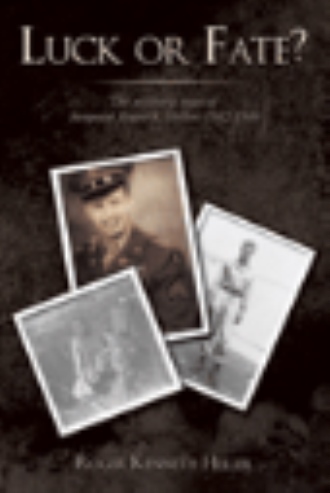
Luck or Fate? documents Sgt Roger K. Heller’s World War II experience in the Pacific, starting with his rejection for service in the U.S. Navy and his "accidental" induction into the Infantry via the Selective Service. He recalls his war experiences from 7 December 1942 through his return home in 1946, and takes us from training at Camp Roberts, CA, through Schofield Barracks, Hawaii, to Australia, New Guinea, the invasions of Leyte and Mindanao in the Philippines, to Japan, and back home to Oakland, CA. The text is richly enhanced by Professor Emeritus Heller’s background in military and world history, and flavored with his own brand of humor and many personal photographs.
About the Author
LTC (Ret) Roger K. Heller USAR was commissioned upon graduation from the University of California, Berkeley, 1950. During World War II, as a noncommissioned officer with the 19th Infantry Regiment of the 24th Infantry Division, he participated in five campaigns and four amphibious assault landings. He joined the 91st Division in 1949 and served as an enlisted man with the 361st Regiment until he received his commission in 1950. He was commissioned based on a Department of the Army circular commissioning sergeants and above with combat experience in World War II. LTC Heller numbers among his awards and decorations the Combat Infantryman’s Badge, the Bronze Star with Oak Leaf Clusters, the Good Conduct medal, the Presidential Unit Citation, the Meritorious Unit Citation, the American Campaign Medal, the Asiatic-Pacific Campaign Medal, the Pacific Campaign Medal with Bronze Arrowhead and one Silver Service Star, the World War II Victory Medal, the Philippine Liberation Medal with four Bronze Stars, the Army of Occupation Medal with Japan Clasp, and the 2nd Echelon Mechanics Badge. As a graduate student at U.C. Berkeley, he participated in Naval R.O.T.C. classes, Marine Corps Section, as an attached Army Officer. In civilian life Mr. Heller is Professor Emeritus of Social Sciences, San Jose State University, San Jose, California. He currently resides in Ojai, CA.