
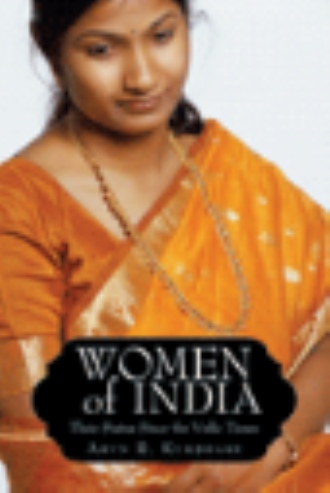
Women of India
Their Status Since the Vedic Times
by
Book Cover & Preview Text
Formats

Book Details
About the Book
A systematic presentation of the status of women of India throughout the long history of about 6000 years has been presented starting from the Vedic times to the post-independence period. A detailed description of the status of women during the Vedic times, which is rarely available in any of the existing literature, and in the following periods is very significant to the study of this subject. The author has discussed how the political and religious conditions over the periods have affected the conditions of women. The age-old evils, which had got firmly entrenched in the Indian society, such as the tradition of Sati, illiteracy, child marriages, and deplorable treatment of widows and so on, still persist and some new ones have joined the list. These are: bride burning, dowry, female feticide, domestic violence, to name a few. Short biographies of some outstanding women have been included to illustrate that in spite of adversities some women had achieved eminence.
To the credit of the Indian Government, legislative measures have been taken to protect and improve the status of women after independence and just prior to it. These have been outlined. Unfortunately, these measures have not been able to achieve their intended results on account of wide spread corruption and lack of education and awareness among women, especially in the rural areas. A snapshot of the present conditions is given along with concluding remarks and recommendations for improvement. Improvement of the status of women is extremely improvement for India if it wishes to become a developed and progressive country and a world leader in culture and ideology.
About the Author
The author, Arun R. Kumbhare, was born in India in an orthodox Brahmin family and spent his first thirty years there before immigrating to Canada. He was a well qualified Civil Engineer with post-graduate degree in Civil Engineering prior to come to Canada where he further improved his qualifications by obtaining a Master of Civil Engineering degree. He had taught engineering in India to undergraduate engineering classes for several years prior to migrating to Canada. He has worked as a professional engineer in Canada for about thirty years holding a number of responsible positions in federal and provincial governments. In the course of his employment he has published a number of technical reports. Arun has been a keen observer of social conditions and is a student of Indology right from his early age. He has learnt a lot from his late father who was an eminent Sanskrit scholar and an educanist and believed in women’s equality and generally encouraged women to educate themselves. He educated both his daughters who are highly qualified in their fields. Arun has recently published a biography of his late father. After retirement Arun has studied the subject of this work extensively for several years. With his direct experiences and observations in India and his research in this subject over the past several years Arun has become well qualified to write on this topic. His father’s knowledge of Sanskrit and the discussions, which used to always take place between his father and his students, Arun could quickly learn and understand the subject matter of the old Hindu scriptures.