
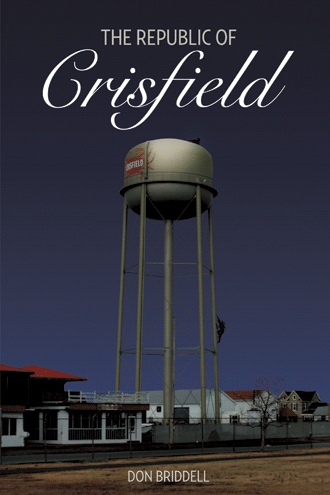
The Republic of Crisfield
A backwater town, chosen by fate to take on overwhelming force and villainy, with only their humanity and good sense to do what matters most. An American Tale
by
Book Cover & Preview Text
After about two long minutes, Ben heard the yelp of bloodhounds coming down the trail they had taken from the Evan’s house; his hair when straight up in alarm. “Oh my God,” he thought, “how am I going to outsmart a pack of bloodhounds?” Ben’s heart leaped clear up his throat. Desperation took over. He couldn’t think. He jumped up and started to move toward one path, then another as he explored the options at the speed of light. Nothing obvious came to mind and that was terrifying. The hounds were getting closer, excited by the freshness of the trail. Without knowing why, Ben bolted for the north trail, away from the two trails being explored by Sparky and Forty-Five. The decision was propelled by instinct. His instincts were good, for when the dogs got to the spot were the trails intersected, they had three separate scent trails to follow. Ben thought he might have a one in three chance of escape. He had not realized there were three dogs, each with its own handler, in pursuit. They could divide up and search all three trails at once. Ben ran and in less than thirty seconds the trail ended at the back yard of the Handy house on Main Street Extended. He passed the house on a run by its more secluded east side. There were no woods for cover. He was out in the open in a residential area. For the first time in his entire life, he was without a plan. He was not in control any longer; he stood out like a beached whale. He crossed the yard and reached the sidewalk in front of the Handy house. A Hummer was coming. He could hear it approaching the corner at the end of the street by the Baptist Temple. It would be in sight before he could run across the street and get behind a house. On top of that, he could tell the barking hound dog would soon emerge from the woods behind him. He was trapped. It was all over. He couldn’t move and stood rigid with fear. “Get in,” said the old man without much alarm, pointing with the bill of his baseball cap to the wheelbarrow he had been pushing. It was only then Ben realized an old man was standing motionless near him on the sidewalk shadowed by a boxwood bush. The old man had heard the commotion and stopped to see what would happen. The large wheelbarrow was piled high with junk, all kinds of junk: cast-off bits of construction materials, a broken stool, worn cushions, an old curtain, cans of empty paint, a large wad of plastic sheeting filled in with lesser junk of every kind. Ben looked at the pile, still transfixed by terror. The approaching Hummer geared down to round the corner and come into view. That was encouragement enough. Without knowing how, Ben dove into the junk and wormed his way to the bottom of the pile with the old man’s help. The scene of Ben’s desperate struggle to disappear amused the old man. Ben heard him chuckling as he filled junk in around Ben to perfect the camouflage. His humor was surreal. The Hummer turned the corner and came up the street, stopping by the old man and his wheelbarrow. A sergeant riding shotgun called out, “Hey old man, seen anybody you don’t know running around here?” The old man thought for a minute and responded, “Nope.” The fact of the matter was that he knew that whoever it was who got into his wheelbarrow was a Crisfielder and that would mean he was a “somebody he knew” in a Crisfield sort of way, so he wasn’t lying. In the fetal position, Ben had suspended breathing for the time being. The Hummer moved off down the road just as the sound of the hound dog became a new source for Ben’s terror. Around the house came a dog, nose to the ground, pulling his handler, who was struggling to maintain control. The old man heard Ben from in the wheelbarrow moan pitifully, “Oh my God.” The old man turned and looked back down the sidewalk. A few feet away were a couple of metal garbage cans. The old man sniffed the air, picked up his wheelbarrow and ambled a few steps over to the garbage cans just as the dog and handler arrived. “Seen anybody running by here?” asked the sergeant, out of breath. The dog was beside himself with glee. He had found Ben. Before the old man answered the question he removed the lid, lifted a garbage can and dumped the contents on top of the trash in the wheelbarrow. The contents made a sucking mushy sound as rotting crab scraps oozed from the garbage can and soaked down through the junk. A cloud of flies swarmed out of the reeking mess. The soldier and the dog stepped back to get breathing space. The slime enveloped the wheelbarrow as the men watched, and soaked down through, covering Ben. Ben had already quit breathing so it didn’t much matter. Having completed his maneuver, the old man knew the dogs were hot on Ben’s scent so he couldn’t very well lie and say that he had not see anybody so he said, “Yes”. “Well, were did he go?” asked the solider impatiently. “He got into a car and drove off,” responded the old man. Another soldier and his dog ran up to join the conversation. Meanwhile, the first dog, who knew exactly what had happened to Ben, was now confused. He was barking the “I found the him” bark but his handler was not properly responding. He looked at his master and the smelly wheelbarrow and back again. The other handler took his dog across the street to substantiate the old man’s story. Sure enough, there was no fresh human scent on the other side of the street. The second solider joined the first soldier to consult on a course of action. Grabbing his walkie-talkie, the sergeant called base. “Bingo, appears he got into a car. Tango, over.” “Roger, Tango. Any details on the car?” He paused to listen. “Bingo, over.” The dogs took it upon themselves to sniff cautiously around the wheelbarrow. In spite of the stench, the dog that knew better seemed to communicate to the new dog blinded by the rotten crabs that Ben was there. They both took a step forward and renewed their excited barking. The old man removed the lid of the second garbage can and with an air of doing a day’s work, routinely dumped a second load of rotting crabs, stale beer cans, and other food scraps. . The dogs withdrew back from the wheelbarrow a little further and looked questioningly at their human handlers as if to say, “What in the hell is going on?” Being well trained, they recovered their sense of duty and returned to the wheelbarrow, baying for all they were worth. They knew Ben was there even though the second dose of rotten crab scraps had now totally eclipsed his smell. The handlers, using their leashes, pulled the dogs back against their will. A test of wills ensued; Mother Nature versus human nature. The dogs renewed their efforts, pulling their handlers closer to the smelly wheelbarrow. The handlers again pulled them away. “My God,” said one, “you’d think we never feed’um.” For effect the old man grabbed his shovel lying across the arms of the wheelbarrow and stabbed around the junk as if to solidify the mess, knowing, of course, to what depth he could safely poke. This final touch worked perfectly. The Agents firmly pulled in their hounds and commanded them to sit. Confused by the situation, they obeyed but were upset by the handler’s inconsistencies. You could see they wanted to argue the point. “What kind of car?” asked the Fed leader. “Ah, it was big and white and went that-a-way,” pointing down Main Street Extended toward town. “What kind was it? What make?” asked the Agent. “Don’t know cars. Can’t tell you. All look alike to me, some are big and some are small,” responded the old man in exactly the way an dumb old man is expected to respond. Dismayed, the team leader took out his walkie-talkie again and relayed the old man’s brief description of the car. He requested a pickup. With that, they moved off along the road, dragging the dogs that continued to look back at the old man and his wheelbarrow in disbelief as they were being led away. The old man picked up the wheelbarrow and moseyed off toward Downneck. Lying in a heap, nauseated
Formats

Book Details
About the Book
In this novel the lead character, Ben Wright, has solved the most vexing problem in physics, the Unified Field Theory. The moment he attempts to make it known, all hell breaks loose. Ben discovers, to his dismay, that his ideas are not his own. After a failed kidnapping attempt by a terrorist cell, the U.S. government, recognizing the weaponry potential, claims ownership of the theory.
Fearful that the theory, in the wrong hands, may do harm to humanity, Ben flees for cover to his native home Crisfield, Maryland, on the Chesapeake Bay. It is there that science and technology collide with the residents of the town in an epic confrontation, involving the U.S. government and the terrorists.
While Crisfield may seem to be an unlikely place for a showdown having world-wide implications, it is revealed in this backwater town, through its wonderful cast of characters, that the moral and ethical compass still points to true north, to the direction we must take if we are to survive into the future.
About the Author
Born in 1944 on the Eastern Shore of Maryland in the town of Crisfield, Don, was raised in small town with big outdoors. He grew up roaming the woods, marshes, rivers, bays of the Chesapeake. At the age of thirteen, he was allowed to hunt and was introduced to the world of duck decoys. In the small town atmosphere, where everyone knew everyone else, Don soon gravitated to the grand old masters of decoy carving, Lem and Steve Ward, who lived down the road a mile. Under their patient and informal instruction, he learned the art of carving and painting, as well as gained a deep and lasting appreciation of the storytelling tradition shared by community. This love a good story carries forward fifty years later to this book. Though Don roamed the world he never encountered a place with a more developed sense of humor and down-home wisdom usually communicated by stories and incidences from life. The Ward Brothers were exemplary at this being both poets and sages and at the same time over 70 years fathering the art form of painted wildfowl decoys and sculptures in wood. They made lasting impressions on young Don as he listened to them recount stories and recite poetry, all having a message and moral behind them. Many of their original carvings, which they sold for a few dollars for most of their lives, later became national treasures. A decoy they sold in 1923 for $1.50 recently fetched $95,000 at auction. Don’s artistic talent led him to Pratt Institute in Brooklyn, New York, where he studied Industrial Design from 1962-1966, a profession that combined his family's cutlery manufacturing business with his interest in art and design. At Pratt, he developed a great interest in Buckminster Fuller’s geodesic and synergetic work and began his own explorations and discoveries into the science of form and structure. He was given a full scholarship to attend graduate school at Illinois Institute of Technology in Chicago, IL and was scheduled to interview at MIT in Boston, MA, when he received a notice from the draft board, rejecting his request to attend graduate school. Don was allowed to join the Peace Corps and served in Ecuador from 1967-1969, working with a craft cooperative project in the Andes making modern furniture. Before Don’s tour was up, the co-op received sizable orders for this furniture from several major department stores in New York City. Returning to the States in 1969, Don married Victoria “Moo” Moller and together they set off with there back packs for an around the world trip leaving San Francisco on a old freighter for Japan. Since Ecuador, Don and Moo had kept elaborate journals and sketchbooks that became numerous as they journeyed through Japan, the Philippines, Vietnam, Malaysia and Sri Lanka, arriving in India in the fall of 1970. Traveling throughout India and Nepal, they reached the Sivananda Ashram in December of that year to begin a course at the Yoga Vedanta Forest Academy at the Ashram. There they encountered the sages of the East and meet their guru, Swami Chidananda. This year changed everything. Don theoretical and artistic work under the influence of Indian metaphysics took a decided turn for the better. This encounter introduced a radically different way of viewing reality, which was to have a profound influence on Don’s later discoveries in form and structure theory, work he had continued privately since college. Returning to the States, Don and Moo settled in Dallastown, Pennsylvania and had two children Matthew (1975) and Christiana (1979). Don returned to bird carving and soon his works were sought by galleries and collectors across the country, including the Smithsonian Institution; The White House, and the patrons of Trailside Galleries, Wild Wings Inc and Crow’s Nest Trading. After the Three Mile Island incident, the family moved from the area to Mt. Airy, MD in 1980 where they built a solar home and workshop. In 1985 Don started Overboard Art, Inc., to reproduce his bird sculptures at prices affordable to the general public. www.overboardart.com In the late nineties he spent a year and a half creating “The Six Million”, a 20’ x 9’ foot painted sculpture memorializing the Holocaust, on view at the Jewish Community Center of York, PA. http://www.yorkjcc.org/culture_holocaust.html Don’s continues his work on “Field Structure Theory” and has presented his discoveries to scientific groups, meeting at the University of Cambridge, UK, Univ. of Connecticut, Univ. of New Mexico, George Mason Univ., VA, Rutgers Univ., Princeton, NJ, Rhode Island School of Design and SUNY Oswego. He is presently working on a non-fiction work in physics and the science of structural skew topology. www.fieldstructure.org